What Is a Quality of Earnings Report and Why It Matters
What is a quality of earnings report? Learn what a QoE covers, who prepares it, key adjustments, red flags, and how it shapes valuation and deal terms.
September 9, 2026
By Remi Taffin · July 29, 2026
A turnkey business is one you can take over and run immediately because the operating system, customers, staff, and revenue are already in place. The job is validation, not build-out, and buyers should verify at least 12 months of financial history, ideally 24 months, before they trust the label (turnkey business definition and diligence guidance).
You’re probably looking at a listing, a broker deck, or a seller’s pitch that sounds polished and “ready to go.” That phrase can mean a lot of things in the market, and some of them are far looser than buyers assume. The word matters because it changes how you price the deal, what you ask for in diligence, and which specialists need to be in the room before anyone shakes hands.
A turnkey business is a business a buyer can take over and operate immediately because the systems, customers, staff, vendors, and revenue are already in place.
That’s the working definition that matters. The phrase comes from turnkey contracting, where a supplier delivers a complete solution, including the materials and services needed, so the customer can pay once and receive a finished product ready to use (historical turnkey meaning and modern adaptation). Business buyers borrowed that idea and applied it to operating companies, especially in franchising, online businesses, and owner-run local services.
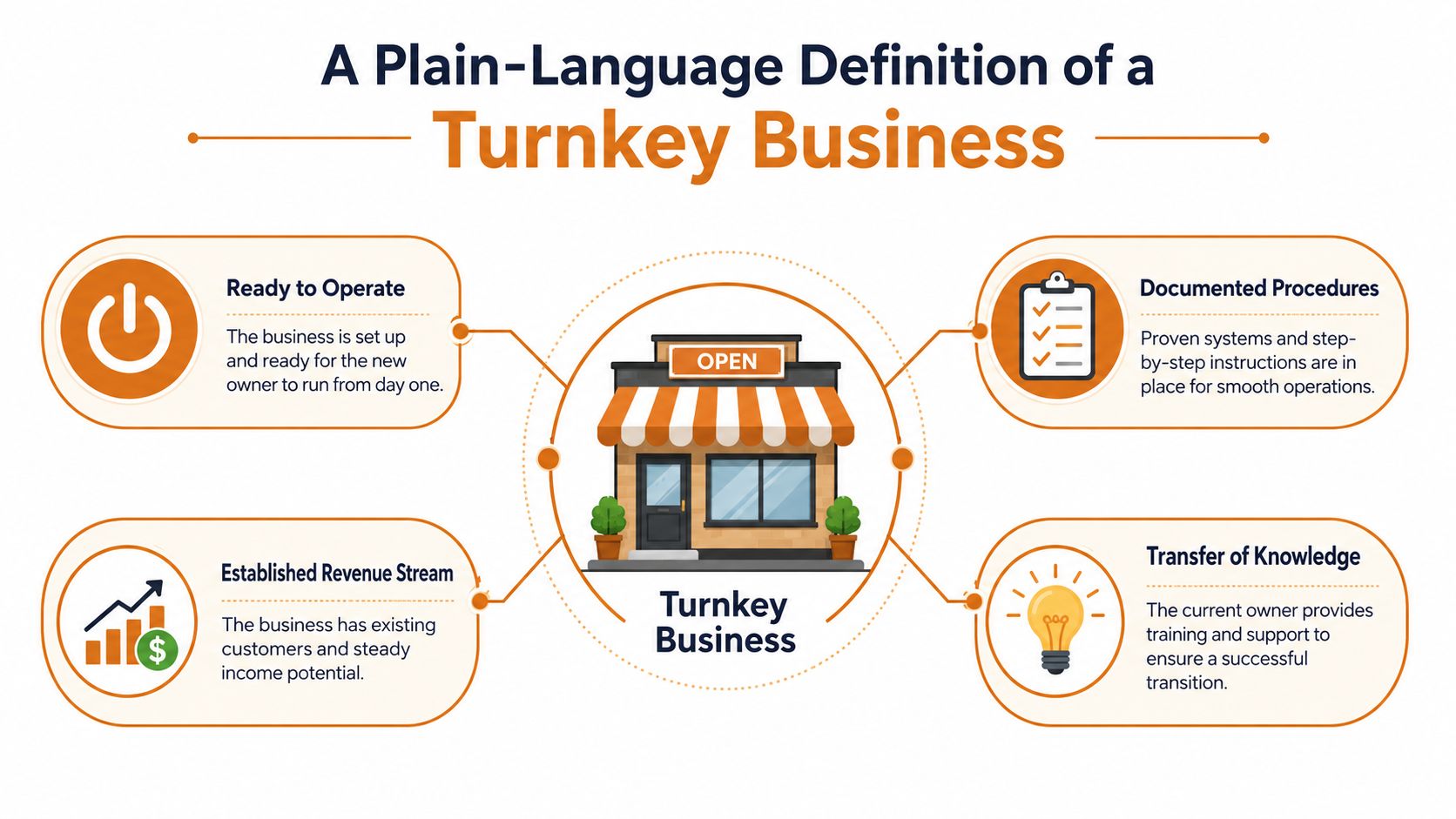
A turnkey deal is about transfer, not creation.
If you’re reading a listing and asking whether the business is turnkey, the question is simple. Can the buyer step in and start serving customers on day one, or is there still major construction to do behind the curtain? If the answer requires new licensing, workflow design, or staffing rebuilds before revenue can resume, the business is only partly developed, not turnkey (operational completeness benchmark).
That’s why the label shows up so often in businesses with established cash flow. Buyers pay for the operating machine that already exists, not a concept that still needs a founder to assemble it. In other words, turnkey value comes from continuity, not from hope.
A turnkey business is already built for handoff. The buyer should be able to step in, keep serving customers, and avoid a rebuild of the core operation. If the business still depends on the seller to hold everything together, the turnkey label is doing more marketing than work.
A buyer should read the listing like a transfer test, not a sales pitch. Sellers like the turnkey label because it sounds polished, but polish does not prove operational completeness. What matters is whether the business can keep producing without the founder acting as the backstop.
Practical rule: if a buyer still needs to design the workflow, rebuild staffing, or secure major approvals, the business is not turnkey.
Owner-dependency is where a lot of deals get exposed. If the founder still answers every key call, handles every exception, and owns all the customer trust, the business may look ready on the surface while staying fragile underneath. The more the operation depends on one person, the weaker the turnkey claim becomes, which is why serious sellers start with reducing owner dependency.
Buying turnkey and building from scratch solve different problems. A turnkey acquisition buys speed and continuity. Building from scratch buys control, but you pay for it with time, uncertainty, and more decisions before the first real dollar comes in.
Turnkey works when the buyer cares most about time-to-operation and cash-flow continuity. The operation is already alive, so the buyer isn’t starting from zero. That matters in trades, franchising, and service businesses where a functioning route, crew, or client base has real value.
Building from scratch makes more sense when the founder wants to own the model from the ground up. Maybe the product is still being shaped. Maybe the buyer needs a custom brand, custom tech, or a workflow that doesn’t exist yet. That path gives freedom, but it also shifts setup risk onto the founder, and acquisition-focused guidance notes that startup build-out can take a year or more (turnkey versus build-out timing and risk).
Here’s the plain decision rule I use:
That’s why turnkey buyers often show up in industries with repeatable routines and standardized delivery. Franchise systems are built for transfer. Manufacturing businesses with established equipment and production runs can be handed off more cleanly than a greenfield concept. Service businesses with established routes and recurring work also lean turnkey because they already have operating rhythm.
Building from scratch isn’t wrong. It just answers a different question. If you need complete control and can tolerate delayed revenue, build. If you want a running operation and can verify the books, buy.
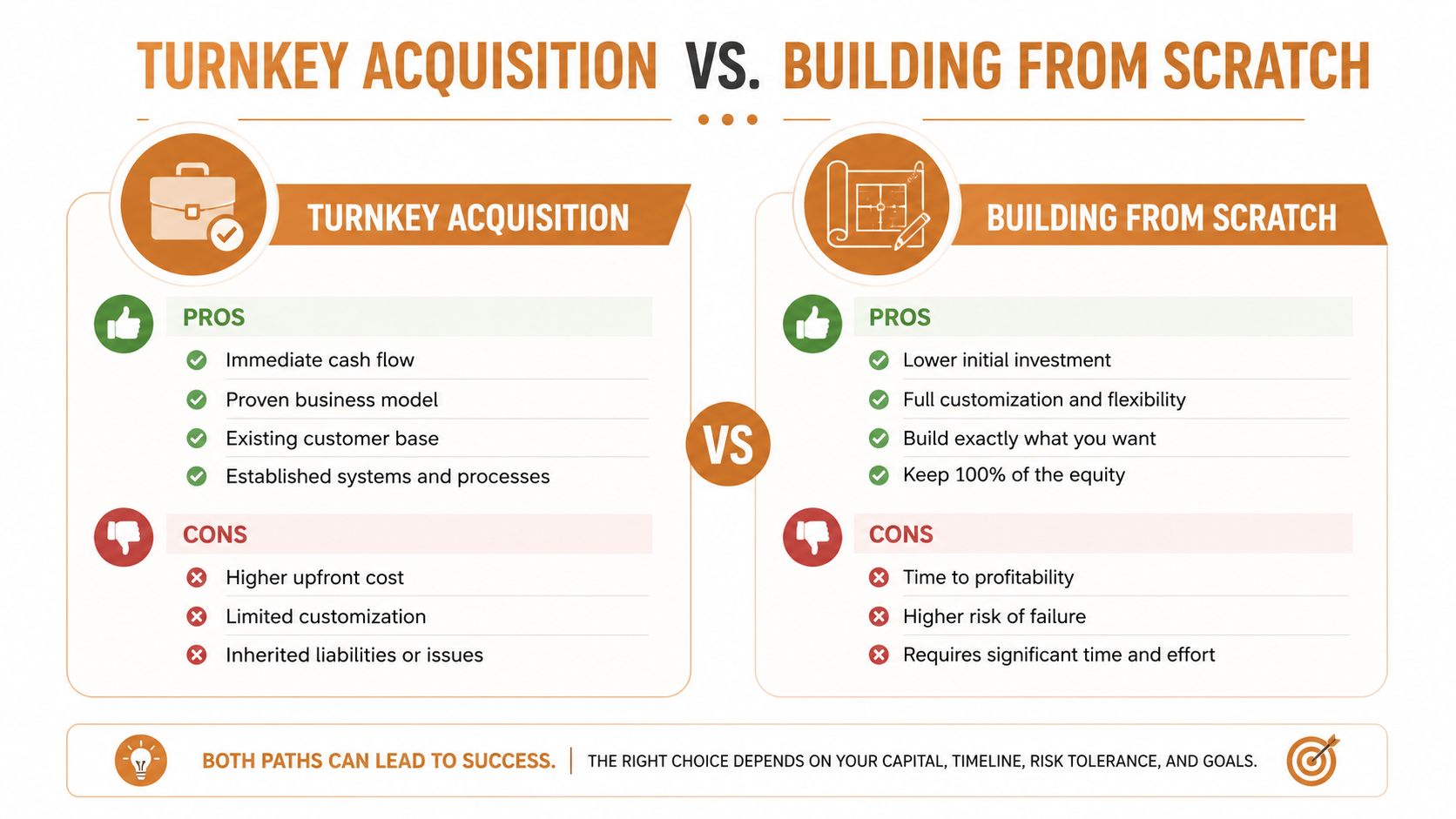
If you want a visual rule of thumb, use this: turnkey compresses the messy part of getting started, while a build gives you the chance to design every piece yourself.
The cleanest turnkey examples show up in businesses where the operating model already runs on routine. An HVAC company with documented maintenance contracts, licensed technicians, and a stable service schedule is much closer to turnkey than a solo operator juggling calls from a cell phone and keeping everything in their head. The same pattern shows up in plumbing, electrical, pest control, and home services, where the work repeats and the customer base is already there.
A franchise is the obvious case. The system is built for transfer, the brand already has a market, and the buyer is stepping into an operating playbook instead of inventing one. That is why franchising keeps showing up in turnkey discussions in the first place (modern turnkey usage in franchising and owner-operated businesses).
Online businesses can fit too, but only when traffic, fulfillment, and monetization are already working. A site with established revenue and documented operations is very different from a content project with promise but no reliable cash flow. Small manufacturing can also qualify, especially when equipment, production routines, and vendor relationships are already in place. For a valuation lens on that kind of transfer, see what drives a business multiple.
A quick test is simple. Ask what happens after closing.
A business can be busy and still not be turnkey.
That is the trap in founder-led service companies. Cash-only operations and ad hoc job shops can look strong on the surface, but if the owner handles every quote, every complaint, and every dispatch decision, the buyer is really purchasing a job, not a system. In contrast, businesses with recurring service routes, documented handoffs, and a trained crew are much easier to transfer because the value sits in the operation, not just in the owner.
Turnkey is most believable where training, equipment, permits, and repeatable workflows are already standardized. Buyers are buying continuity there, not chaos in a cleaner wrapper.
Turnkey is a valuation argument dressed up as a convenience label. When a business has documented continuity, recurring revenue, and standardized procedures, buyers are more willing to pay for it because the handoff is cleaner and the post-close risk is lower. That does not mean every turnkey listing deserves a premium, but it does mean any premium has to be supported by evidence, not just the listing copy.
A useful way to look at price is through the business multiple. Clean records, stable operations, and proof that the cash flow is real all support a stronger number, while vague claims push buyers to discount the deal. One industry guide notes that small local businesses often sell for two to four times their last 12 months of stable, verifiable net profit, which is why operating continuity matters so much (small-business valuation context). If the books are clean and the history holds together, the turnkey story carries weight. If the seller cannot prove it, the premium starts to disappear.
The diligence checklist is simple on paper and unforgiving in practice.
The legal and financial work belongs before anyone gets carried away by the word turnkey. A valuation specialist can separate operating continuity from marketing language and press on the weak points. For owners trying to understand what drives price, the business multiple question is usually the one that matters most.
Valuation rule: clean documentation tightens the bid-ask spread, sloppy documentation widens it.
In plain terms, a seller who can prove the business is ready to run tends to draw more attention and move through a cleaner process. A seller whose records do not support the claim usually sees the number get smaller, fast. Turnkey status makes existing value easier to trust, and that trust is what buyers are pricing.
People love the turnkey label because it sounds safer than starting from zero. Sometimes it is. But in the current market, financing and transfer risk still matter a lot, and buyers shouldn’t confuse convenience with certainty. The Federal Reserve has noted tighter credit conditions in recent years, and small firms continue to report that borrowing is harder and more expensive than before, even as SBA 7(a) lending volume rose materially in fiscal 2024 according to SBA lending activity reporting (small-business financing context).
Owner-dependency is the biggest one. A seller can describe a business as turnkey while still being the only person who knows the key clients, the pricing exceptions, or the local labor pool. Once that person exits, the buyer inherits a business that looks finished but still leans on the seller’s relationships.
Customer concentration is the next trap. “Established relationships” sounds good until you learn that a few accounts drive most of the revenue. That’s not a turnkey asset, that’s a concentrated risk profile with a nicer name.
Financing can also move the risk around instead of reducing it. If the deal depends on debt, the buyer may win the asset but lose breathing room. Tight lending conditions make that problem worse because the acquisition has to survive both the closing and the debt service afterward.
Local permits and labor are the quiet issues that get underestimated. A business may be fully operational on paper, but if the buyer can’t keep licensed staff, renew approvals, or retain key technicians, the operation can stumble right after the transition. That’s why turnkey status should be treated as a transfer-of-risk decision, not a magic stamp.
If the seller is the business, the business isn’t really turnkey.
That’s the line I’d use in a diligence meeting. A true turnkey deal reduces startup risk, but it can also shift risk into hidden transfer problems, financing pressure, and post-close transition issues. Buyers need to know where the risk moved, not just whether it moved.
Run every deal against a blunt checklist. If the seller can’t show verified financials, documented revenue streams, transferable licenses, trained staff in place, and vendor contracts, the turnkey claim is still unproven. Add a written transition plan that spells out who trains whom, for how long, and what happens if a key employee leaves during the handoff.
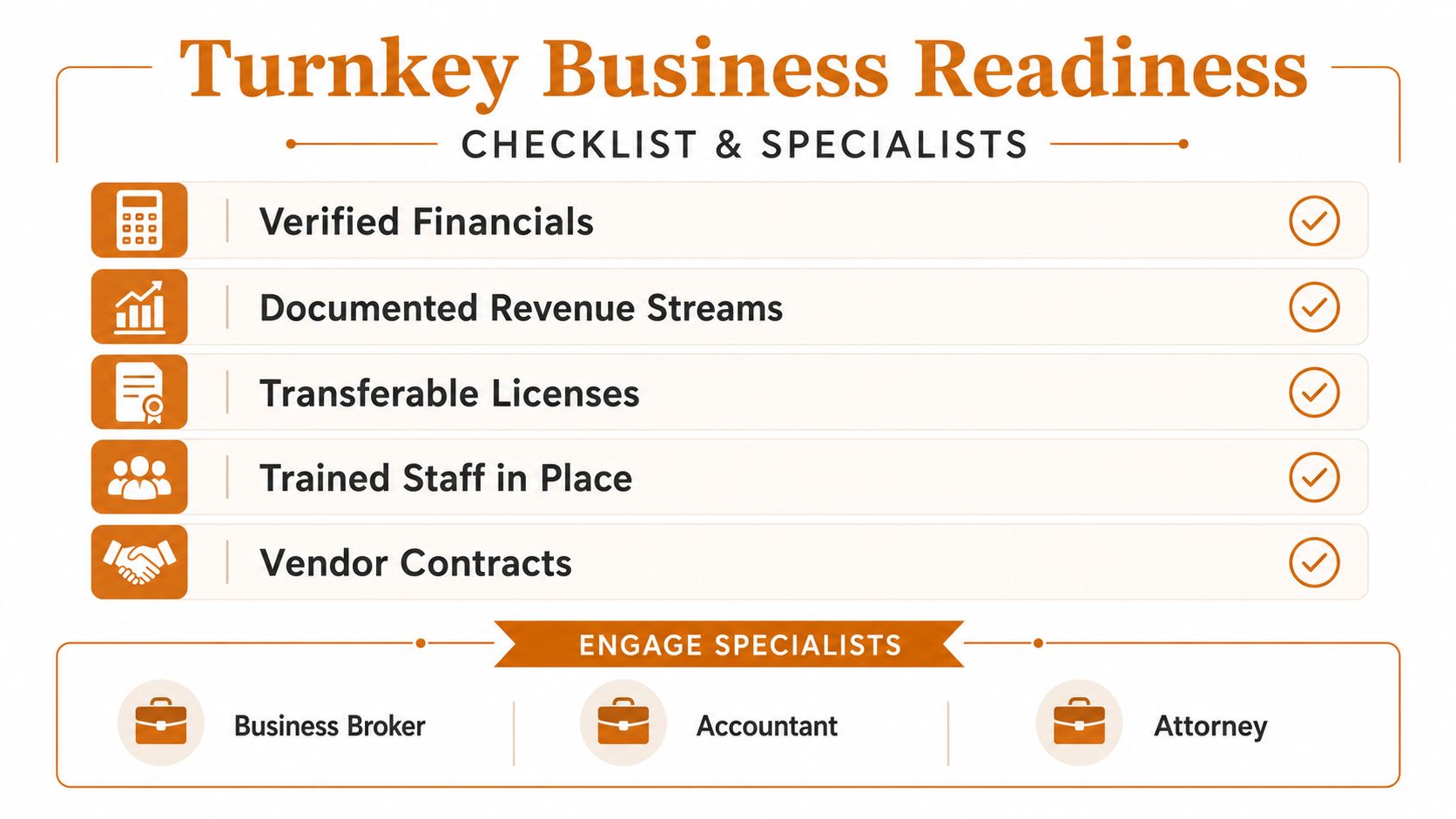
A valuation specialist helps set a defensible number before emotions take over. An accountant helps read the books and plan for the tax result. An attorney helps with structure, contracts, and the legal handoff. If financing is part of the deal, bring in an acquisition lender or financing advisor early. If the transaction is complex, a succession or M&A advisor can keep the process from drifting.
The Owner’s Shortlist is one place owners use to find vetted specialists across valuation, taxes, legal, financing, and succession, along with practical guides on sale preparation and deal readiness. For business owners who need a cleaner starting point, how to prepare your business for sale is the kind of work that should happen before a buyer starts asking hard questions.
My advice: don’t hire specialists after the deal gets messy. Get them involved before the number hardens.
Turnkey only helps you if the transfer is real. If you want a sharper read on whether your business is ready, or you’re trying to buy one without overpaying for the label, start with The Owner’s Shortlist and use it to line up the right valuation, tax, legal, and financing conversations before you sign anything.
Tell us your situation. We'll connect you with a specialist who works with owners like you. One conversation, no sales pressure.
Found this useful?
Add The Owner's Shortlist as a preferred source and get our articles highlighted in Google Search results.
Add to Preferred SourcesWhat is a quality of earnings report? Learn what a QoE covers, who prepares it, key adjustments, red flags, and how it shapes valuation and deal terms.
September 9, 2026
Learn the key methods for a plumbing business valuation. This guide covers SDE, multiples, value drivers, and how to prepare for a defensible assessment.
September 7, 2026
Learn how to do business valuation with a clear owner-focused method covering income, market, and asset approaches, multiples, and common pitfalls.
September 4, 2026
Recurring vs reoccurring revenue explained for business owners. Learn the valuation difference, real trade examples, and how to strengthen your revenue mix
August 27, 2026