What is an earnout and how does it affect your sale price?
An earnout pays you more after closing if the business hits targets. Learn how they're structured, when they make sense, and the real risks sellers often miss.
April 19, 2026
By Remi Taffin · November 20, 2026
If the buyer promises you another $800,000 only when the business hits its numbers, when do you owe tax on that money? Most owners answer with the same instinct: when the cash lands. That instinct is mostly right, and that’s precisely the problem, because “mostly” leaves a gap wide enough to cost six figures. Earnout tax treatment doesn’t follow one rule. It follows the wording of your purchase agreement, the shape of the payment schedule, and what you agreed to do after closing. Get the structure right and the tax follows the cash. Get it wrong and you can owe tax on money the buyer never pays.
When you sell a service business to a U.S. buyer, an earnout tied to the business’s future results is generally treated as part of the sale price, not as a bonus paid on top of it. Tax usually follows the payments as they arrive rather than the full promised amount in the year you sign.
Say you sell your plumbing company for $2,000,000 cash at closing plus up to $800,000 paid over three years if revenue targets are met. In the ordinary case, you don’t report $800,000 of income on the closing-year return. Each payment that does arrive gets split between a return of your tax basis and taxable gain.
How that split works, and when each piece lands on a return, turns on three questions you can answer by reading the draft:
Those three questions explain why two owners selling similar companies for similar headline numbers can end up with very different bills. Earnout tax treatment is set by the agreement, not by what either side calls the payment.
The Owner’s Shortlist works with Florida owners of service businesses doing about $1M to $50M a year, and an earnout is one of the terms we see owners agree to before anyone has priced the tax. If one is on the table, get matched with a tax specialist who has worked through these structures. It costs nothing and carries no obligation.
What a label does and doesn’t do. Writing “purchase price” above an earnout clause helps a little. What helps much more is a payment that behaves like purchase price after closing.
Three things to carry forward. An earnout isn’t automatically tax free. It isn’t automatically deferred. And the result changes with each term you sign off on.
Under U.S. federal tax law, an earnout whose total can’t be pinned down by the end of the tax year in which the sale closes is generally a contingent payment sale. Unless you elect otherwise, these sales are reported under the installment method, and IRS Publication 537 uses the sale of a business for a percentage of profits earned in future years as its own example. The rules also compute the contract price and gross-profit percentage differently than they do for a fixed price sale.
The plain version: you don’t report an unknown amount as if you knew it. You report as money comes in.
Take a small ballpark sold for a fixed sum plus a share of next season’s gate receipts. Nobody knows the final price on closing day, so the tax system lets the seller report as the turnstiles click. A business earnout works the same way, with one caveat. The analogy holds for the timing. It stops holding when you discover that your basis gets recovered at a pace the contract sets, which may run slower than the pace you’d choose.
Every payment during the earnout period splits in two: recovery of basis and gain. Your basis is what you have invested in the business for tax purposes, and it comes back to you tax free before the rest is taxed.
Take the plumbing sale and assume your basis plus selling expenses produces a gain ratio of 60 percent. A $100,000 payment then carries $60,000 of gain and $40,000 of basis recovery. Change the cap, and you change the ratio. Change the ratio, and the early years of the schedule get recalculated.
You can elect out of installment reporting and report under other applicable rules, though the election generally has to be made by the due date of the return for the sale year, extensions included. Electing out pulls the tax forward: gain gets measured against the obligation’s value in the year of sale, even if a payment later never arrives. That’s a decision to take to your CPA with a model in front of you.
The regulations don’t give one method. They give you the method that matches the deal you signed.
| Deal structure | Basis recovery | Watch for |
|---|---|---|
| Capped earnout with a stated maximum price | Gross-profit ratio based on the maximum | A later cut to the cap changes early-year gain |
| Uncapped earnout with a fixed payment period | Basis recovered evenly over the fixed period | Length of the period sets annual reporting |
| Uncapped earnout with no fixed period | Basis recovered over a 15-year period | Open-ended schedules can stretch reporting for years |
| Payment tied to staying on as an employee | Not treated as sale consideration | Taxed as wages, not capital gain |
Row by row, using the same $800,000 earnout over three years.
A capped earnout with a stated maximum of $800,000 lets both sides fix the gross-profit ratio at closing. You know in year one roughly how much of each $266,000 installment is gain. Clean, predictable, and the version most sellers should be pushing toward.
An uncapped earnout with a fixed three-year period sends you to even annual recovery. Your basis, including selling expenses, gets spread in equal increments across the years the payments can arrive. If a year pays out less than its allocated share, the shortfall carries into later years, so gain can land in a year that paid you little. The reporting stays manageable, but your year-one result can differ from the capped version of the same deal.
An uncapped earnout with no fixed period is the one to avoid unless there’s a reason. When neither a ceiling nor a schedule exists, the rules fall back to a fifteen-year basis-recovery period. You’ll be filing on this sale long after you thought you were done with it.
A capped earnout can also produce a different early-year gain percentage than an uncapped one. Two deals with identical headline numbers can produce different tax bills in years one through three.
Large deferred balances get extra attention. The tax code can impose an interest charge on tax deferred through certain large installment obligations once the outstanding balance crosses a set level at year end, subject to further conditions and exceptions. Most service business sales stay well below that level, though a big rollup or a large equipment-heavy sale can cross it. Ask your CPA to test it rather than assume.
Three items carry most of the weight. Find them, write them down, and confirm your CPA has read them.
The assumption that an earnout defers tax is the most expensive one in the room. It holds often enough to feel like a rule, and it fails in exactly the deals where the numbers are biggest.

A closed transaction treats the deal as finished at signing even though part of the price is still contingent. The seller may have to estimate the earnout’s value at closing and can recognize gain before the contingent payment is received, as Weil’s review of M&A tax issues sets out. In effect, the tax bill behaves as if the full price already arrived. The earnout still has to earn its way there.
Open transaction treatment, the version that defers all gain until the cash arrives, is highly unusual.
Don’t plan around it.
Walk the downside with real numbers. Your earnout is valued at $1,000,000 at closing and you pay tax on that figure. Over three years the business pays out $300,000. The earlier tax has to be corrected through later reporting, which means corrective filings, more time with your CPA, and a bill you already funded out of your own pocket. Cash you never received still produced a tax return you had to file.
Partial payout isn’t the exception. Sellers regularly collect well under the modeled maximum, even on deals where the earnout pays something. A deal that pays is not a deal that pays what the model assumed.
Three protections are worth negotiating before you sign:
If the sale carries deferred payments beyond the earnout, the year-by-year mechanics are covered in this guide to installment sale tax treatment.
Ask for the low-payout model. Before you agree to any earnout figure, have your CPA show the tax result at full payout, half payout, and no payout. Then ask where the money for the tax bill comes from in the third case.
The short video below covers how earnout structures are built and negotiated in practice, which helps when you’re reading your own draft.
Clean records decide how expensive the correction gets. Logging each contingent payment monthly, the metric tested, the amount received, and the gap against the closing estimate gives your CPA working inputs for an amended filing instead of a reconstruction project. Keeping those books current through the earnout period costs far less than rebuilding three years of payments from bank statements, whether you keep them in-house or hand them to a bookkeeper.
Labels don’t decide this one. A clause can sit under a heading that says “Purchase Price” and still be taxed as wages if it behaves like pay after closing.
The gray area is real. An earnout labeled purchase consideration can still be challenged if payment is forfeited when the seller leaves, depends heavily on the seller’s personal work, or resembles compensation for the role, as CliftonLarsonAllen’s analysis of contingent earnouts explains. Purchase-price treatment generally tracks long-term capital gain rates. Compensation arrives as ordinary income and brings payroll taxes and withholding with it.
Three arrangements look alike on paper. They aren’t taxed alike.
| Factor | Sale consideration | Consulting agreement | Employment pay |
|---|---|---|---|
| Tax character | Capital gain or installment sale income | Ordinary income | Ordinary income |
| Withholding and payroll tax | Generally none | Self-employment tax, no withholding | Withholding and payroll taxes apply |
| Link to the sale | Tied to the business interest sold | Tied to defined services at market rates | Tied to the job and its duties |
| Effect of leaving early | Forfeiture invites a compensation challenge | Contract terms govern the remaining fee | Ends with the employment |
Say you sell an HVAC company you’ve run for two decades. The buyer wants the customer relationships and the supplier history, and also wants you in the building as salaried general manager for two years. The earnout pays only while you’re employed.
That structure invites the compensation argument. The payment stops when the job stops, the metric tracks work you personally do, and the amount has no clear link to the customer list and fleet you transferred. A buyer reporting those payments as wages, with withholding, is describing the arrangement it thinks it bought. Meanwhile you’re paying ordinary income rates and payroll tax on what you thought was a capital gain.
Now change three facts. The earnout stays payable if you leave, or if you die. It’s tied to company-wide revenue rather than your personal book of accounts. Your salary is set separately at what the market pays a general manager. Same deal economics, very different tax posture.
Duration, duties, market-rate pay, and the performance metric all shape how the arrangement reads. A two-year consulting agreement with defined deliverables, invoiced monthly at a supportable rate, looks nothing like an open-ended “help out where needed” clause attached to a seven-figure payment.
Keep the two agreements apart. If you’re staying on, sign a separate consulting or employment deal with its own market-rate pay and written duties, and leave the earnout tied to the business’s results.
Mixing the earnout with employment conditions raises both tax risk and negotiation friction. The buyer wants your continuity. You want capital gain. Write two documents and let each do one job.
Work through the draft in this order. Each step changes the arithmetic in the one before it, so skipping ahead means redoing the model.
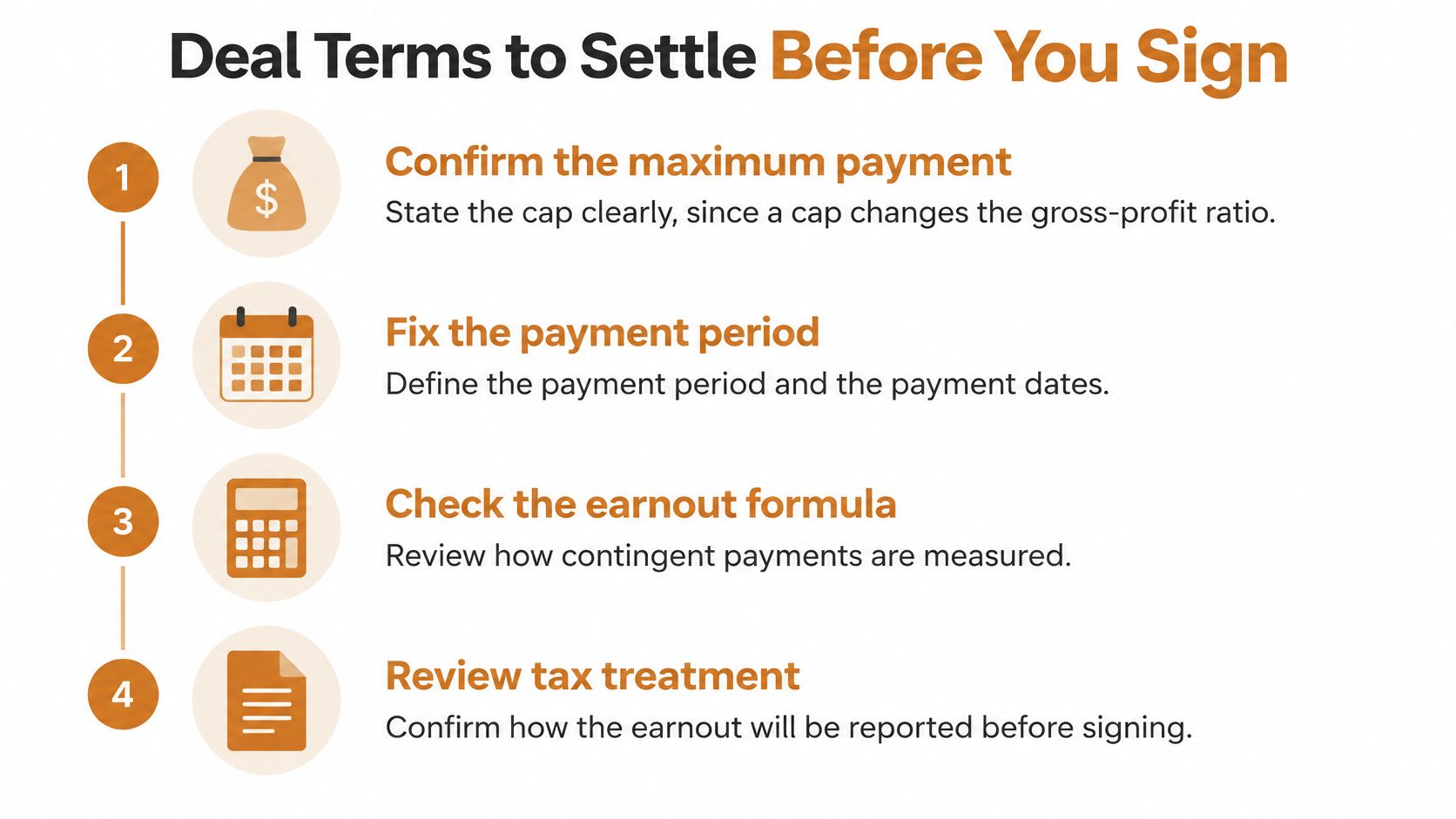
Expect pushback. Buyers resist caps, fixed dates, and book-control language because each one limits their flexibility. Rank the eight items before you sit down, decide which two you won’t trade, and negotiate from that list.
The wider agreement, including escrow, holdbacks, and working capital, is covered in this explanation of deal structuring.
A clause that reads cleanly to you can still read like wages or a closed sale to the IRS, and that difference decides whether you owe tax on money that never arrives. Getting the answer takes a CPA or tax attorney holding the actual agreement, your basis records, and your state’s rules.
Bring these five:
Which professional to call depends on the question. Reporting math and election deadlines belong to a CPA; disputes over how the clause is drafted and whether payments get reclassified as compensation lean toward a tax attorney. If you’re unsure which one your situation calls for, this breakdown of when you need a tax attorney versus a CPA can help you decide before you book the meeting.
Nothing here is legal, tax, or financial advice, and it isn’t a substitute for someone reading your agreement. The rules decide how a properly written earnout gets reported. They don’t decide whether your specific clause qualifies, and that’s the part that needs a professional with the document in hand.
If you’d rather not interview five advisers to find one who has handled business sales like yours, The Owner’s Shortlist introduces you to one specialist whose past work fits your situation. Owners pay nothing for the introduction, and there’s no obligation afterward. A real person reviews your business first and makes one introduction, not a list of names.
Book that review before you agree to any earnout size. One conversation with the right adviser costs far less than a tax bill for money that never arrived.
The Owner’s Shortlist is built for owners of service businesses doing $1M to $50M a year who need a straight answer about taxes, deal terms, and what happens after closing. If an earnout is on the table, we will introduce you to one specialist who has worked through these structures before, at no cost and with no obligation. Start with a phone call and keep the conversation private until you are ready.
If the earnout is part of a sale you have not started yet, find a business broker who negotiates these terms for a living. There is more on deal structure in our Taxes section.
Who wrote this: The Owner's Shortlist is not a broker and doesn't sell businesses. We get paid the same no matter which specialist we introduce you to. More about how we work.
Tell us your situation. We'll connect you with a specialist who works with owners like you. One conversation, no sales pressure.
Found this useful?
Add The Owner's Shortlist as a preferred source and get our articles highlighted in Google Search results.
Add to Preferred SourcesAn earnout pays you more after closing if the business hits targets. Learn how they're structured, when they make sense, and the real risks sellers often miss.
April 19, 2026
The tax hit on selling a business is real, but there are ways to reduce it. Here's what to expect on capital gains, deal structure, and when to call your CPA.
March 28, 2026
What is a seller note? The seller lends part of the sale price to the buyer. Learn how repayment, interest, security and default work.
November 18, 2026