Will I get paid for my accounts receivable when I sell?
Sometimes. In small sales the owner often keeps the unpaid invoices. In bigger ones the buyer pays for them at a discount. Here's how to protect that money.
November 15, 2026
By Remi Taffin · November 12, 2026
Depreciation recapture is the federal rule that taxes part of the gain on depreciated business property as ordinary income rather than capital gain, and it reaches back only as far as the depreciation allowed or allowable. A $100,000 piece of equipment with $70,000 of depreciation behind it, sold for $60,000, can put the full $30,000 of gain into ordinary income.
That’s the mechanics in two sentences. The part that surprises owners is how differently the rule lands on each asset inside one company, and how little a single headline sale price tells you about the tax that follows it.
A buyer’s number is a price, not a paycheck. Between the offer and the deposit sits a calculation nobody shows you until you ask for it: how much of that gain is ordinary income, how much is capital gain, and when each one comes due.
Say an HVAC contractor has run the same company for more than twenty years. The shop has a parts room, six vans, two excavators bought when the company added underground work, laptops, recovery machines, and a building held in a separate LLC. A buyer names a price, and for a day it feels like the finish line.
Then the tax preparer asks for the fixed-asset schedule, and the conversation splits in two. Price and cash are one discussion. The character of the gain is another, and it has been building since the first van was written off.
Recapture doesn’t add a separate tax on your company. It changes the character of part of your gain. Instead of the whole profit qualifying for long-term capital gains rates, the slice tied to past depreciation is taxed at ordinary rates, which for a profitable owner is usually the higher number.
It works this way because every year you claimed depreciation on a van, the deduction reduced your taxable income and decreased your basis in that van by the same amount. When you sell the van, the gain is calculated against that reduced basis, so the deduction you took years ago is now added back into your income. You didn’t do anything wrong. You used a benefit the code offers, and the code recovers it when you sell.
What a headline price can’t tell you: two companies that sell for the same amount can owe wildly different tax, because one wrote everything off in year one with Section 179 and the other depreciated slowly and kept clean records.
If you’ve ever typed what is depreciation recapture into a search bar after a buyer’s first call, you’re in good company. The answer isn’t a rate. It’s an asset-by-asset question, and it starts with sorting what you own into the right buckets before a single dollar gets discussed.
Recapture is not one tax bucket. The code splits depreciable business property into categories, and the category decides whether the depreciation-related gain is taxed at your ordinary rate, at a capped rate, or not recaptured at all. The IRS Publication 946 sets out how the categories work and why a price allocation between equipment, real estate, and goodwill changes the seller’s result.
| Asset | Typical examples | Gain tied to depreciation | Rate to plan for |
|---|---|---|---|
| Section 1245 personal property | Trucks, tools, machinery, computers, fixtures | Ordinary income up to depreciation allowed or allowable | Ordinary income rates |
| Section 179 and bonus property | Same personal property expensed early | Still ordinary-income recapture | Ordinary income rates |
| Commercial building | Shop or office, straight-line after 1986 | Little or no Section 1250 ordinary recapture; unrecaptured Section 1250 gain | Maximum 25 percent |
| Goodwill | Name, customers, going-concern value | Generally not depreciation recapture | Long-term capital gain if holding period is met |
| Land | Yard or lot | No depreciation, so no recapture | Capital gain on any appreciation |
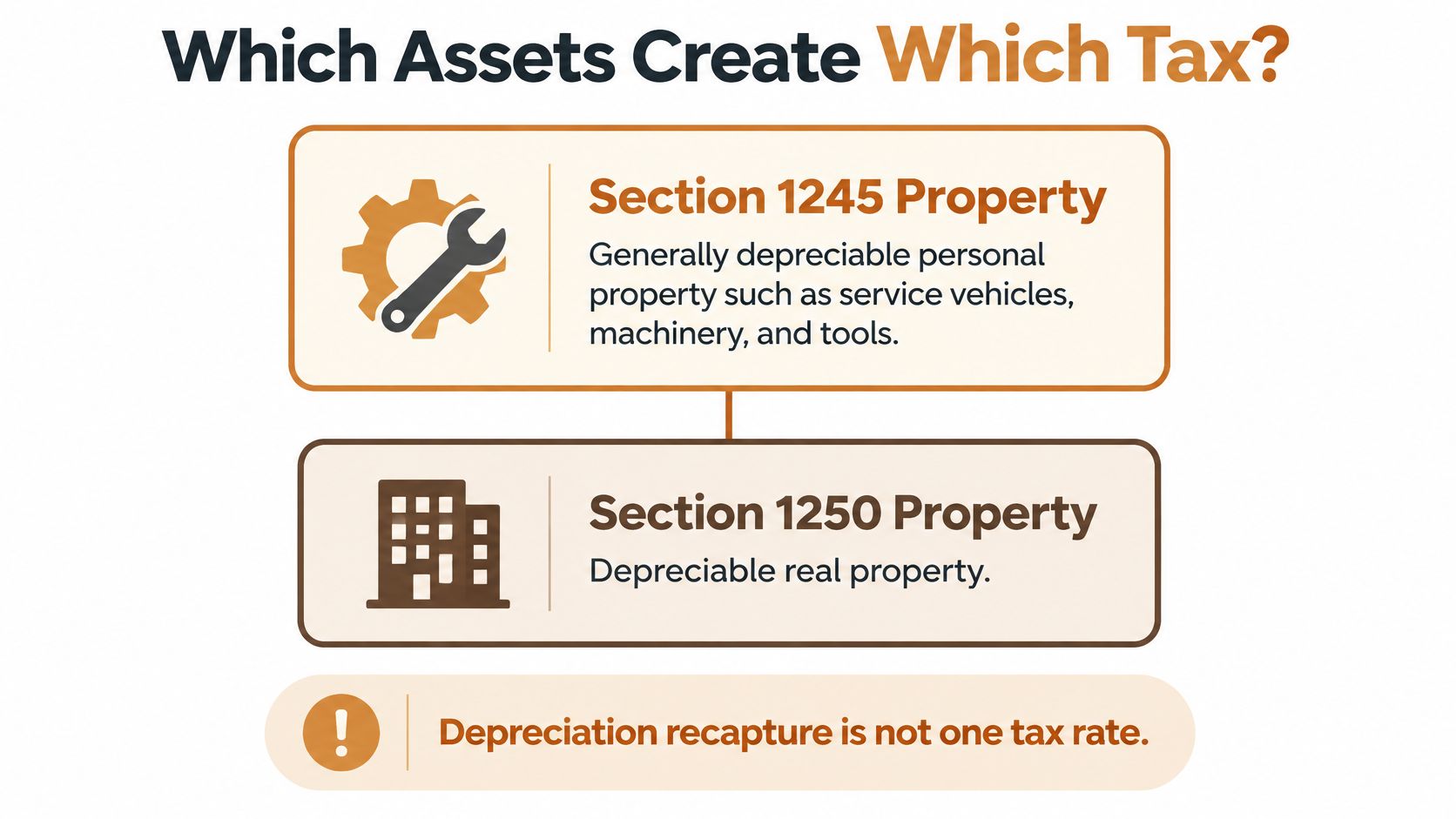
Vans, lifts, welders, mowers, diagnostic equipment, computers, and shop fixtures are generally depreciable personal property. Gain on them is ordinary income up to the depreciation allowed or allowable, and that includes amounts you wrote off under Section 179 or bonus depreciation. The IRS position is blunt: depreciation that should have been claimed counts even if you never claimed it, so a thin tax return doesn’t erase the exposure.
Commercial real property placed in service after 1986 is generally depreciated straight-line, which leaves little or no Section 1250 ordinary-income recapture. The depreciation-related slice doesn’t vanish. It becomes unrecaptured Section 1250 gain, taxed at a maximum of 25 percent rather than your ordinary rate.
Goodwill and going-concern value generally sit outside equipment recapture and often qualify for long-term capital gain once the holding period is met. Land is never depreciated, so it produces no recapture at all. Leasehold improvements need a judgment call, because some behave like personal property and others follow real-property rules.
Section 1231 property is business property held more than a year, and its net gain is generally long-term capital. Recapture under Sections 1245 and 1250 gets pulled out of that treatment first, which is why the category you assign each asset matters before anything else. If the buyer’s letter of intent is an asset purchase, the split is negotiable, and understanding what purchase price allocation does to your tax is more useful than arguing about the top-line figure.
For a general reference on how the remaining gain is taxed once recapture is carved out, this explanation of capital gains help from Nanak Accountants covers the rate structure. Put every major asset on one row of the table above before you talk price with anyone.
The arithmetic is simple enough to do on a legal pad, and the IRS Publication 544 states the rule plainly: for Section 1245 property, the recapture amount is generally the lesser of the gain realized or the depreciation deductions previously allowed or allowable.
Walk one piece of equipment through it. A business bought it for $100,000, claimed $70,000 of depreciation, and has an adjusted basis of $30,000.
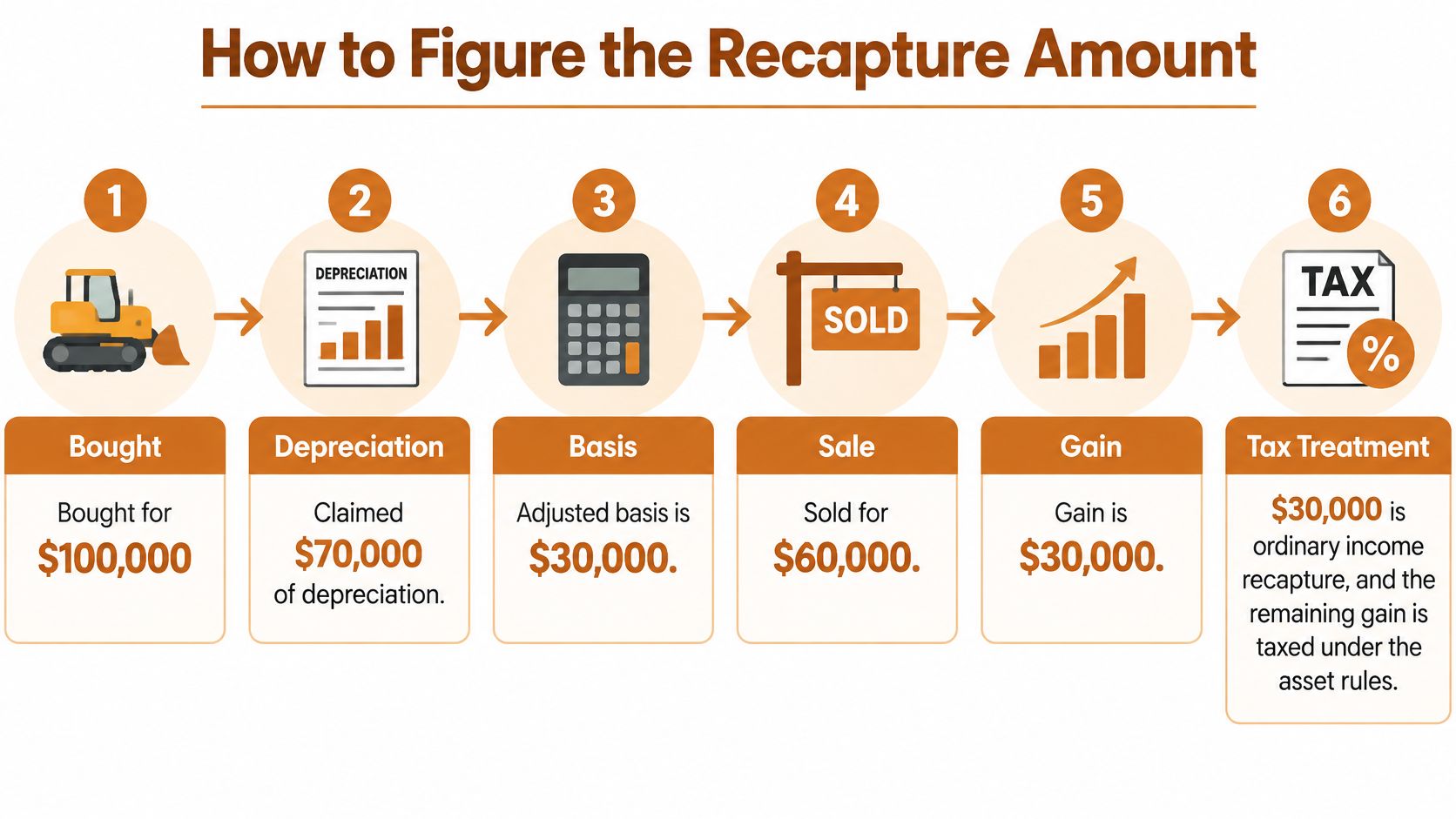
The sale price minus the $30,000 adjusted basis gives a $30,000 gain. That entire $30,000 can be Section 1245 ordinary-income recapture, because it doesn’t exceed the $70,000 of depreciation claimed. None of it reaches capital gains treatment.
Same asset, better market. The gain is now $90,000. The first $70,000 is generally recapture, and the remaining $20,000 can receive capital-gain treatment, subject to your full facts.
| Sale price | Adjusted basis | Total gain | Ordinary recapture | Remaining gain |
|---|---|---|---|---|
| $60,000 | $30,000 | $30,000 | $30,000 | $0 |
| $120,000 | $30,000 | $90,000 | $70,000 | $20,000 |
The pattern scales to a fleet. Trucks expensed with bonus depreciation can carry a basis near zero, so nearly the whole resale price becomes ordinary income even though the owner thinks of those trucks as long paid for. The recapture slice is taxed at ordinary rates. Only the slice above prior depreciation may qualify for long-term capital gain rates.
Here is where the method earns its keep. Publication 544 also notes that recapture can apply in certain like-kind exchanges and that the amount may be limited by statutory rules, so the sale price never finishes the calculation on its own.
Practical rule: pull the depreciation schedule and run this on the three or four largest assets before you react to any offer. Those four lines usually explain most of the gap between the price and the cash.
The same five steps work for any single asset:
Once you have a number, tax software makes the reporting side less painful, and this guide to the best tax software covers the packages that handle Form 4797 work. Your accountant still needs the fixed-asset schedule.
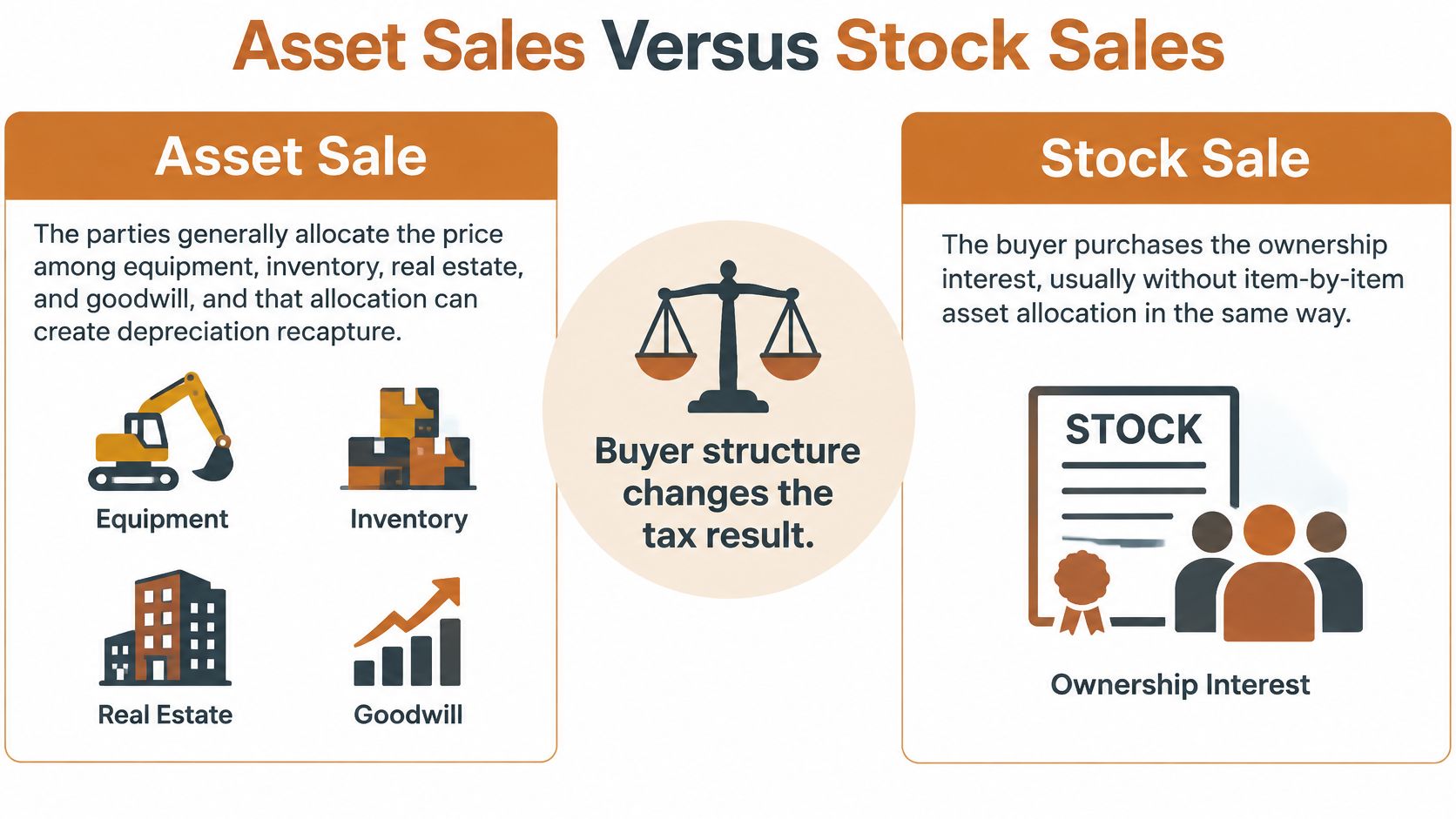
The deal form decides who carries the recapture. In an asset sale, the buyer and seller generally allocate the price among equipment, building, land, and goodwill, and that allocation can create depreciation recapture. In a stock or membership-interest sale, the buyer purchases the ownership interest, usually without an item-by-item allocation in the same way.
| Deal form | How the price is assigned | Where recapture usually shows | What not to assume |
|---|---|---|---|
| Asset sale | Buyer and seller allocate among equipment, building, land, and goodwill | Equipment portion can be ordinary income in the year of sale | The headline price estimates the tax |
| Stock or membership sale | Buyer buys the equity; inside asset bases often stay put | Seller often has gain on the equity, not a direct asset-by-asset recapture | An equity sale always erases depreciation inside an S corp or partnership |
Say the purchase price is $2,000,000 and the parties agree to assign $600,000 to fully depreciated equipment, $400,000 to the building, $200,000 to land, and $800,000 to goodwill. Same company, same buyer, same wire amount. The tax result depends almost entirely on how those four numbers read.
The equipment slice can be ordinary income up to the depreciation already claimed, which on fully depreciated trucks and tools could be most of the $600,000. The building’s depreciation-related portion follows the property rule described earlier. Land and goodwill more often follow capital-gain treatment.
Move $200,000 from equipment to goodwill and the seller’s ordinary income falls by roughly that amount, while the buyer loses depreciable basis on the equipment. That’s the trade, and it’s why buyers push back.
In a stock or membership-interest sale the seller often reports gain on the equity, and the depreciation history stays inside the company rather than being recaptured asset by asset on the seller’s return. Don’t treat that as a guarantee. Owners of S corporations and partnerships need to check whether entity rules or an election pull the recapture back to them, and the answer changes with how the company holds real estate.
Ask two questions before you discuss money. Which form does the letter of intent use, and what allocation is on the table? The comparison of asset sale and stock sale mechanics is worth reading before that call, because the difference is structural, not cosmetic.
The assumption sounds reasonable and it’s wrong: an installment sale does not defer the tax on recapture just because the money arrives in pieces. The IRS Form 6252 instructions state that ordinary-income recapture under Sections 1245 or 1250 is fully taxable in the year of sale, even if the seller receives no payments that year.
The remaining gain may qualify for installment reporting if the transaction otherwise qualifies. The recapture amount has to be identified first, and it comes due whether or not a check clears.
Say the sale produces $400,000 of Section 1245 recapture on equipment and $200,000 of remaining Section 1231 or capital gain. The buyer pays $100,000 down and the balance over five years.
The $400,000 is income this year. Your return recognizes it in full, at ordinary rates, against a $100,000 down payment. Only the $200,000 may be spread as payments arrive, if the sale otherwise qualifies for installment treatment. A seller in that position can owe more in year-one tax than the closing produced in cash, and that shortfall has to come from somewhere else.
The distinction that matters: installment treatment can defer eligible gain. It does not automatically defer recapture.
That’s a timing point, not a rate point, and it’s the one general explanations tend to blur. Contractors who spent years taking Section 179 deductions, buying fleet vehicles, and writing off tools and shop improvements are exactly the owners who arrive at closing with a large gap between tax basis and sale value.
Then there’s the downside case. If the buyer defaults three years in and you take the assets back, the tax already recognized on the recapture doesn’t automatically reverse. You carry a note, you carry the tax, and you may end up carrying the equipment again too. Imperfect depreciation records don’t rescue the calculation either, because the test runs on depreciation allowed or allowable rather than only what you claimed.
Have the year-one tax computed before you agree to a small down payment. The installment sale tax treatment explainer walks through how payments and character interact, and it’s the right reading before you sign a note that pays out over five years.
Once the recapture number exists, three levers remain: when you sell, what form the deal takes, and how the price is split. None of them makes the tax disappear. Each one moves it.
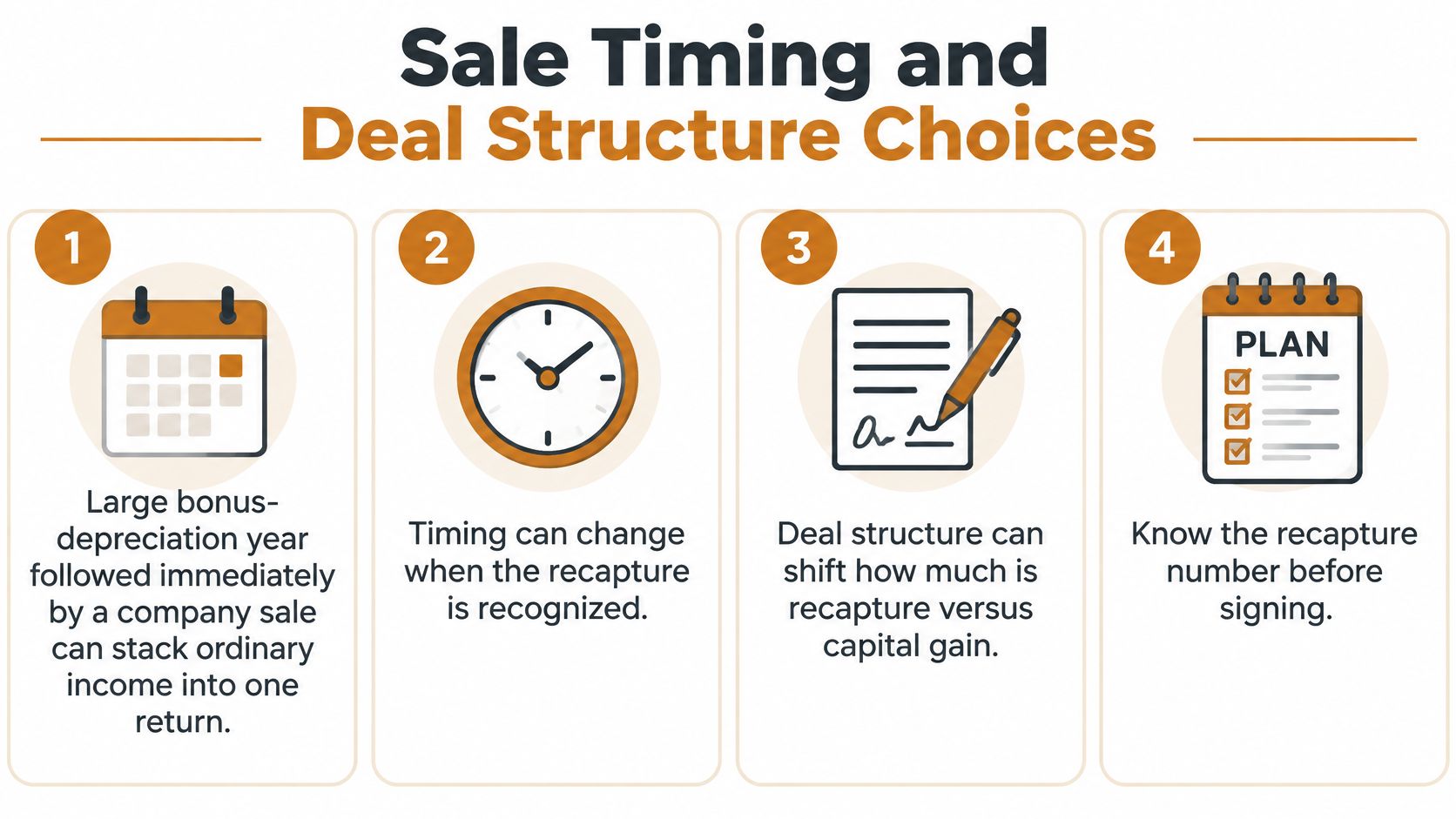
A large bonus-depreciation year followed immediately by a company sale can stack ordinary income into one return, pushing the whole pile into your top bracket. Some owners separate a fleet refresh from the sale by a year or more, or wait for a period when other ordinary income is lower. The recapture is the same size. The rate applied to it isn’t.
The asset-versus-equity choice and the equipment-versus-goodwill split are negotiations, not technicalities. Shifting price toward goodwill can reduce the seller’s ordinary income, and it also reduces what the buyer gets to depreciate, so neither side should treat the split as a free fix. Everything else in the deal rides on the same foundation. An earnout or a later true-up still takes its character from the assets it pays for, so it belongs in the same estimate rather than a separate one.
Like-kind treatment is a narrow possibility, not a do-it-yourself exit. Publication 544 flags it, and it doesn’t fit a sale of the whole company for cash.
Bring these four items to the conversation: the fixed-asset schedule, your Section 179 and bonus depreciation history, the entity type, and whether the real estate sits in the operating company or a separate LLC.
That last item decides whether the building’s portion shows up on your return at all. If year-one tax plus debt payoff leaves too little cash to live on, change the timing, the allocation, or the deal form before signing. Waiting is cheap. Unwinding a closed sale isn’t.
Pause before you say yes to a number. Work through four steps.
Bring the depreciation schedule, the entity type, and the letter of intent to that review. If you’d rather understand the terms before that meeting, we publish a guide on what an earnout is that spells out how those payments are structured. For a confidential first conversation about a sale, The Owner’s Shortlist works by phone and one real person reviews your business before making an introduction. This is an explanation, not tax, legal, or financial advice.
If you own a trades or service company and you’re weighing an offer, the tax math comes before the broker conversation, not after it. The Owner’s Shortlist matches owners of established businesses with one specialist whose past deals fit theirs, and the call is free and confidential. Visit The Owner’s Shortlist to start with a phone call and a real person, or browse the tax and business value articles first if you’re still in the quiet research stage.
Who wrote this: The Owner's Shortlist is not a broker and doesn't sell businesses. We get paid the same no matter which specialist we introduce you to. More about how we work.
Tell us your situation. We'll connect you with a specialist who works with owners like you. One conversation, no sales pressure.
Found this useful?
Add The Owner's Shortlist as a preferred source and get our articles highlighted in Google Search results.
Add to Preferred SourcesSometimes. In small sales the owner often keeps the unpaid invoices. In bigger ones the buyer pays for them at a discount. Here's how to protect that money.
November 15, 2026
Your business name usually sells with the business. It only stays on the trucks if the contract says so. Here's what buyers do and what to put in writing.
November 15, 2026
What is a data room? Learn how virtual data rooms work in business sales, which documents to include, and how to control who sees them.
November 14, 2026
Selling a business valuation explained for owners: the methods buyers use, the earnings they price, and how to get a number you can defend.
November 4, 2026