Reps & Warranties in M&A: A Practical Guide for Owners
Learn what reps & warranties mean in M&A deals, why they matter, and how to negotiate them effectively. A clear guide for business owners.
September 27, 2026
By Remi Taffin · August 13, 2026
In the U.S. market for auto repair and service businesses, mechanic shops for sale traded at a median sale price of $410,000 against median revenue of $819,431 in 2025. That’s the number buyers need in their head before they start touring shops, because it tells you these deals are rarely cheap, and they’re usually priced around the cash flow, not the paint on the walls.
If you’re staring at listings right now, you’re probably seeing a mix of thriving independents, tired owner-operated garages, and shops that are really real estate stories wearing an operating-business label. The mistake is treating them all the same. A clean shop with good books, strong technicians, and a long lease is a different asset from a building-inclusive deal with deferred maintenance and an owner who can’t step away.
A mechanic shop is never just a mechanic shop. You are buying an operating business, sometimes a real estate position, and almost always a pile of equipment whose condition matters more than the listing photos.
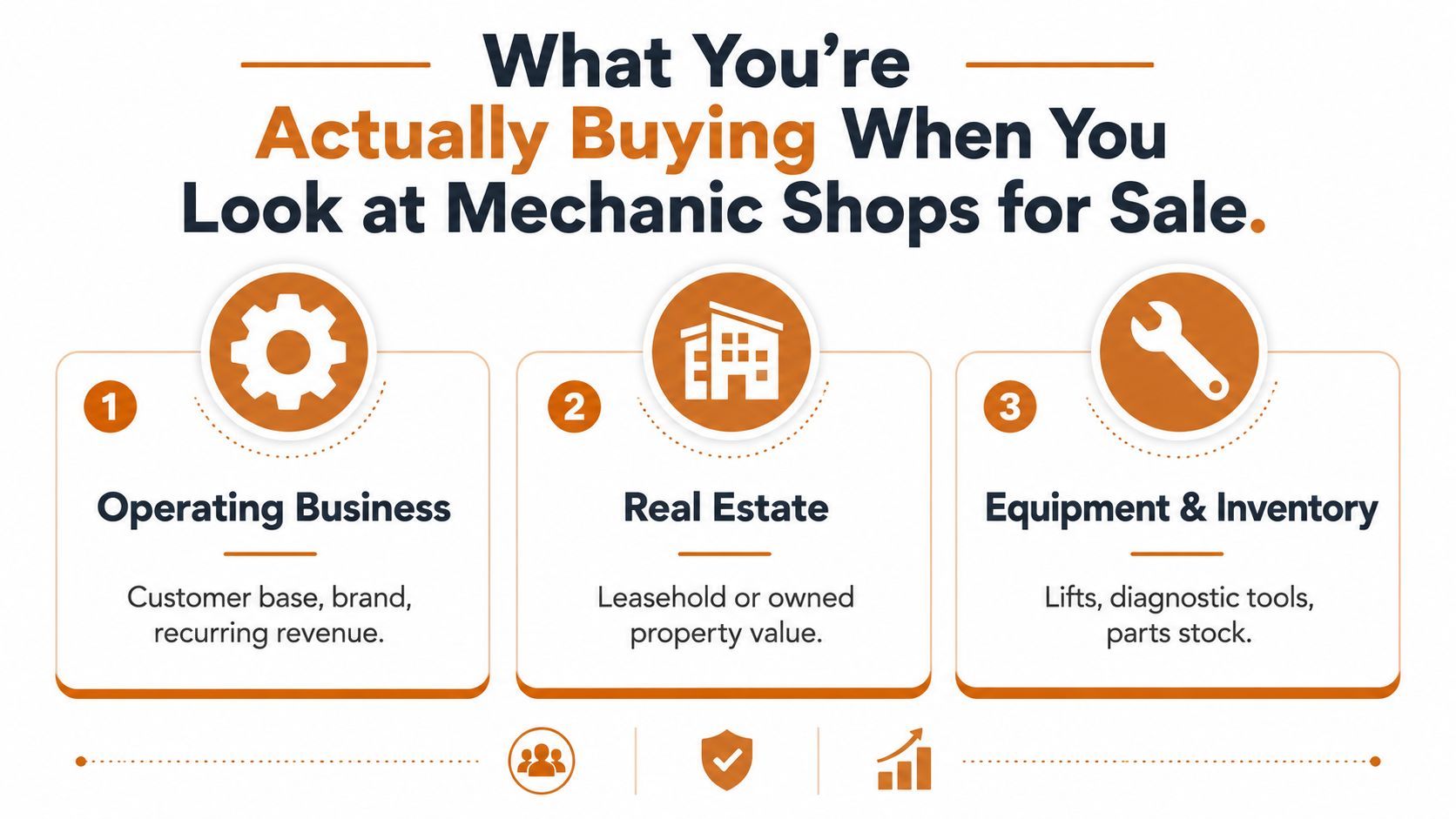
The price only makes sense if you know which asset is carrying the value. If the seller owns the building, part of what you are paying for is the property. If it is a leasehold shop, you are buying the customer base, the staff, the systems, and whatever equipment still has useful life left. That distinction drives structure, financing, and what breaks first after close.
There are three common buyer types. First-time owner-operators want a shop they can run themselves and improve fast. Strategic acquirers already own a location and want a second or third unit with systems they can plug in. Owner-operators expanding want more capacity, more bays, or a stronger trade area without reinventing the wheel.
Those groups do not value the same shop the same way. A first-time buyer may care most about whether the seller will stay for a transition. A strategic buyer cares about overlap, labor utilization, and whether the site can be absorbed into existing systems. A corporate roll-up cares about standardization, property control, and whether the shop can scale without creating chaos.
Practical rule: Do not ask, “Is this shop good?” Ask, “Good for which buyer, at what price, and under what structure?”
The deal lifecycle is simple on paper and brutal in practice. You search, screen, qualify, offer, diligence, finance, close, and transition. Buyers get excited in the search phase and stay sloppy through qualification, which is exactly where bad deals slip through.
The 2025 benchmark analysis from BizBuySell shows what sellers are anchoring to. Analysts at BizBuySell found 1,286 sold listings with a median asking price of $450,000, median owner earnings of $182,133, a median days on market of 207, and an average earnings multiple of 2.82 (BizBuySell benchmark analysis). That is the frame. This is not a bargain-bin market, and sellers who know their numbers usually price accordingly.
Median 2025 Mechanic Shop Sale Benchmarks
| Metric | 2025 Median |
|---|---|
| Sale price | $410,000 |
| Asking price | $450,000 |
| Revenue | $819,431 |
| Owner earnings | $182,133 |
| Days on market | 207 |
| Earnings multiple | 2.82 |
A shop pitched as a lifestyle business usually runs on the owner’s relationships, the owner’s memory, and the owner’s presence in the building every day. A growth platform has tighter books, a steadier team, and clearer processes. A real estate play puts the building and lease terms at the center of the deal.
That is where buyers get tripped up. The equipment can look fine and still be near the end of its useful life. The customer list can look solid and still depend on one technician or one service advisor. The building can look like an asset and still need capital that wipes out your first-year return.
The right question is simple. What am I really buying, and what part of that asset can survive without the current owner in the chair?
Most buyers start with the big listing sites, and that’s fine, but the channel shapes the deal quality. Public marketplaces are noisy. Off-market sources are usually cleaner. Regional brokers can be better on local context, while association referrals often surface owners who were never planning to list publicly.
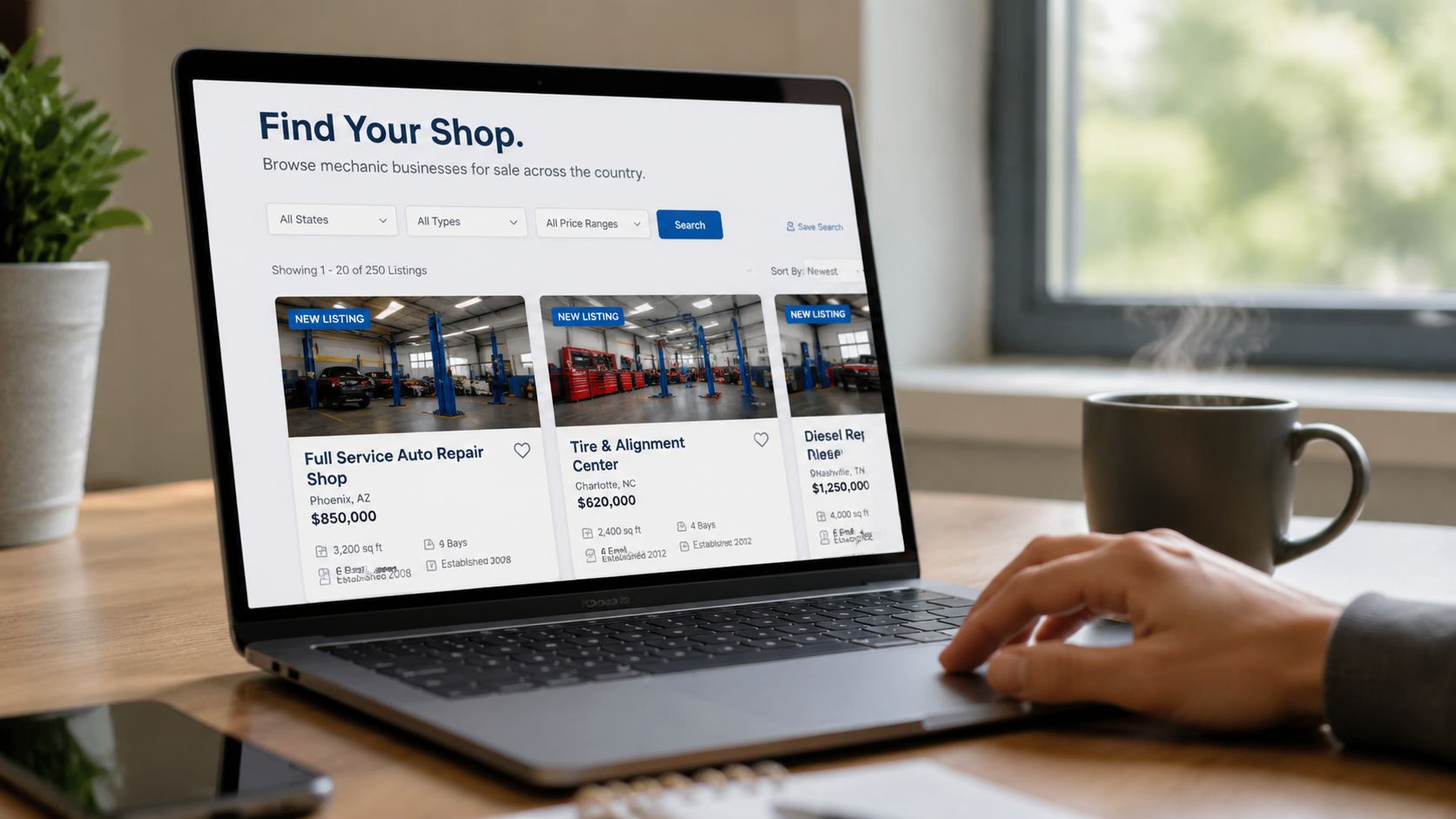
BizBuySell is useful because it shows you how wide the market really is. Its California auto repair and service listings showed a median asking price of $390,000 across 195 established shops, while the broader national listing set showed a median of $595,000 (BizBuySell California listings). That spread matters. The same keyword covers very different deal types, from small leasehold garages to higher-value property-backed businesses.
If you’re a first-time buyer, public listings help you learn the market fast. You’ll see what owners are asking, how long deals sit, and what kinds of shops are available. The downside is obvious. The best deals get attention quickly, and the weak ones sit there because buyers can smell the problem.
If you’re a strategic buyer or a serious operator, off-market and broker-fed deals are where the better conversations happen. Sellers who haven’t blasted their business across the internet are often more practical about price, timing, and transition. Brokers also tend to qualify buyers before sharing financials, which cuts out a lot of window-shopping.
Direct advice: If a shop has been publicly listed for a long time, treat that as a question, not an opportunity. The asking price may be too high, or the business may have issues the seller won’t volunteer.
The channel also tells you what kind of shop you’re looking at. DealStream’s Australian listings separate mechanic shops, tire and alignment centers, transmission specialists, and full-service garages (DealStream listings). That segmentation is smart because buyers don’t buy “auto repair” in the abstract. They buy a service mix, a labor model, and a customer profile.
If you want a quick filter, focus your search on two or three channels only. Public listings for market education, broker referrals for serious opportunities, and one local off-market source, usually an accountant, attorney, or industry contact. Anything more turns into spam.
The cleanest opportunities usually come through people who already know the seller. The loudest listings are often the most overworked.
A seller can sound polished and still be overpriced. The first screen is simple, the cash flow has to make sense, the equipment has to be worth owning, and the business has to survive without the owner doing everything himself. Mechanic shops are priced as a mix of operating business and hard assets, so you need to test both sides at once.
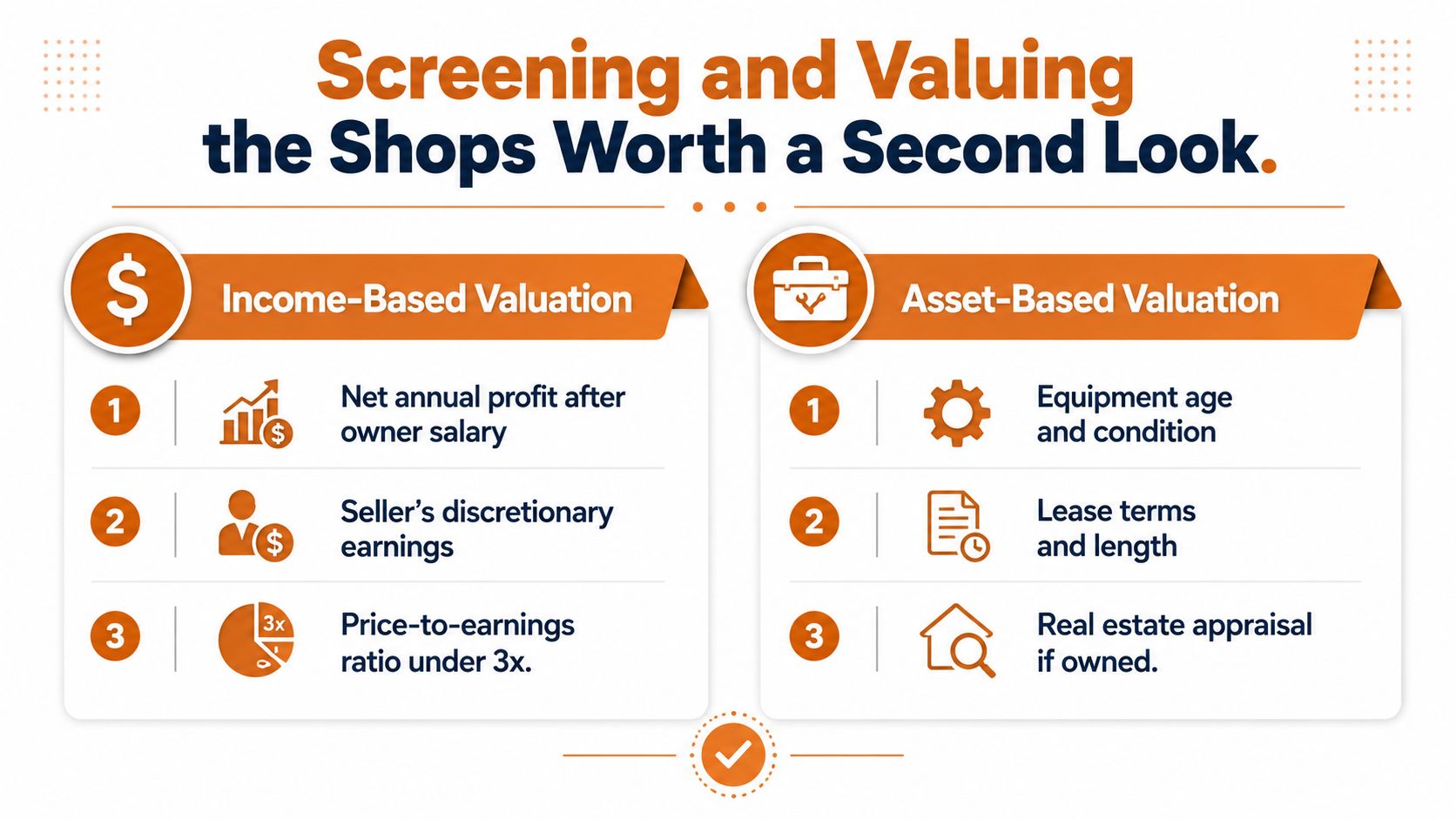
BizBuySell’s benchmark analysis for auto repair and service shows an average earnings multiple of 2.82 for sold shops, which means buyers were commonly paying about 2.82 times owner earnings (BizBuySell benchmark analysis). Use that as a check against the seller’s asking price. If the multiple is much higher, the seller owes you a real explanation, not a story about potential.
The earnings lens comes first. Calculate seller’s discretionary earnings, normalize the books, and compare the result with the asking price. If the price is based on fantasy margins or personal add-backs that do not hold up, pass.
The asset lens matters right after that. Lifts, diagnostic scanners, alignment racks, compressors, and inventory all have replacement cost and useful life, and those facts change what you can safely pay.
Survey data from the industry shows how big these businesses can be and how much work they need to produce consistent cash flow. 72% of independent shops and multi-store operators reported annual revenue above $1 million, 50% fell between $1.0 million and $2.499 million, and 65% had an average repair order above $400 (industry survey). That is a throughput business, not a brand-name business.
Before you get attached, run a fast screen on the listing. Look at revenue, owner earnings, bay count, service mix, and whether the price sits inside a reasonable valuation range. A shop that looks cheap on asking price but weak on earnings usually stays weak after closing.
The same survey also put national average annual revenue per bay at $203,000, which helps explain why bay count can justify different prices for shops with similar top-line revenue (industry survey). A bigger building with poor bay productivity is dead weight. A smaller shop with tight workflow can be worth more.
| Check | Why It Matters | Red Flag |
|---|---|---|
| Asking price versus owner earnings | Shows whether the deal is priced off cash flow | Seller wants a premium with weak earnings support |
| Revenue per bay | Shows whether the physical layout is productive | Too much square footage for the revenue |
| Service mix | Impacts repeat business and labor demand | Overreliance on one shrinking category |
| Equipment condition | Affects immediate capex after close | Lifts, compressors, or scanners are tired |
| Days on market | Suggests market acceptance or hidden issues | Long listing life with no clear explanation |
The seller-readiness workflow from John Salony is useful because serious preparation starts before the exit window opens (sale-readiness workflow). That does not help you overpay. It just means a cleaner seller may move faster and present better books.
If you want a broader frame for comparing asking price to earnings, see how to value a small business. Use it as a reference point, then come back to the shop-specific facts, bay output, equipment, and owner dependence.
If the seller cannot explain how the shop makes money by customer type, bay use, and technician output, the deal is not ready for serious underwriting.
Buyers either save themselves or write a check they regret. The listing is the invitation. Due diligence reveals whether the invitation was honest.
Start with the books. You want three years of financials, tax returns, and a clean normalization schedule that strips out personal expenses, one-time items, and owner perks. Then compare those adjusted earnings to what the seller claimed in the teaser, because the gap is often the first sign that the story was polished.
You also need to see how the shop really runs. Ask what shop management software they use, how they track technician productivity, how they order parts, and whether they can show you actual labor utilization. A shop with good numbers but no operating discipline is fragile the moment the owner steps back.
Customer concentration can wreck the deal. If one fleet customer drives too much of the business, the shop may be stable only until that account moves. Online reviews matter too, not because stars are magical, but because consistent complaints about communication, comebacks, or billing usually point to operating sloppiness.
Practical rule: If the books are strong but the operators can’t show you their customer mix, parts workflow, and technician output, assume the earnings are less durable than they look.
Inspect the lifts, diagnostic scanners, alignment equipment, compressor, HVAC, and any specialty tools tied to the service mix. Deferred maintenance here is expensive because replacement often lands right after closing, when cash is already tight. I’ve seen buyers discover enough old equipment to force an immediate capital injection that changes the whole return profile.
The property side is just as important. A leasehold shop with a short remaining lease can be a trap because renewal risk follows you into ownership. A shop that owns its building has a different risk profile entirely, and it often pulls in a different buyer pool because the asset includes land or structure value.
If you’re buying a leasehold operation, read every renewal clause, assignment clause, and rent escalation mechanism. If the seller owns the property, figure out whether the business sale and real estate sale are being treated together or separately, because that changes everything from lender appetite to closing complexity.
The financial due diligence framework from The Owner’s Shortlist is useful if you need a plain-English refresher on what belongs in a serious review (financial due diligence guide). Use it as a checklist, not as a substitute for an accountant and a lawyer.
A bad deal usually doesn’t fail because the shop had zero customers. It fails because the buyer discovered the customers, the equipment, or the lease were less durable than the teaser suggested.
The headline price is only the start. Two shops can show the same asking price and require very different cash at close depending on whether the building is included, how the sale is structured, and how the lender underwrites the transaction.
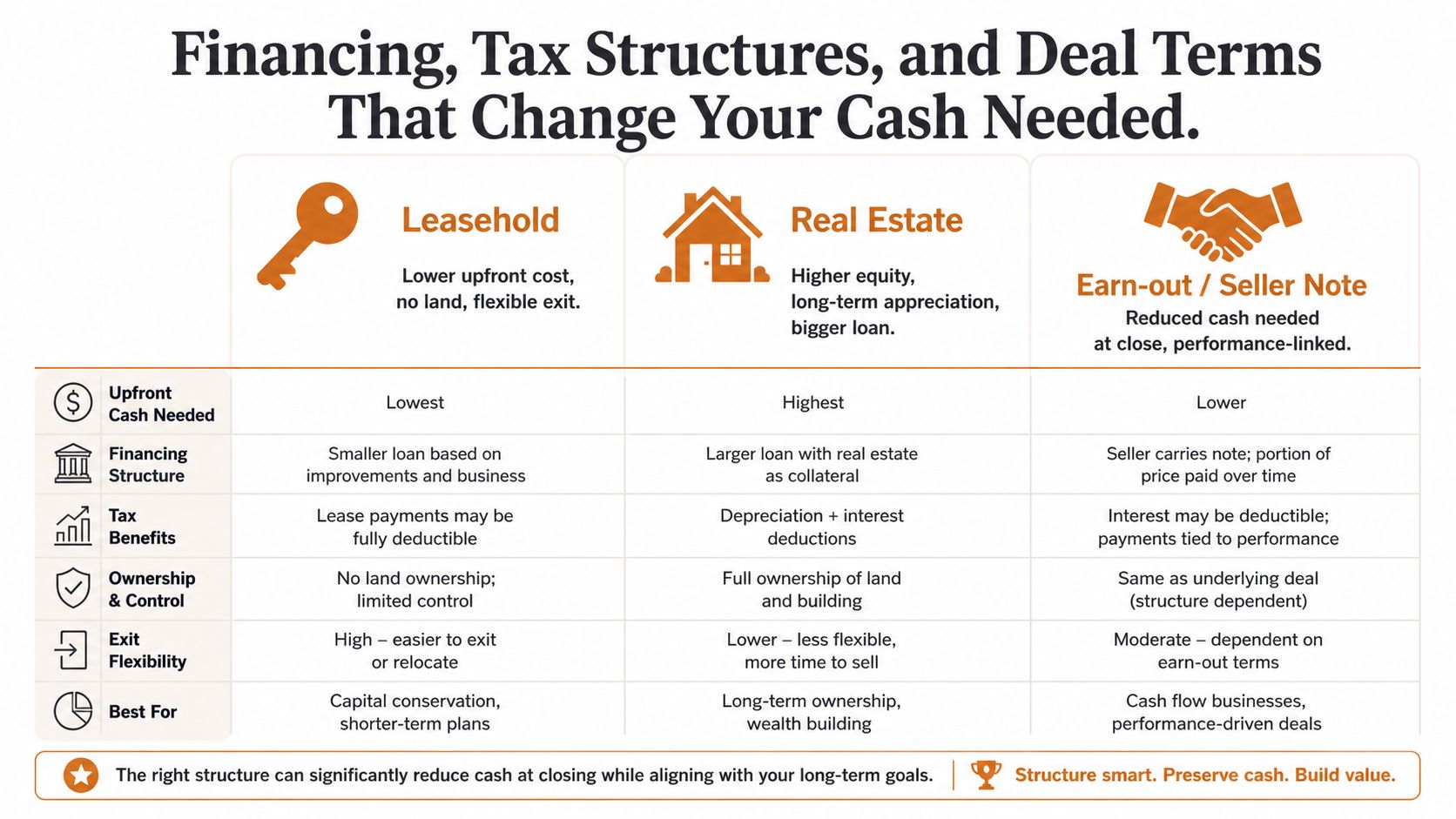
A leasehold shop usually means lower upfront capital because you’re not buying the land or building. That can make the business easier to enter, but it also means you’re exposed to rent, renewal terms, and landlord risk. A real estate included deal needs more cash and usually a larger loan, but it can give you more control and a different exit path.
The choice matters because the same operation can sit on two very different balance sheets. If the building is part of the deal, the lender may view the transaction differently and your long-term return may be tied partly to property value, not just shop earnings. If it’s leasehold, your value lives and dies with the business.
Most buyers prefer an asset sale because it lets them buy the equipment and operating assets while avoiding legacy liabilities. It also gives you a cleaner tax and depreciation posture on the assets you purchase. A stock or equity sale is a different animal. You inherit the entity, the history, and whatever legal baggage comes with it.
That’s why the purchase agreement matters so much. You don’t just negotiate price. You negotiate representations, warranties, indemnities, transition support, noncompetes, and who is responsible if an old issue surfaces later.
The seller-financing article from The Owner’s Shortlist is a solid primer on why note terms can bridge a valuation gap without forcing one side to abandon the deal (seller financing pros and cons).
SBA 7(a) loans remain a practical workhorse for smaller deals, and conventional banks can work when the credit is strong and the shop has clean books. Seller financing shows up often because it helps bridge price gaps and keeps the seller invested in the transition.
The tax side needs equal attention. Equipment-heavy acquisitions can create useful deductions, but only if the structure is handled correctly and the timing fits your tax year. Don’t let the broker treat this like a footnote. It isn’t.
Ask your lender and CPA to model the same shop three ways before you sign the LOI. Leasehold, real estate included, and seller-financed bridge terms can all produce very different closing checks.
The question isn’t just whether a shop is profitable today. It’s whether that profit still looks durable three to five years from now. EVs pressure the old maintenance model, so buyers need to underwrite resilience, not nostalgia.
Shops built around tires, brakes, suspension, diagnostics, ADAS calibration, fleet work, and hybrid-specific service are better positioned than shops leaning on aging internal-combustion work alone. Transmission and engine-heavy businesses can still be good, but they’re more exposed if their customer base is tied to service lines that shrink as vehicle technology changes.
That’s why smart buyers are already segmenting shops by capability instead of treating every garage as interchangeable. The listing market is doing this too. Mechanic shops, tire and alignment centers, transmission specialists, and full-service garages are not the same asset, and buyers who ignore that distinction usually overpay for the wrong profile.
You want to know whether the shop already services hybrids and EVs, whether technicians have ADAS training, and whether the business has fleet relationships that create recurring work. You also want to know the average vehicle age in the trade area, because an older fleet can support repair demand longer than a newer one.
The risk isn’t abstract. If the shop depends on services that are tied to declining maintenance intensity, the multiple should reflect that. If the shop has already adapted its service mix, the earnings are more defensible.
Bottom line: Buy shops with optionality. If the business can earn from diagnostics, tires, ADAS, fleet maintenance, and hybrid work, it has a better shot at holding value than a shop built around one shrinking repair category.
That’s the contrarian take most listing pages won’t give you. They sell present revenue. You should be buying future resilience.
The seller doesn’t have to accept your first number, and you don’t need to buy the deal as presented. You need a structure that reflects what diligence found, then a transition plan that keeps the business from wobbling after close.
If diligence turns up weak equipment, lease risk, customer concentration, or sloppy books, reprice the deal or walk. Don’t let the seller frame every issue as normal wear and tear. A fair purchase price is one that reflects the actual cost of taking over the shop, not the story they told when they listed it.
The LOI should establish price, exclusivity, timing, diligence scope, and the major deal terms before lawyers get into the weeds. Exclusivity matters because it stops the seller from shopping your offer while you spend money on advisors. After that, the purchase agreement has to spell out transition support, inventory treatment, training, and what happens if key employees leave.
The first 30 days are about retention. Introduce yourself to customers, honor warranties, keep pricing steady, and hold onto the lead tech. Don’t rip out the shop management software in week one. The staff need continuity before they need your grand plan.
Days 31 to 60 are for stabilization. Fix the deferred maintenance you identified in diligence, review vendor terms, and tighten the parts ordering process. If the seller was the main relationship holder, start moving those vendor relationships into your name without creating friction.
Days 61 to 90 are where you install control. Weekly P&L review, parts inventory tracking, technician productivity tracking, and a defined CapEx plan should be in place by then. If you wait six months, the shop’s hidden leak will already be in your cash flow.
The Owner’s Shortlist can help here because it’s built around owners who need practical guidance before they engage specialists, including valuation, taxes, legal work, and financing. If you’re shopping for mechanic shops for sale and want a clearer process before you hire a team, visit The Owner’s Shortlist and use it to line up the right next conversations.
Buying the shop is the easy part. Running it profitably after close is where your return gets earned.
Tell us your situation. We'll connect you with a specialist who works with owners like you. One conversation, no sales pressure.
Found this useful?
Add The Owner's Shortlist as a preferred source and get our articles highlighted in Google Search results.
Add to Preferred SourcesLearn what reps & warranties mean in M&A deals, why they matter, and how to negotiate them effectively. A clear guide for business owners.
September 27, 2026
Your business's sale price and your retirement number are two different figures. Here's how to build the second one before you rely on the first.
September 21, 2026
Ten straight questions to work through before you set a retirement date, with a short answer to each and where to go deeper on your own time.
September 21, 2026
Being financially ready to sell and having a plan for your time are two different things. Here's why the second one catches so many owners by surprise.
September 21, 2026