How much is my manufacturing business worth? 2026 numbers
Small manufacturers sell for about 2.75 to 3 times owner earnings. Bigger ones sell for 6 to 9 times EBITDA. Here's what sets your number and how to check it.
October 29, 2026
By Remi Taffin · November 21, 2026
Global industrial-manufacturing deal volume in Q2 2025 was 16.5% below Q2 2024, according to PMCF’s industrial-manufacturing review. That doesn’t mean buyers have disappeared. It means an owner selling a manufacturing business needs more than an attractive asking price to keep a buyer committed.
The strongest preparation makes earnings verifiable, management capable of operating without you, and skilled employees willing to stay. Those aren’t housekeeping tasks. They determine whether the buyer can collect the profits they’re paying for.
Most owner-operated shops are priced on normalized EBITDA, and the published middle-market ranges you will find online are drawn from deals far larger than yours. Our page on manufacturing business valuation works through the earnings measures that actually apply at this size, and manufacturing valuation multiples covers how those ranges get built.
This page is about the twelve to twenty-four months before any of those numbers get tested, which is where the price is actually decided.
Buyers generally start with normalized EBITDA, meaning operating earnings adjusted to reflect the business they’ll inherit. Revenue alone doesn’t establish value. A busy factory with weak margins, overdue machine replacements, and slow-paying customers can be less attractive than a smaller operation with dependable profits.
A buyer will examine whether repeat orders reflect durable customer demand or a favorable production cycle. They’ll also ask whether backlog is profitable, cancellable, dependent on material availability, or concentrated in a customer whose purchasing manager knows only you.
Equipment deserves the same scrutiny. EBITDA excludes depreciation, but buyers still need cash to replace machinery. An aging production line can therefore weaken an otherwise persuasive earnings story.
Use a guide to manufacturing company valuation multiples to understand the terminology, then ask a specialist to select comparable transactions that resemble your company in size, subsector, and management structure. Don’t apply these middle-market indicators automatically to a small owner-operated shop.
Practical rule: A valuation range is useful only when you can explain what earns the upper end and what could force the lower end.
This week, calculate your normalized earnings, identify the relevant transaction-size band, and write down a provisional range. List the conditions behind it, including management depth, customer concentration, equipment condition, and working-capital demands. Keep enterprise value separate from your eventual personal proceeds, which require adjustments for debt, cash, taxes, transaction costs, and negotiated terms.
Begin 12 to 24 months before marketing with a sell-side quality-of-earnings review, rather than treating an informal valuation as financial preparation. Iconic’s manufacturing valuation commentary, citing GF Data, reports average multiples of 7.4x EBITDA with a sell-side QoE versus 7.0x without one, equivalent to illustrative enterprise values of $14.8 million versus $14.0 million on $2 million EBITDA, an $800,000 difference before transaction adjustments.
That’s an association, not proof that commissioning a report causes a premium. The practical benefit is identifying weak evidence before the buyer does.
Use this checklist to organize the preparation work.
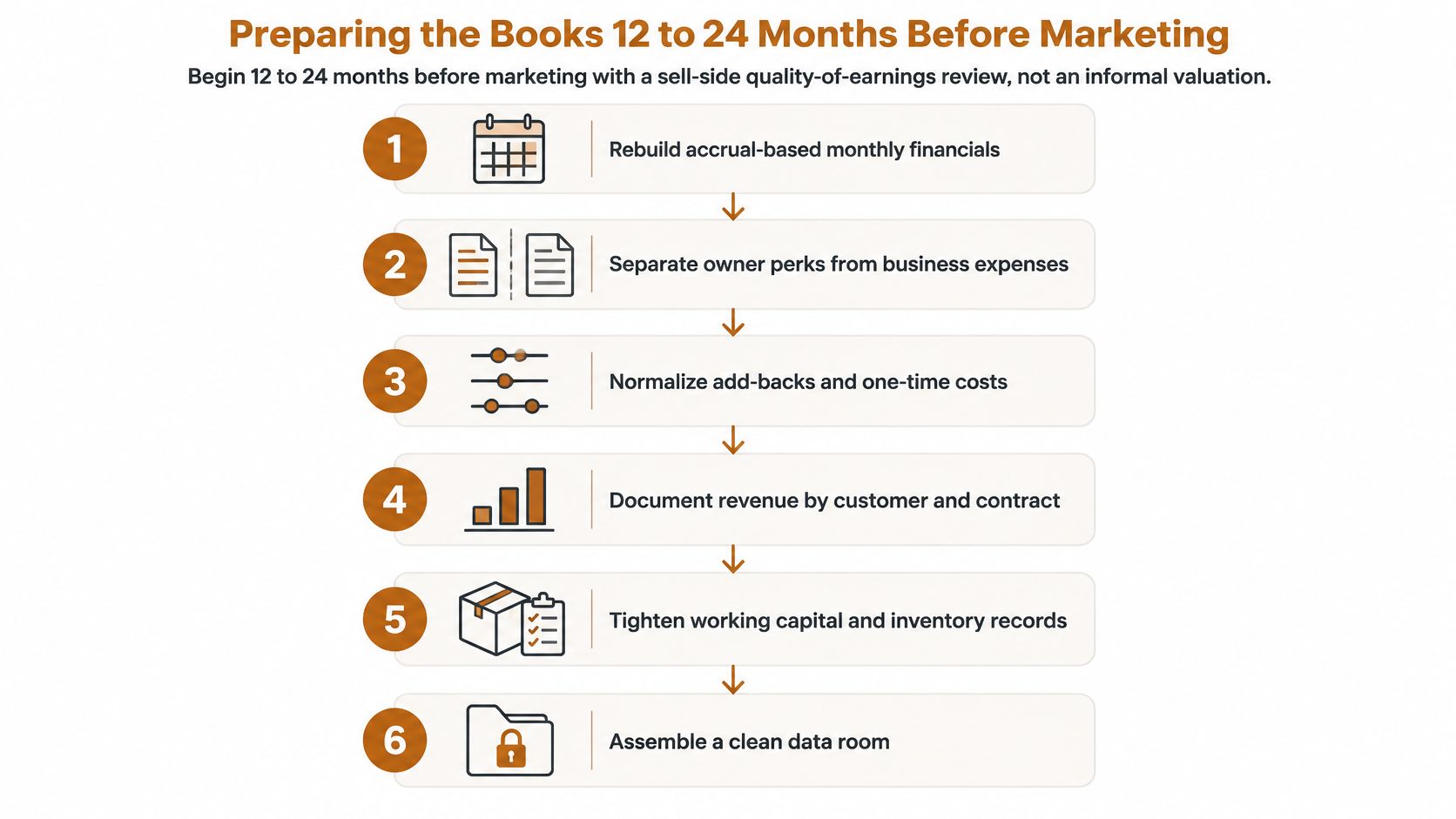
Rebuild accrual-based monthly statements. Match revenue and expenses to the periods in which they were earned or incurred so shipment timing and supplier payments don’t distort operating performance. The common mistake is presenting tax-oriented annual accounts without a reliable monthly bridge.
Reconcile the manufacturing accounts. Trace revenue, gross margin, inventory, work-in-process, and capital spending to invoices, job records, inventory counts, and the fixed-asset register. Watch for unfinished jobs recorded inconsistently, obsolete stock carried at full cost, and machine purchases mixed into operating expenses.
Document every EBITDA adjustment. Separate personal expenses, nonrecurring repairs, and other supportable one-time costs from normal operating spending. An adjustment labeled exceptional without an invoice and explanation is an invitation for the buyer to remove it.
Price the owner’s replacement accurately. Replace your compensation with the market-rate cost of performing the necessary role, including responsibilities spread across production, sales, and administration. Adding back all your pay while leaving your work unfunded overstates transferable earnings.
Test the obligations behind the profit. Examine customer concentration, backlog quality, warranty claims, environmental exposure, equipment condition, and maintenance-capital requirements. Don’t present the income statement as complete evidence while ignoring costs that will arrive after ownership changes.
Define normalized working capital before the letter of intent. Agree which receivables, inventory, payables, and accruals belong in the calculation, then examine seasonality and unusual balances. A target without consistent accounting definitions creates an avoidable closing dispute.
If bank exports and spreadsheets are slowing reconciliation, moving the routine collection work onto software is worth doing before diligence starts. Keep an accountant responsible for classifications, source-document checks, and manufacturing-specific judgments such as work-in-process valuation.
Store the support in a permission-controlled data room with filenames that match your adjustment schedule. Include an explanation of what changed, why it’s nonrecurring, and where it appears in the accounts.
The readiness test is straightforward: can someone unfamiliar with your business trace every adjustment to a document? If the answer depends on calling you for an explanation, the file isn’t finished.
4.0x versus 7.5x EBITDA was the reported median valuation gap between owner-dependent and professionally managed manufacturers in an analysis of more than 4,700 U.S. manufacturing transactions from 2015 to 2025, described in an EXM announcement published by Yahoo Finance. The same dataset reported the transaction timelines below; applying those multiples to $3 million EBITDA implies $12 million versus $22.5 million enterprise value, a $10.5 million illustrative spread before adjustments.
Owner involvement and sale outcomes compared
| Leadership model | Median EBITDA multiple | Median transaction timeline |
|---|---|---|
| Owner deeply involved in daily operations | 4.0x | 11.3 months |
| Professional executive management | 7.5x | 7.5 months |
These are dataset-specific comparisons, not universal rules or a promised return on hiring a general manager. Businesses with professional executives may differ in other important ways. Still, the commercial question is unavoidable: what stops working when you leave?
Start an activity map covering quoting, engineering approvals, key-account management, purchasing, hiring, production scheduling, and lender or supplier relationships. For each activity, record:
A manager with a title but no spending or decision authority doesn’t solve the problem. Neither does an operating manual that omits the judgment required to quote difficult work or recover a delayed job.
A buyer needs evidence that your replacement can make decisions, not evidence that your staff can follow your instructions.
Demonstrate performance over several months while deliberately stepping back. Review outcomes at scheduled management meetings instead of privately reversing decisions throughout the day.
Be especially candid about sales. Repeat orders aren’t fully transferable if you personally rescue every major negotiation. Give managers direct customer exposure and let them demonstrate account ownership before a buyer asks to meet them.
Exit routes compared on the same criteria
| Exit route | Cash at closing | Control after closing | Employee impact | Tax and structure complexity |
|---|---|---|---|---|
| Full sale to strategic buyer | High relative to deferred routes | Lost at closing | Integration changes likely | Moderate |
| Full sale to private equity | High, subject to rollover and deferrals | Lost, may keep a minority stake | Governance and acquisitions may change roles | Moderate to high |
| Minority recapitalization | Partial | Often retained, subject to investor rights | Usually limited immediate disruption | Moderate to high |
| ESOP | Partial to full over time | Formal fiduciary governance | Employees gain beneficial ownership through the plan | High |
| Internal or family succession | Often staged and financing-dependent | Kept until handover | Continuity if successor is prepared | Moderate |
These are planning comparisons, not guaranteed outcomes. Preparation time follows the readiness of the buyer, successor, financing, and governance arrangements, not the route’s name.
A strategic sale suits an owner seeking a decisive exit where another manufacturer can use the capacity, capabilities, or customer relationships. Synergies may support an attractive offer, but the buyer may consolidate production or change the brand.
A private-equity sale may suit an owner who wants to take money off the table while the business keeps investing in growth and acquisitions. Confirm whether continued employment or rolled equity is expected, and distinguish selling control from leaving the business entirely.
A minority recapitalization lets you take some of the money out while you remain in charge of daily operations. However, investor consent rights can constrain borrowing, distributions, capital spending, and a later sale even when you retain majority ownership.
An ESOP deserves serious consideration where workforce continuity matters. Manufacturing represents 21% of ESOP companies and 42% of total assets held by ESOP-owned firms, according to Logistics Viewpoints’ coverage of manufacturing ownership transitions.
Employee ownership doesn’t eliminate financing constraints or give each worker direct control over operating decisions. Compare cash at closing, debt service, trustee oversight, administration, and tax treatment with a conventional sale before choosing it.
Internal or family succession works best when the successor can lead and the funding plan supports both your retirement and the factory’s needs. If managers can’t fund a conventional purchase, explore financing and a phased transfer rather than assuming enthusiasm equals purchasing capacity; this guide to selling a business to employees explains the broader choices.
A staged buyout transfers ownership or control through successive purchases over several years. Unlike a minority recapitalization, which may leave the future exit unresolved, it should establish how later purchases occur, how they’re priced, and what happens if financing or performance deteriorates.
Before proceeding, rank cash in hand, control, employee impact, tax complexity, and preparation time. The best price isn’t always the best exit when preserving the plant or workforce matters to you.
66% of manufacturing professionals experienced employee resignations after a merger or acquisition, according to a 2025 Travelers report on manufacturing M&A. That figure measures reported experience, not the share of employees who resigned, but it makes workforce continuity a transaction issue rather than a post-closing HR task.
Confidential discussions need a plan for the people who’ll eventually hear about the sale.

Prepare an anonymous teaser. Describe capabilities, broad geography, and the investment opportunity without naming customers or revealing a distinctive combination of facts that identifies the plant.
Require confidentiality before detailed disclosure. Use a signed agreement before sharing financials, then release customer and employee details only when justified. A business-sale confidentiality agreement should address permitted recipients, restricted use, and unauthorized contact.
Screen for capacity and fit. Establish who funds the purchase, who approves it, and why the buyer wants this manufacturer. Don’t arrange disruptive site visits for buyers who can’t explain their financing or operating intentions.
Identify key-person concentration. Map the machinists, supervisors, engineers, and customer-facing employees whose departure would interrupt production or relationships. Limit transaction knowledge to a need-to-know circle while documenting setups, inspection methods, troubleshooting, and account history as normal business improvement.
Confidentiality and retention can conflict. You may be unable to announce a possible sale early, but an abrupt announcement without credible answers gives employees reason to look elsewhere.
Negotiate who communicates after signing, subject to legal restrictions and the disclosure plan. Prepare answers about reporting lines, location, benefits, and what remains undecided; don’t promise employment protections the buyer hasn’t accepted.
Keep workforce transition on the agenda throughout buyer discussions.
Design retention bonuses with defined payment triggers. A closing payment can recognize transaction support, while later payments can encourage employees to stay through the operational transition.
There’s no defensible universal dollar premium for retention. Calculate your own exposure by identifying contribution margin at risk, replacement and training costs, overtime, and potential delivery penalties if a critical employee leaves.
Protecting production capacity can be worth more than negotiating a higher multiple on earnings the buyer no longer believes will continue.
Ask competing buyers how they’ll retain key employees, not just what they’ll pay you. Their answers help distinguish a credible continuity plan from reassuring language.
The headline price isn’t the cash you keep. An offer can look attractive while placing substantial collection risk on you through deferred payments, financing, or performance conditions.
Build a proceeds bridge before accepting the commercial terms. Start with enterprise value, apply the agreed cash, debt, and working-capital treatment, then separate closing proceeds from escrowed, financed, and contingent amounts. Have your tax adviser estimate the personal result under the proposed transaction structure.
The letter of intent, or LOI, establishes the negotiating framework. Have counsel identify which provisions are binding, whether the stated price is binding, and what allows the buyer to change its offer.
Pay particular attention to:
A seller note is a credit decision, not closing cash. Review interest, repayment dates, collateral, guarantees, senior-lender restrictions, default remedies, and any right to offset indemnity claims against payments.
An earnout creates a different exposure: you may need the buyer’s cooperation to achieve the result that triggers payment. If you won’t control operations, negotiate reporting access, precise accounting definitions, operating protections, and a workable dispute mechanism.
Negotiation discipline: Agree what each payment means before deciding whether the total offer meets your needs.
Maintain a shared issues log with the question, supporting document, responsible person, and resolution date. If a buyer challenges an adjustment, resolve the evidence separately from any proposed change to the multiple or payment structure.
Set your walk-away position before exclusivity, including minimum acceptable closing proceeds and maximum deferred exposure. Don’t trade price against structure in an undifferentiated conversation: evaluate the cash offer first, then price the additional risk you’re being asked to accept.
Keep counsel and your tax adviser involved as terms develop, not merely when the purchase agreement arrives. This is general information, not legal, tax, or financial advice.
Before a broker call, identify your preferred exit route, or the alternatives you’re weighing. Bring normalized EBITDA with support behind each adjustment, plus a clear description of your daily responsibilities and unresolved workforce risks.
We select brokers for The Owner’s Shortlist because they have a track record with businesses like the owner’s, rather than because they offer a confident pitch. Our network is Florida-based today, so tell us where your manufacturing business operates if it’s elsewhere.
Your action this week is concrete: write down your value range and list every earnings adjustment you can’t yet trace to a document. That gives a specialist something useful to assess and gives you a preparation agenda before approaching buyers.
Tell us about your manufacturing business, your involvement, and the exit you’re considering, and a real person will introduce you to one specialist whose past work fits your situation. The service costs owners nothing, and the first conversation comes with no sales pressure. Our network covers Florida, so include your location when you get in touch.
When the preparation is done, we can find the best broker to sell your manufacturing business in Florida. If you want a number before you start, get a free business valuation. There is more on timing in our Future Options section.
Who wrote this: The Owner's Shortlist is not a broker and doesn't sell businesses. We get paid the same no matter which specialist we introduce you to. More about how we work.
Tell us your situation. We'll connect you with a specialist who works with owners like you. One conversation, no sales pressure.
Found this useful?
Add The Owner's Shortlist as a preferred source and get our articles highlighted in Google Search results.
Add to Preferred SourcesSmall manufacturers sell for about 2.75 to 3 times owner earnings. Bigger ones sell for 6 to 9 times EBITDA. Here's what sets your number and how to check it.
October 29, 2026
Learn how manufacturing company valuation multiples work, how size, earnings quality and industry move them, and how to estimate what your business is worth.
November 15, 2026
A strong business needs 2 to 3 years of preparation before going to market. Here's what that work looks like and why starting early changes everything.
April 28, 2026