Selling
How Long Does It Take to Sell a Business
How long does it take to sell a business? Discover realistic timelines, phases, and factors that speed up or delay a sale for owner-operated companies.
September 8, 2026
By Remi Taffin · November 25, 2026

Selling a business in Florida takes seven steps: check that the business is ready, get it valued, prepare the paperwork, market it quietly, sign a letter of intent, get through due diligence, and close. Allow roughly seven to eighteen months. Florida has no personal income tax, but the sale still triggers state sales tax filings and possible liability for unpaid taxes, plus federal tax on the gain.
The Owner’s Shortlist is a free service that introduces Florida owners to one broker who has sold businesses like theirs. Nearly every term a buyer offers traces back to one question: would the business keep earning if you stopped answering the phone? The rest is process, and this article walks through it in order.
Each stage should produce something a buyer can inspect, not a feeling that progress is happening. The timing below is a rough guide, not a rule. It’s part of our selling hub, where the other steps are covered one by one.
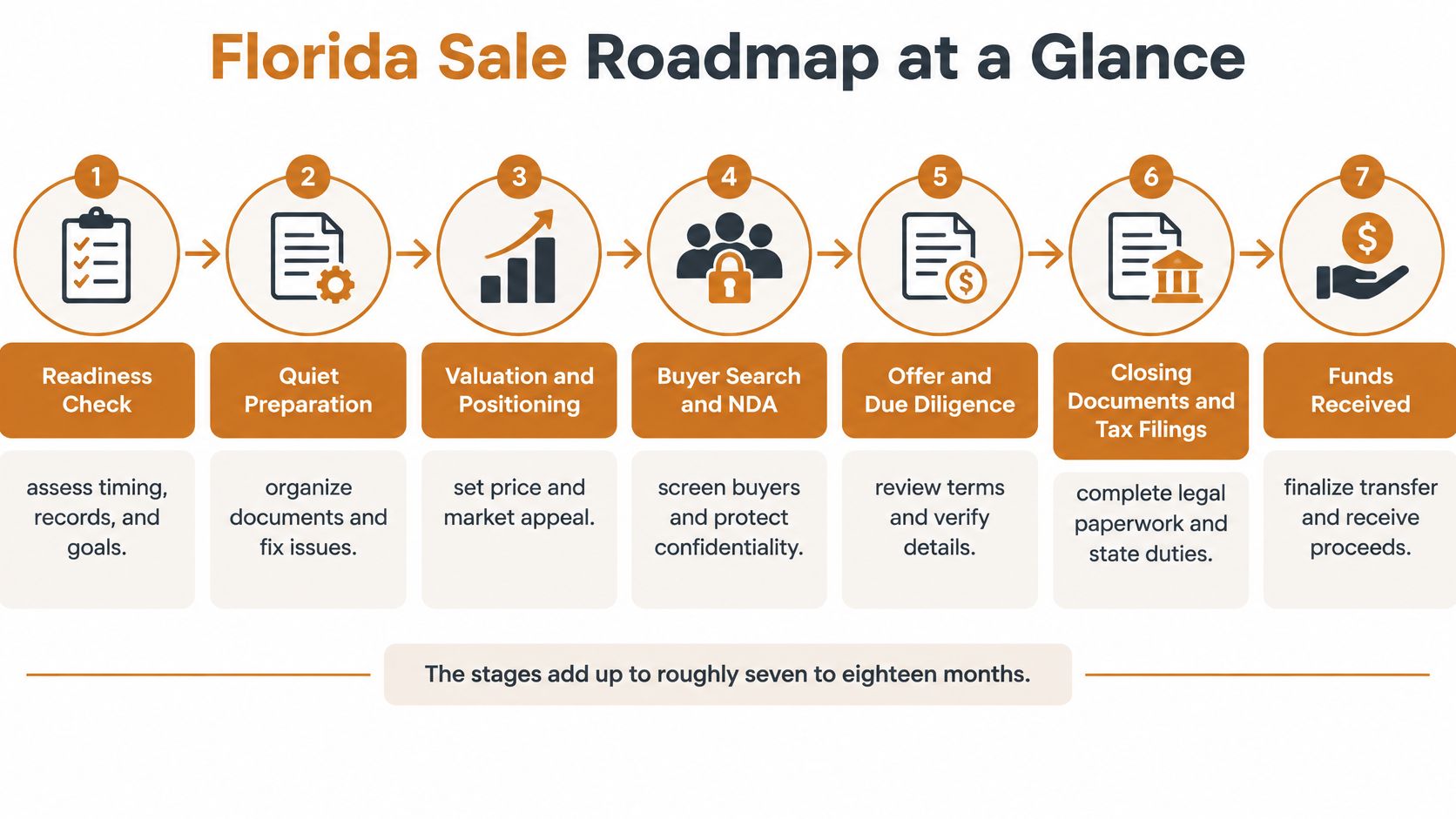
| Stage | Main output | Typical timing | Who to involve |
|---|---|---|---|
| Readiness check | Owner-dependence review and three years of clean financials | 1 to 3 months | CPA |
| Valuation | Value range with normalized earnings and adjustments | 2 to 4 weeks | Broker or valuation specialist |
| Preparation | Information memorandum, anonymous teaser and data room | 1 to 3 months | Broker and attorney |
| Marketing and buyer screening | Signed NDAs and first indications of interest | 2 to 6 months | Broker |
| Letter of intent | Price, structure, exclusivity period and timeline | 2 to 4 weeks | Attorney and CPA |
| Due diligence | Checked records, contracts, licenses and tax filings | 1 to 3 months | Attorney and CPA |
| Closing | Purchase agreement, tax filings and transfer of assets or shares | 2 to 6 weeks | Attorney, CPA and recording office |
The letter of intent is the hinge. It fixes price, structure, exclusivity and timeline, and it usually does so before diligence has confirmed a single document. Diligence then checks the records, contracts, licenses and tax filings. Closing turns all of it into a purchase agreement, state tax filings and the transfer of assets or shares.
Owners lose time in the same two places. At the readiness check, unclear financials and decisions you’ve never handed over surface late and push the whole timetable. At the letter of intent, price and structure get fixed before diligence has confirmed them, which is why the buyer’s first diligence memo so often turns into a re-trade.
Intention isn’t a plan. An owner who means to retire in six years and still prices every estimate, signs every contract above a threshold and takes every emergency call owns a business a buyer will discount. The buyer then adds a long earnout to protect against the risk. Our guide to how to prepare your business for sale covers the full checklist.

The question that sets your price: could this company keep producing the same cash flow if I stopped answering the phone tomorrow?
Quiet marketing is a discipline, not a hiding strategy. Sign an NDA before any financial statement leaves your building, send an anonymous teaser first, and build a buyer list that covers strategic buyers in your trade, private equity groups, an employee buyer and a family successor. The full information memorandum stays away from staff until a letter of intent is signed, and no customer hears anything until diligence requires it. If you want a broker whose completed deals look like your business, our list of Florida business brokers shows who covers which cities and trades.
A sale isn’t the only exit that protects what you built. A staged handoff, with you stepping back over two or three years, keeps customer relationships intact while a successor learns the accounts. A minority recapitalization brings in capital and a partner without handing over control. An employee purchase funded from the company’s own cash flow protects staff and customers better than a rushed listing to a stranger.
Reducing owner dependence raises the price more reliably than rushing to market. Every quarter spent documenting decisions, training a successor and proving renewal rates is a quarter a buyer can’t price as risk.
The method decides the number before a buyer ever sees it. Four approaches cover most service businesses in this state, and the fit depends on who does the work and what a buyer is buying.
| Method | Best suited for | Basis of calculation | What moves it |
|---|---|---|---|
| Seller’s discretionary earnings multiple | Owner-operated firms where the owner does most of the work | Profit with owner pay added back, times a market multiple | Owner dependence and customer concentration |
| Adjusted EBITDA multiple | Firms with a manager in place and buyers such as platforms or private equity groups | Earnings after a market-rate manager’s pay, times a multiple | Add-backs, replacement salary and growth |
| Asset-based value | Low-profit firms with heavy equipment, vehicles or inventory | Net tangible assets at fair market value | Fleet age, inventory counts and receivables quality |
| Discounted cash flow | Firms with predictable recurring work such as maintenance or service contracts | Projected cash flow discounted to today’s value | Contract renewal rates and forecast credibility |
Start with one question: who answers the phone? If the answer is you, a buyer will use seller’s discretionary earnings, and the multiple reflects how much of that income walks out the door with you. If a manager already runs daily operations, adjusted EBITDA becomes credible and the buyer pool widens to platforms and private equity groups.
Here is a made-up example, not a reported sale. A plumbing company bills about $1.4 million a year and shows net profit of $150,000 after paying the owner $120,000. Add back the owner’s pay and $25,000 of one-time or personal costs, such as a family member on payroll, the truck and a legal bill that won’t repeat. The seller’s discretionary earnings land near $295,000.
Now run the buyer’s side. A replacement general manager costs $95,000 plus roughly $12,000 in payroll burden, which removes about $107,000 and leaves $188,000 of earnings. At three times the $295,000, the answer is about $885,000. At four times the $188,000, the same company with the same customers is about $752,000.
Neither multiple is a market rule. The point is that the answer moves by six figures depending on whether the buyer has to replace you.
A buyer is not paying for your revenue. A buyer is paying for the earnings that survive your departure.
Give a broker or valuation specialist three years of statements that match your returns, a fixed-asset list with depreciation, a customer list showing revenue by account and contract term, and your add-back schedule with a written reason for each line. What comes back should be a range with a stated basis. The top is what a strategic buyer pays for a business it can plug in. The bottom is what a financial buyer pays for one it has to fix.
A seller note or an earnout isn’t a way to get a bigger price. It’s a second deal, with its own documents and its own collection risk. If a buyer offers paper, read how a seller note works before you counter.
| Structure | Seller’s risk | Protective clause | Red flag |
|---|---|---|---|
| All cash at closing | Lowest payment risk, but the buyer may push on price | Working-capital adjustment and a clear closing statement | Price reopened after the letter of intent |
| Seller note | Buyer default and slow collection | Security interest, stated interest rate, acceleration on resale | No collateral or open-ended repayment |
| Earnout | Results depend on decisions you no longer control | Objective metric, defined accounting policies, records access | Vague wording such as profit or performance |
| Escrow holdback | Cash held back for claims may not be released on time | Set amount, defined release date and claim process | Release tied to undefined events |
The failure mode is predictable. An earnout gets drafted against “profit”, then the buyer raises the salary credited to your replacement, charges more shared overhead to the business and changes a customer-transfer policy. The payment that looked like $300,000 at the letter of intent arrives at zero, and you never controlled any of the three decisions that erased it.
The price on a letter of intent is a headline. What reaches your bank account is the headline minus the working-capital adjustment, minus assumed debt, minus whatever the earnout actually pays.
Working capital is where quiet money changes hands. Agree the target figure, how it’s measured and who prepares the closing statement before you sign anything.
The sentence that costs Florida sellers money is “there’s no state income tax here, so the sale is simple”. The lack of a personal income tax is real. It still leaves a set of state duties that attach to the sale itself.
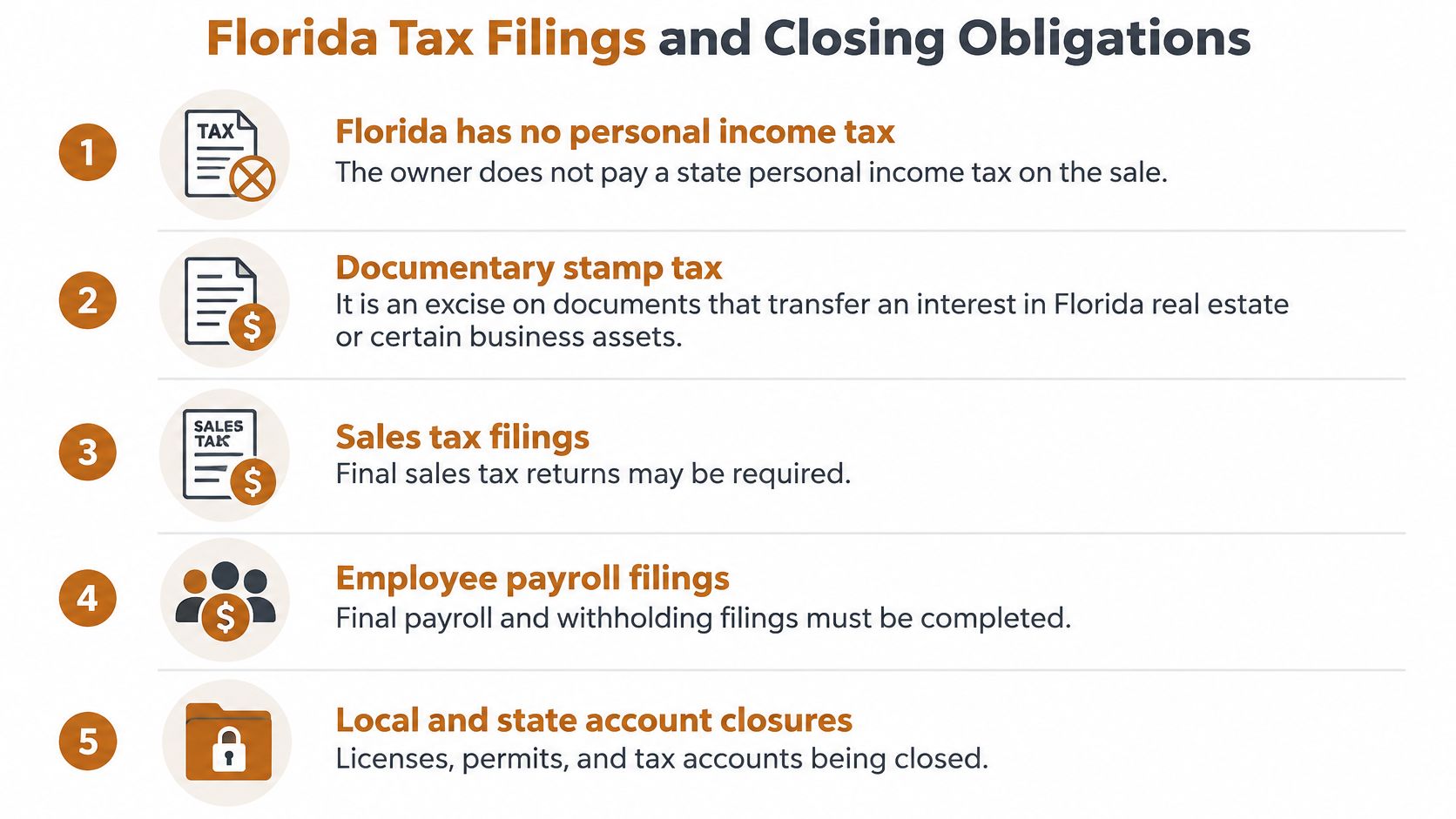
| Issue | What it means | Action to take |
|---|---|---|
| Documentary stamp tax | An excise tax on certain documents executed, delivered or recorded in Florida. For unrecorded documents, a business averaging five or more taxable transactions a month must register. Recorded documents pay the clerk. | Ask a CPA which of your closing documents are taxable and who pays |
| Sales tax registration | A change in ownership requires a new registration, not an update to the old one | The buyer files the new application before closing, and you notify the state of the sale |
| Buyer liability for unpaid tax | A buyer of more than 50% of the business, its assets or its stock of goods can be liable for your unpaid taxes | Ask the state for a receipt or certificate of compliance before closing |
| Final return | Due with full payment within 15 days of the transfer, or within 15 days of quitting with no buyer | Put the date on the calendar before closing |
| Form 8594 | Buyer and seller each report how the price was divided among assets | Model the split with a CPA before accepting a headline price |
A change in business ownership requires a new Florida sales tax registration, according to the Florida Department of Revenue’s sales tax page. That detail alone delays closings, because a buyer who can’t charge sales tax on day one asks for a holdback to cover the gap. The same page lists closing or selling your business as an event you must notify the state about. For the stamp tax, see the Department of Revenue’s documentary stamp tax page.
The bigger exposure is the buyer’s. Under section 213.758 of the Florida Statutes, a buyer of more than 50% of a business, its assets or its stock of goods is liable for the seller’s unpaid tax from running that business. The buyer is protected if the seller provides a Department of Revenue receipt or certificate of compliance. The buyer may also hold back part of the price to pay the seller’s tax. Expect the buyer’s attorney to insist on this before any money moves.
The same statute sets the clock for your own final return. If you transfer the business, you must file the final return and pay in full within 15 days of the transfer. If you quit with no buyer, the same 15 days run from the day you quit. That clock runs on the calendar, not on your closing wire.
Clearance before cash: ask for the tax receipt or certificate of compliance before the wire moves, not after.
An asset sale transfers the listed assets and leaves the liabilities with you unless the buyer assumes them. A stock sale or membership-interest transfer moves the entity and its whole history, including accounts, contracts and exposure. Contractor and other occupational licenses generally have to be obtained by the buyer or a qualified license holder rather than handed over. Check license continuity with the attorney months before the sale date, because it decides whether the buyer can legally do the work on Monday morning.
The IRS treats a lump-sum sale of a business as a sale of each individual asset, and the gain or loss on each is figured separately, per IRS Publication 544. Both buyer and seller must report the allocation of the price to the IRS on Form 8594. Work the allocation in four steps:
Two offers with the same headline price can leave you with very different after-tax proceeds, depending on the mix of inventory, depreciated equipment, receivables and goodwill. Before you accept a price, have a Florida CPA and transaction attorney model the split. The tax implications of selling a business run well past the headline number.
A letter of intent usually fixes price, structure and exclusivity before diligence has confirmed anything. Five terms to walk through with the attorney before signing:
The attorney drafts and negotiates the binding terms, including license continuity. The CPA models your after-tax proceeds, the stamp tax position and the allocation. A broker or valuation specialist tests the price range against completed deals in your trade. Ask each one for a written fee estimate.
Then write down the decisions only you can make and put a date on each. Whether to sell now or spend a year reducing owner dependence. Whether the successor is family, a key employee or an outside buyer. Whether you’d accept a note and an earnout, and at what level of security. Book the first meeting with the attorney and the CPA in the same week, because the answers feed each other.
If you’d rather have one conversation than interview six brokers, get matched with a business broker in Florida. Tell us your trade, your revenue and how involved you are day to day, and we’ll introduce you to one broker whose completed deals fit a business like yours. You can also call (321) 320-7239.
Who wrote this: The Owner's Shortlist is not a broker and doesn't sell businesses. We get paid the same no matter which specialist we introduce you to. More about how we work.
Tell us your situation. We'll introduce you to one broker who has sold businesses like yours. One conversation, no sales pressure.
Found this useful?
Add The Owner's Shortlist as a preferred source and get our articles highlighted in Google Search results.
Add to Preferred SourcesHow long does it take to sell a business? Discover realistic timelines, phases, and factors that speed up or delay a sale for owner-operated companies.
September 8, 2026
A Letter of Intent locks in the deal before contracts are written. Learn what it includes, which parts bind you, and what to negotiate before you sign.
April 27, 2026
A strong business needs 2 to 3 years of preparation before going to market. Here's what that work looks like and why starting early changes everything.
April 28, 2026
Understand the tax implications of selling a business, from asset versus stock sales to capital gains, recapture, and state-level planning strategies that
August 31, 2026