Reps & Warranties in M&A: A Practical Guide for Owners
Learn what reps & warranties mean in M&A deals, why they matter, and how to negotiate them effectively. A clear guide for business owners.
September 27, 2026
By Remi Taffin · August 7, 2026

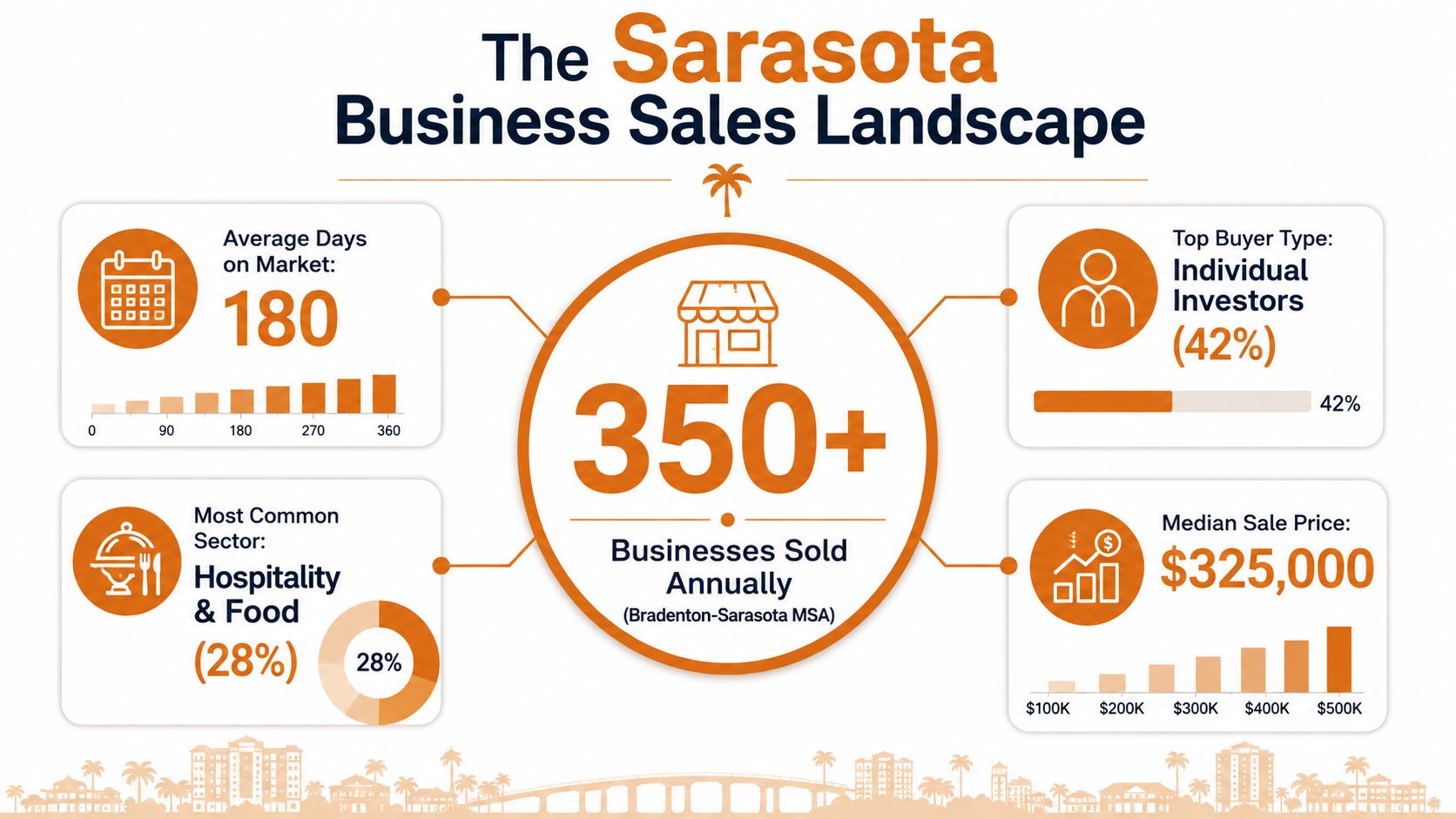
There are 27.2K employer businesses and 284K people employed in the Sarasota–Bradenton market, with about 679 businesses sold per year and roughly 136 broker-assisted deals annually (Sarasota-Bradenton market snapshot). That’s not a sleepy list-and-wait market. It’s a real transaction ecosystem, and if you’re thinking about a business for sale in Sarasota, the hard question isn’t “What can I ask?” It’s “What will a lender, buyer, and underwriter accept?”
Owners usually get tripped up by the same mistake, they anchor on asking price and ignore financeability. A listing can look strong on a marketplace page and still fail because the cash flow isn’t documented well enough for SBA-backed lending, the lease is weak, or the owner’s role is too central. In Sarasota, where succession pressure is real and buyer interest is active, that gap kills deals.
Sarasota is not a thin market where deals happen only when one lucky buyer appears. The local base is large enough, with 27.2K employer businesses and 284K people employed in 2023, that ownership changes hands often enough to support brokers, lenders, and advisors who work this process every day (market snapshot). That matters because active deal flow changes buyer behavior. Buyers compare more options, and sellers get measured against real transaction patterns, not wishful pricing.
The same snapshot estimates about 679 businesses sold per year, with roughly 20% broker-assisted, which works out to about 136 broker-assisted deals annually (market snapshot). That level of activity gives the market a clear baseline for what a financeable deal looks like. It also exposes weak files fast. Brokers, lenders, and buyers see enough listings to spot sloppy records, shaky lease terms, and prices that do not match the cash flow.
The biggest mistake is timing. Owners assume they can decide to sell, call a broker, and be ready in a few weeks. They cannot, not if they want financing to clear and diligence to move without drama.
Practical rule: if your financials, lease, and owner compensation story are not clean, the market will discount your business before the first serious offer arrives.
The local seller profile reinforces that urgency. In a 2025 Sarasota business-sales summary, 50% of sellers were Baby Boomers and 38% were selling because of retirement (2025 Sarasota market data). That points to real supply pressure. More owners are reaching exit age, and buyers have more comparable opportunities to choose from.
The transaction rhythm also changes how you should think about timing. If you wait until you are exhausted, then start preparing, you are not selling from strength. You are selling under pressure, and buyers can see that immediately.
Most owners start by scrolling marketplace listings and comparing asking prices. That’s a mistake if you treat the number as the answer instead of the opening position. A listing is only a starting point, and in Sarasota the question is whether the file behind that listing can support a lender’s review.
A business listing should tell you whether the asking price has a cash flow story behind it. If it doesn’t show how earnings were normalized, how the lease supports the operation, or whether the business can survive a bank’s underwriting standards, the asking price is mostly marketing. Buyers who need SBA-backed financing can’t close on marketing language.
The dominant marketplace pages in Sarasota often showcase inventory, but they rarely make financeability obvious. That gap matters because buyers need more than a catchy description. They need a business that can survive debt service, support an equity injection, and stand up to documentation requests. Independent SBA and lender guidance published in the last year emphasizes cash flow, borrower experience, and source-of-funds documentation, and those are exactly the items many listings leave vague. I’d rather see a slightly lower asking price with clean support than a flashy price nobody can finance.
Brokered deals tend to be more disciplined than owner-posted ads because a decent broker knows buyers will ask harder questions. Still, even broker listings can overstate what the business is worth if the cash flow file is thin. The difference isn’t just presentation, it’s whether the seller has done the work to make the business lendable.
Buyer filter: if a seller can’t show lender-ready records, the listing is not “priced high,” it’s unfinished.
A practical way to evaluate any business for sale in Sarasota is to separate three things. First, the asking price. Second, the documented cash flow. Third, the financing path. If those three don’t line up, the deal is fragile no matter how good the photo gallery looks.
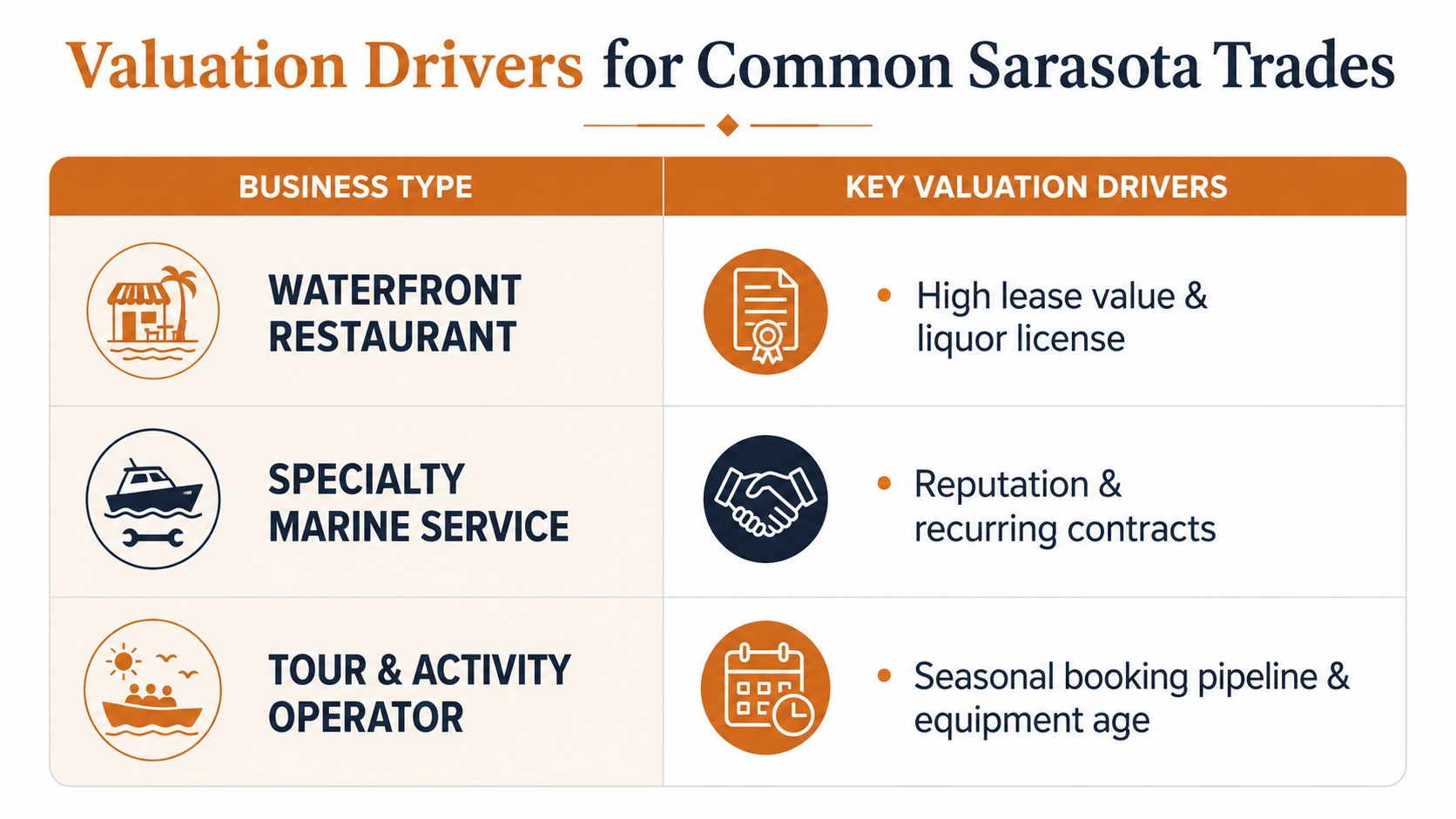
Some Sarasota businesses sell on earnings quality, others sell on contracts, and some sell on location and license value. That difference matters more than owners want to admit. A restaurant, a marine service shop, and a tour operator can all look busy, but buyers don’t underwrite them the same way.
Recurring revenue and transferability drive value. A service business with maintenance agreements or repeat contracts is easier to price because the buyer can see continuity. A project-based operation can still sell well, but the buyer will discount the uncertainty. They’re not buying last month’s sales, they’re buying the probability of future cash flow.
The smart move is to estimate value around what a buyer can prove, not what the owner hopes to get. For service-heavy businesses, that means contract visibility, customer retention, and owner independence. For seasonal or project-based businesses, it means pipeline quality, booking visibility, and how much of the work depends on the owner’s relationships.
| Business type | What buyers care about most | What usually hurts value |
|---|---|---|
| Waterfront restaurant | Lease value, location quality, and transferable licenses | Weak lease terms, inconsistent books, owner-heavy operations |
| Specialty marine service | Reputation and recurring contracts | No documented service history, customer concentration |
| Tour and activity operator | Seasonal booking pipeline and equipment age | Outdated gear, unpredictable bookings, weak process documentation |
The hard lesson is this. Generic multiples are a starting point, not a valuation. If you apply a national rule of thumb to a Sarasota owner-operated company without adjusting for dependency, contract quality, and local buyer demand, you’ll miss the mark.
For owners who want a cleaner framework, the concept of seller discretionary earnings is worth understanding, and this guide from The Owner’s Shortlist on SDE is a useful plain-language reference.
Buyers in Sarasota know they have options. That gives them room to compare your business against others with cleaner systems or stronger customer retention. If your books don’t show durable earnings, your valuation will be pulled toward the lower end of the buyer’s comfort zone.
In the trades, reputation helps, but reputation alone doesn’t close a sale. A buyer wants evidence they can step in and keep money moving. That means documented processes, stable staff, and enough customer stickiness to survive the transition.
In Sarasota-sized transactions, the buyer pool is not abstract. You are usually dealing with an individual operator, a financial buyer, or a buyer using SBA-backed debt to stitch the deal together. The mix matters because financing quality decides which inquiries become offers and which offers become closings.
As noted earlier in the 2025 market summary, deals in Sarasota with asking prices between $500,000 and $1 million drew multiple offers, most transactions were reported as cash at close including SBA-financed deals, and a meaningful share used seller financing. That pattern tells you two things. Buyers are active. Deal structure decides whether the headline number is real or just a number on a listing.
| Metric | Value | Implication for Sellers |
|---|---|---|
| Average offers on $500K to $1M deals | 2.3 | Good listings can attract multiple buyers |
| Cash at close, including SBA-financed deals | 81% | Financing structure still matters even when the sale looks like cash |
| Seller financing used | 14% | Some buyers need seller support to bridge the gap |
The gap that matters is between asking price and lender-ready cash flow. A listing can look strong on paper and still fail underwriting if the earnings do not support debt service, the books are messy, or the owner still sits at the center of the operation. That is why sellers in Sarasota should stop talking about price first and start with financeability first. Price gets attention. Bankable cash flow gets deals closed.
A strategic buyer pays for fit, synergy, and the value they can add after closing. A financial buyer pays for cash flow, stability, and transition risk they can live with. Those are different underwriting minds, and you need to address them differently from the first conversation.
For a clear comparison, see this guide on strategic buyers versus financial buyers. It is a useful filter for deciding who is likely to close and what terms they will fight over.
The biggest mistake is treating every inquiry like a real buyer. It is not. Serious buyers show up with financing pre-approval, a clear acquisition thesis, and enough capital to satisfy lender expectations. Casual browsers want information. Real buyers want to know whether the deal can survive diligence.
A seller note can help bridge a gap, but only when the business is already strong enough to support it. Use it to strengthen a good file. Do not use it to rescue a weak one. If the earnings are thin, the transition is shaky, or the records do not hold up, seller financing just pushes a bad deal a little farther down the road.
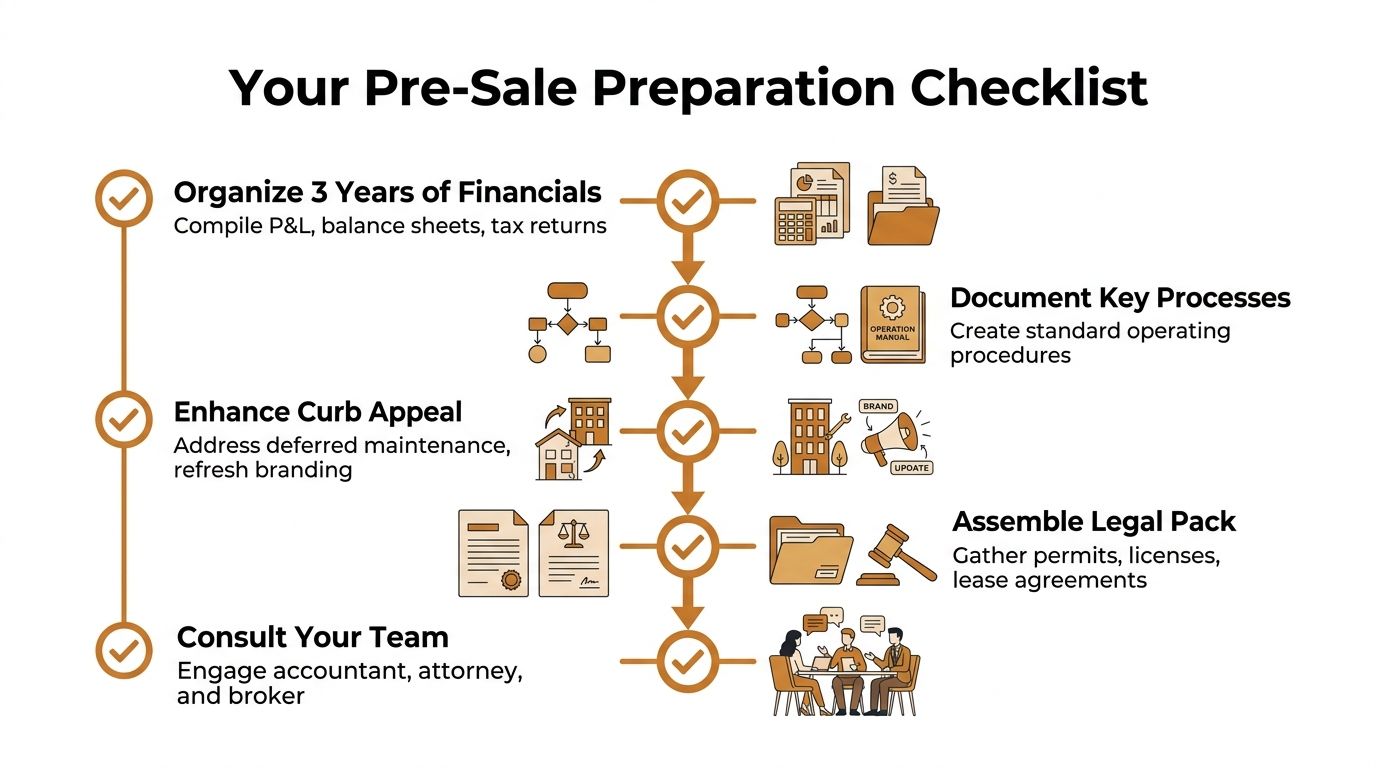
Preparation is where most Sarasota sellers win or lose real money. Not because the business is bad, but because the file is messy, the ownership role is too personal, or the tax and legal issues weren’t cleaned up early enough. You can’t fix that after a buyer is already under NDA and asking hard questions.
The first file set is financial. Three years of organized financials, a current balance sheet, and clean add-backs are not optional if you want a credible asking price. If the books don’t support the story, the buyer’s accountant will pull the number apart fast.
The second file set is legal. Entity records, licenses, lease terms, liens, and tax compliance all have to be clean before you go to market. A weak lease or unresolved tax issue can turn a promising deal into a stalled one. I’ve seen more closings die from paperwork than from price.
Buyers pay for transferability. If the owner is still handling every key relationship, the business is not really for sale yet. Document the operating rhythm, identify the manager or shift lead who can keep things moving, and reduce the owner’s daily footprint as early as possible.
Practical rule: if a buyer can’t see how the business runs without you, they’ll price in risk instead of paying for momentum.
The published checklist at Hallmark Business Brokers says the most successful sales are usually built over 6 to 18 months of preparation, with the strongest files showing assessment first, then cleanup, then go-to-market readiness (Hallmark checklist). That timeline matches what I see on the ground. Owners who rush the process usually pay for it in lower offers and slower diligence.
Owners lose money when they wait until a buyer appears to bring in help. By then, the advantage has shifted, and the weak spots are already visible. The right move is to build the advisory team before the listing goes live, not after a buyer starts poking holes in the file.
A valuation specialist helps you defend the number. A tax advisor helps you think about what you keep after the sale. An attorney who knows business transfers helps you avoid contract mistakes that can delay closing. A broker can bring buyer traffic, but a single broker shouldn’t be your only source of judgment.
The fear is usually cost. That fear is backward. The expensive mistake is not paying for guidance, it’s accepting a deal structure that leaks value because nobody reviewed the tax, legal, and financing angles early enough.
For owners who want a curated starting point rather than a random list of search results, The Owner’s Shortlist advisors directory is one place to find vetted professionals connected to business-sale decisions. It’s a directory, not a substitute for judgment, but it can save time when you’re trying to identify the right category of help.
Ask whether they’ve handled owner-operated businesses, not just corporate transactions. Ask how they approach lender-ready cash flow, not just annual tax filings. Ask how they coordinate with the broker, because the best advisors don’t compete with each other, they keep the file moving in the same direction.
The biggest tell is simple. Good advisors ask what can derail the closing, not just what the asking price should be. That’s the mindset you want on your side.
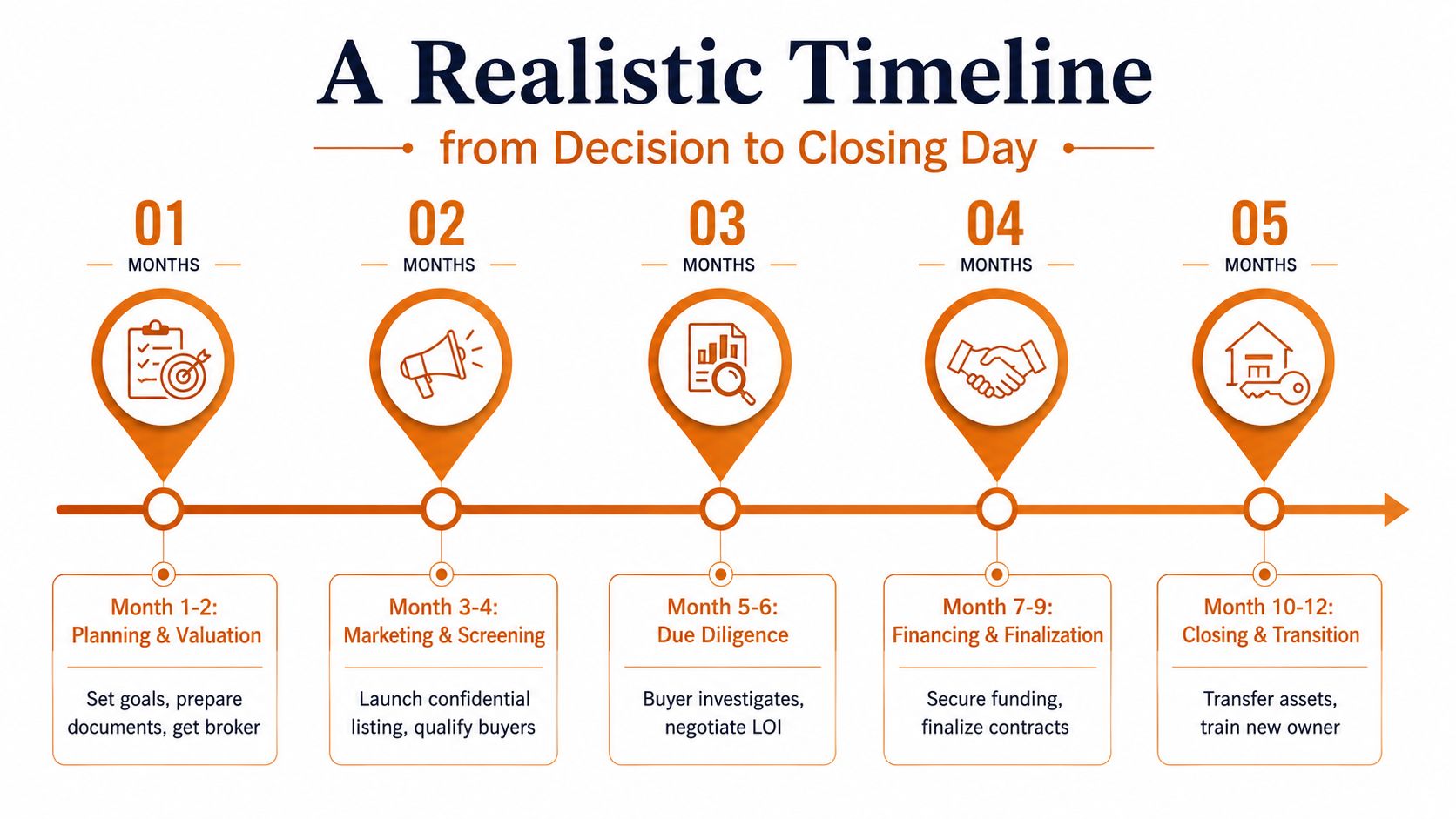
A clean Sarasota exit usually unfolds in phases, not leaps. If the business is well prepared, the process can move steadily. If it isn’t, every phase drags because the buyer keeps waiting on missing documents, corrected numbers, or resolved legal issues.
In the early stage, the owner sets goals, gets a valuation, and organizes the records that will later be handed to buyers and lenders. The business either becomes market-ready or stays stuck in “almost ready” limbo. The mistake is listing before this work is done, then trying to solve problems in real time.
From there, marketing and buyer screening begin. Serious buyers sign confidentiality agreements, ask direct questions, and want proof that the business can support financing. Weak prospects fall away quickly. That’s healthy. A bad buyer wastes more time than no buyer at all.
Once an offer is accepted, the buyer’s lender, attorney, and accountant start checking the file line by line. If the financials are clean and the lease is assignable, this stage moves. If not, the deal slows down. Title issues, customer concentration, and unverified add-backs all create friction that the buyer can use to renegotiate or walk away.
Bottom line: a faster closing comes from a cleaner business, not from pushing harder.
A realistic well-prepared timeline often looks like this. Planning and valuation first. Then marketing and screening. Then due diligence. Then financing and final contracts. Then closing and transition. That sequence is why owners should start earlier than they think, especially if their business depends on personal relationships or seasonal revenue patterns.
If you’re weighing a business for sale in Sarasota, don’t start with the asking price alone. Start with financeability, documentation, and the deal structure that can reach closing. Visit The Owner’s Shortlist to compare vetted specialists, learn how value is really determined, and get practical help before you put your business on the market.
Tell us your situation. We'll connect you with a specialist who works with owners like you. One conversation, no sales pressure.
Found this useful?
Add The Owner's Shortlist as a preferred source and get our articles highlighted in Google Search results.
Add to Preferred SourcesLearn what reps & warranties mean in M&A deals, why they matter, and how to negotiate them effectively. A clear guide for business owners.
September 27, 2026
Your business's sale price and your retirement number are two different figures. Here's how to build the second one before you rely on the first.
September 21, 2026
Ten straight questions to work through before you set a retirement date, with a short answer to each and where to go deeper on your own time.
September 21, 2026
Being financially ready to sell and having a plan for your time are two different things. Here's why the second one catches so many owners by surprise.
September 21, 2026