How to Sell a Pest Control Business in 2026
How to sell a pest control business: normalize earnings, prove recurring routes, pick one broker, and negotiate financing, earnouts, and a quiet close.
October 30, 2026
By Remi Taffin · October 31, 2026
You’ve built the crews, the name, and the backlog over 20 years, and now a competitor or an acquisition platform is asking if you’d talk. You’re not burned out enough to walk away cheaply, but you’re tired of being the estimator, the production manager, and the person every insurer and angry homeowner calls. If you’re thinking, “I want to sell my roofing business, but only on numbers a buyer will believe,” timing alone won’t carry you. Durable earnings, clean job files, and a team that runs without you decide what you keep.
Most owners underestimate the gap between deciding to sell and cash in hand. From first clean-up to closing, 9 to 18 months is a realistic planning window. Rushing it usually means the buyer does the clean-up work in diligence and charges you for it through a lower price, a holdback, or tougher terms.
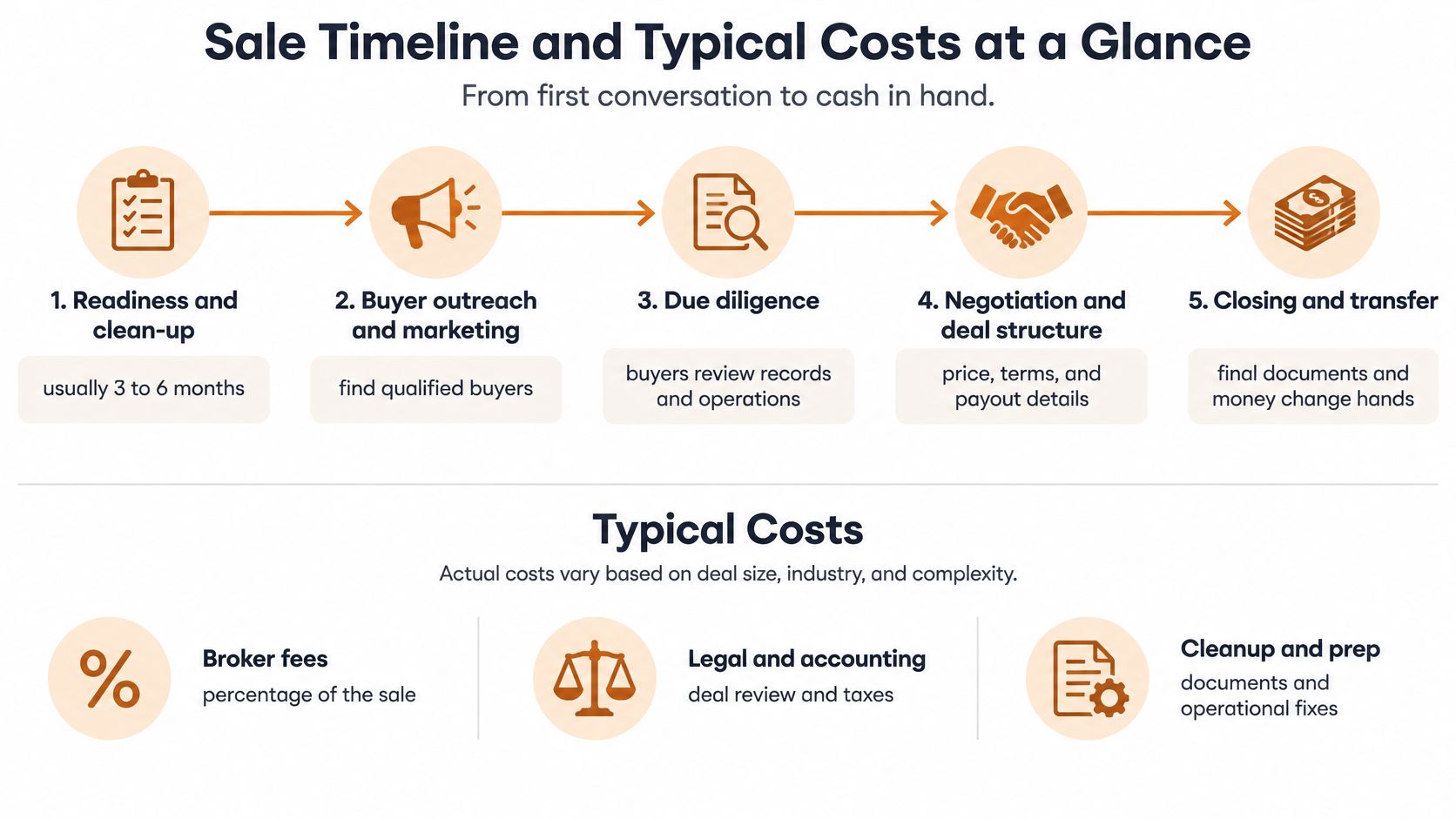
Readiness comes first because it’s where value is either proved or lost. You reconcile three years of financials, close aged jobs, tidy permits and warranty files, and move key relationships off your shoulders. Valuation and adviser selection follow, when you get a written range and interview one or two brokers rather than accepting the first confident pitch.
Confidential marketing is quieter and slower than owners expect. Buyers sign NDAs, review a short summary, then submit indications of interest before anyone sees customer names or pricing. At the letter of intent stage, price gets attention, but working capital, exclusivity, and deal structure matter just as much because they control how much of that price you receive and when.
Due diligence is where most deals stall. Buyers verify contracts, backlog, insurance, warranties, licenses, and whether profit turned into cash. Closing is shorter if diligence was clean, because the documents mostly record what was already agreed. For a broader view of pacing, see how long it typically takes to sell a business.
Market context helps explain buyer urgency, but it doesn’t replace preparation. The 2024 roofing industry report from DavCap Advisors estimated approximately 79,139 roofing businesses and found roofing merger-and-acquisition activity increased 116.7% over the six years through 2023. Fragmentation gives buyers choice, so a documented company stands out.
| Phase | Typical duration | What it costs you |
|---|---|---|
| Readiness and clean-up | 3 to 6 months | Accountant, bookkeeper and attorney fees; quoted hourly or as a fixed clean-up project |
| Valuation and adviser selection | 2 to 6 weeks | Formal valuation fee if ordered; billed separately from any broker fee |
| Confidential marketing and buyer talks | 3 to 6 months | Broker success fee, usually a percentage of price paid at closing; set in the written engagement |
| Letter of intent and exclusivity | 3 to 6 weeks | Tax and attorney review fees; paid by you whether or not you sign |
| Due diligence | 30 to 90 days | Document preparation time and accountant support; mostly staff time plus adviser hours |
| Closing | 2 to 4 weeks | Legal closing costs and transaction expenses; deducted or paid at closing |
Do this week: pull three years of tax returns and list every open job with its contract value, costs to date, and estimated cost to complete.
A buyer doesn’t value last year’s revenue. They value normalized earnings, which means the profit they expect to keep after you leave, after paying a manager to replace you, and after removing one-off events. Build your own range before any broker gives you a number, so you can test their reasoning.
Construction diligence focuses heavily on whether that profit becomes cash, including work in progress, retainage, deposits, and warranty reserves, as Lyndon Advisory’s construction M&A guidance explains. That is why unbilled revenue and aged receivables can cut a valuation even when the income statement looks strong.
Build low, mid, and high cases by changing only the multiple and the storm normalization. Write the reason for each assumption next to the number.
Say a residential roofer has its best year during a hail season, with two quieter years before it. If you value only the hail year, you’re asking a buyer to pay for weather. If you average the three adjusted years and remove the surge, the range drops, but it’s a range you can defend in diligence.
A formal valuation from an accountant or appraiser is optional and billed separately. I would ask for the method, the add-back schedule, and the storm adjustment in writing, not just a final figure. That method becomes your negotiating tool when a buyer tries to normalize more aggressively than the records support.
Owner dependence moves price first. If customers call your cell phone, crews wait for your instructions, and only you can price a commercial reroof, the buyer isn’t buying a system. They’re buying transition risk, and they’ll protect themselves with a lower multiple, a seller note, or an earnout tied to you staying.
Cost volatility makes the next test harder. In a 2025 roofing-industry survey reported by Roofing Contractor, 64% of contractors viewed higher material prices as their top risk, 58% cited labor shortages, and 53% cited labor and overhead costs. Buyers know margins on older bids can look better than margins you can earn at current material and labor costs, so they’ll compare backlog pricing against today’s replacement costs.
Insurance scrutiny adds another filter. When carriers demand more roof-condition documentation and higher deductibles, claim-funded revenue can slow or shrink, even if your crews did nothing wrong. Buyers therefore favor maintenance agreements, repeat commercial accounts, and retail replacement work that doesn’t depend on one carrier’s decision.
| Value driver | What buyers check | How to improve it |
|---|---|---|
| Owner dependence | Whether customers and crews rely on you or on managers | Move estimating and key accounts to a manager for at least 12 months |
| Repeat and maintenance revenue | Share of revenue from maintenance plans and repeat commercial clients | Sell maintenance agreements and track repeat-customer share |
| Customer concentration | Share of revenue from the largest clients or one general contractor | Reduce dependence on any single client; buyers watch the top five closely |
| Earnings quality | Whether reported profit turns into cash after normalizing adjustments | Document owner pay, personal expenses and one-time costs in a schedule |
| Backlog and work in progress | Signed contracts, gross margin by project and cost to complete | Close aged jobs and report margin for each backlog project |
| Warranty and insurance exposure | Warranty reserves, callback history and insurance claim patterns | Log every warranty claim and reserve for known callbacks |
| Crew and subcontractor stability | Licenses, certifications, worker classification and turnover | Keep current certificates and written subcontract agreements on file |
The practical test is a line-by-line bridge from reported profit to sustainable profit. Put the item that moves price most at the top, usually replacing you, then storm normalization, then margin pressure on open work. If you build that bridge before marketing, you negotiate from evidence. If the buyer builds it in diligence, you negotiate against their assumptions.
Start with four plain questions. Can the business run for two weeks without you? Would the top customers stay if your name left the trucks? Do crews and subcontractors hold current licenses and insurance? Have the books closed monthly, consistently, for three years? A no on any one doesn’t kill a sale, but it tells you where a buyer will discount.
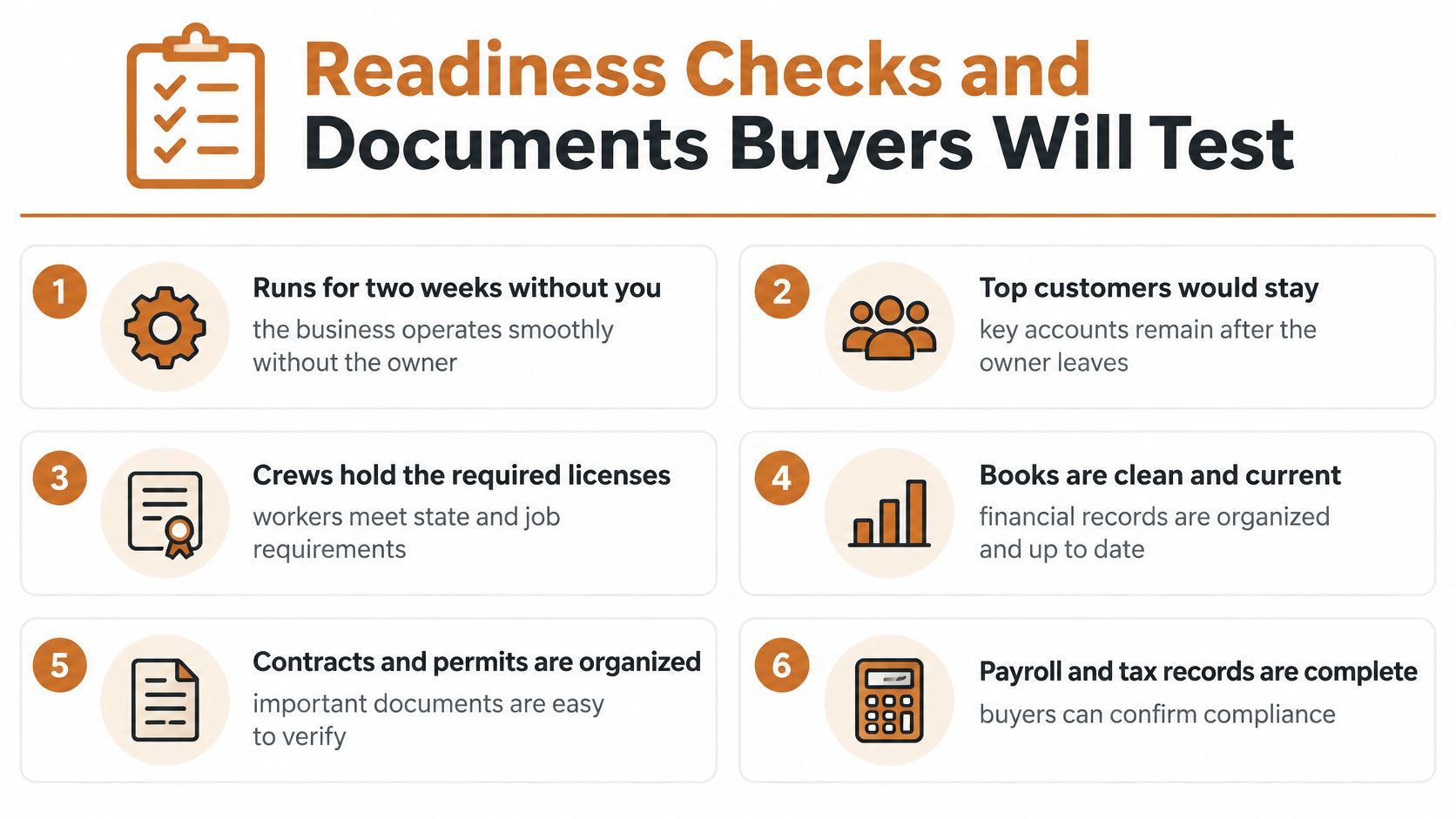
A Roofing Contractor guide to selling a roofing company notes that buyers may review supplier agreements, insurance policies, human-resource policies, corporate records, and other nonfinancial documents, not just financial statements. Missing paperwork becomes a price issue because the buyer prices the unknown.
Mark each gap as fixable within 90 days or as a price risk. Expired certificates, unsigned subcontractor agreements, and unlogged warranties are usually fixable. Heavy customer concentration and no second-in-command are not quick fixes.
Practical rule: a smaller, well-documented roofer can be more saleable than a larger, opaque one, because transparency reduces the buyer’s need to demand a big escrow or a steep discount.
I would spend the first 90 days on open-job reconciliation and warranty logging. Those two files answer the buyer’s two sharpest questions, namely what work remains and what liabilities follow the work already done.
You have three workable routes, and the right one depends on how much process you want to run yourself. A business broker runs a confidential search, screens buyers for funding and fit, manages NDAs, and usually charges a success fee calculated as a percentage of the sale price. That structure aligns payment with closing, but you still need to know what’s included, how long the engagement lasts, and whether you owe anything if you find the buyer yourself.
A private search through a strategic buyer, a regional platform, or a competitor you know can avoid a broker fee. It can also narrow your options to one buyer’s view of value. If that buyer stalls during exclusivity, you’ve lost months and shared sensitive information. Private doesn’t mean informal. You still verify proof of funds, you still use an NDA before sharing financials, and you still keep your attorney involved before signing a letter of intent.
Consolidation has widened the buyer pool beyond local succession. The DAK Group 2024 building-services M&A review counted 459 transactions, up 15.6% from 2023, while total disclosed deal value rose 30% to approximately $10 billion. More buyer types can help price, but only if someone manages the process so you’re comparing structures, not just headline offers.
A matching service is the third route. The Owner’s Shortlist is a free service that introduces owners to one specialist whose past deals fit their industry and size, which can save the time of interviewing several brokers cold. It’s not a broker and doesn’t sell businesses. That distinction matters, because the specialist runs your sale while the introduction helps you start with relevant experience instead of a generalist pitch.
Before choosing any route, read up on how business broker fees work in Florida so fee language in an engagement letter doesn’t surprise you. Then ask every adviser the same questions and compare answers side by side.
I would not sign with anyone who can’t name the buyer types they’d approach first and why those buyers would care about your mix of work. Roofing knowledge shows up in small details, such as how they treat storm revenue, warranty reserves, and subcontractor classification. If they wave those away, keep interviewing.
The headline price is not what you keep. Two offers at the same price can leave you with very different after-tax cash, paid on very different schedules, with very different risk if the buyer stumbles. Structure is where quiet money is won or lost.

The IRS guide on the sale of a business treats a lump-sum trade-or-business sale as the sale of individual assets, with consideration allocated under the residual method across cash, inventory, equipment, real property, and goodwill or other intangible assets. Buyer and seller generally report the agreed allocation on Form 8594, and gains on inventory, depreciable equipment, and goodwill may receive different treatment. An allocation that helps the buyer’s depreciation can raise your tax bill unless the price compensates you.
| Structure | How you get paid | Main risk to you | What to negotiate |
|---|---|---|---|
| All cash at closing | Full price at closing | Buyer funding shortfall or delayed financing | Proof of funds and a firm closing date |
| Seller-financed note | Scheduled payments over several years | Buyer default and slow collection | Personal guarantee, security interest and payment schedule |
| Earnout | Part of the price after post-closing results | Metrics you cannot control | Clear metric definitions, accounting method and access to records |
| Equity rollover | Retained stake in the buyer | Value depends on the buyer’s later exit | Governance rights, exit timing and tag-along terms |
| Asset sale or equity sale | Tax treatment differs by asset class | Allocation favors the buyer’s tax position | Model each allocation with tax counsel before the letter of intent |
Model at least three scenarios before you negotiate hard on price: an asset sale, an equity sale where legally and commercially feasible, and an installment structure with seller financing. For each one, calculate taxes, debt payoff, transaction expenses, escrow or holdback exposure, and the timing of cash receipts. If payments arrive over time, the installment method requires allocating the selling price and payments among asset classes rather than automatically deferring all gain.
Three traps deserve special attention. Don’t accept an allocation before pricing your own tax cost. Don’t ignore uncollectible receivables or open warranty obligations that can reduce working capital at closing. Don’t accept an earnout based on revenue or profit the buyer controls through pricing, overhead allocations, or lead assignments after you’re gone.
Have tax counsel and a transaction attorney review the letter of intent before exclusivity, because allocation, indemnities, working-capital adjustments, and earnout definitions can change realized proceeds more than a modest change in purchase price.
If your buyer, property, or family ownership sits across state lines, get local counsel involved early as well. For example, owners with California ties can review resources on ownership transitions for Northern California businesses from Brillant Law Firm alongside advice from their own transaction team. None of this is tax or legal advice. It’s a warning to price the structure, not just the number at the top of the offer.
Confidentiality protects value. Buyers sign NDAs before they see names, customer lists, or pricing, and your data room should be limited to named individuals with a reason to be there. Use a code name in early materials and keep sale documents off shared drives that the whole office can open.
Employees are part of what the buyer is purchasing, especially foremen, estimators, and the office manager who knows billing and permits. The guide on what happens to employees when you sell is useful for thinking through timing and communication before you’re under pressure to answer questions in the hallway.
After signing, customers need a short, calm letter. Name the new owner, confirm warranties carry over, explain who to call for scheduling, and state what won’t change. Don’t overpromise on behalf of the buyer, and don’t let customers learn the news from a supplier or a former employee.
Leaked news causes predictable damage. Estimators start taking recruiter calls, a property manager pauses a maintenance renewal, and the buyer sees turnover in diligence and lowers the price. I would tell fewer people, later, with a better plan, rather than reassuring everyone early with incomplete information.
Turn the sale into one 30-day decision. Week one: write your low, mid, and high value range, with the storm normalization and multiple assumption behind each case. Week two: list the five people your value depends on and decide who needs retention terms. Week three: finish the readiness file, starting with warranty logs, open-job margins, and gaps you can fix within 90 days. Week four: choose between a broker, a private buyer search, and a matching introduction using consistent interview questions.
When you’re ready to talk, you can call (321) 320-7239. Owners tell The Owner’s Shortlist their situation, and it connects them with the right specialist in one conversation. Owners contact specialists directly, with no forms to fill out and no middleman. The Owner’s Shortlist is paid the same no matter which specialist it introduces an owner to, its specialist list is Florida-based today, and it says so when there’s no good fit. It isn’t a broker and doesn’t sell businesses. Nothing here is legal, tax, or financial advice, so have your own advisers review any letter of intent before exclusivity begins.
If you’re weighing whether to sell my roofing business now or spend a year making the earnings easier for a buyer to trust, start with one conversation about your numbers, your crew, and your timing. The Owner’s Shortlist will introduce you to one specialist whose past deals fit a roofing company like yours, so you can contact that specialist directly and decide your next step without listing your business or interviewing a stack of generalists.
Who wrote this: The Owner's Shortlist is not a broker and doesn't sell businesses. We get paid the same no matter which specialist we introduce you to. More about how we work.
Tell us your situation. We'll connect you with a specialist who works with owners like you. One conversation, no sales pressure.
Found this useful?
Add The Owner's Shortlist as a preferred source and get our articles highlighted in Google Search results.
Add to Preferred SourcesHow to sell a pest control business: normalize earnings, prove recurring routes, pick one broker, and negotiate financing, earnouts, and a quiet close.
October 30, 2026
Your electrical business is worth a multiple of its earnings, set by your crew, your license, and how much repeat work you have. Here's how buyers judge it.
October 29, 2026
Enterprise vs equity value in plain numbers: what a 5x EBITDA offer means after debt, cash, and closing adjustments for a trade business.
October 29, 2026
Small manufacturers sell for about 2.75 to 3 times owner earnings. Bigger ones sell for 6 to 9 times EBITDA. Here's what sets your number and how to check it.
October 29, 2026