Selling a Business Valuation: What Your Number Means
Selling a business valuation explained for owners: the methods buyers use, the earnings they price, and how to get a number you can defend.
November 4, 2026
By Remi Taffin · November 2, 2026 · Updated November 3, 2026

You’re still answering service calls, approving payroll, and handling the customers who insist on speaking to you. Meanwhile, you’re wondering whether it’s time to sell, and whether the business would keep running if you weren’t there.
Searching “sell my security company” often turns up valuation multiples before it answers the more important question: what, exactly, can a buyer take over? Your business model, the reliability of its earnings, and the work you still do personally will shape both the price and the terms.
Preparation starts before buyer outreach. Use the timeline below as a sequence of readiness gates, not a promise about how many months your sale will take. Move forward when the output is usable, rather than because a calendar date has arrived.
| Phase | Typical timing | Main job | Output |
|---|---|---|---|
| Normalize financials | Before valuation and outreach | Build a history of adjusted earnings | Adjusted EBITDA schedule |
| Reduce owner dependence | Begin during financial preparation | Move sales and dispatch to managers | Documented roles and customer contracts |
| Value the business | Once earnings and revenue mix are clear | Set a realistic value range | Written valuation summary |
| Choose a broker | Before approaching buyers | Vet candidates and review an engagement | Signed broker agreement |
| Prepare confidential materials | Before qualified buyers receive details | Build the memorandum and data room | Memorandum and secure data room |
| Market and negotiate | After materials and buyer screening are ready | Qualify buyers, compare offers, negotiate a letter of intent | Signed letter of intent |
| Diligence and closing | After the letter of intent, subject to agreed conditions | Answer requests and finalize terms | Closed sale |
An active acquisition market doesn’t remove these steps. Security Sales & Integration’s review of security-industry transactions identifies recurring monitoring revenue, retention, geographic density, installation capabilities, and owner dependence as relevant considerations beyond annual sales.
A buyer needs evidence that those strengths will survive the handover. If customers call your personal phone, only you know their pricing, and renewal dates live in your memory, the buyer has to investigate whether they’re acquiring a company or your continuing involvement.
Start with your largest customer accounts. Can someone other than you retrieve each signed agreement, renewal date, cancellation provision, and service obligation promptly? If not, organizing those records comes before polishing a sales presentation.
For the legal sequence, Coto & Waddington, Attorneys at Law offers a resource on navigating a business acquisition. Our guide to how long it takes to sell a business can also help you separate preparation from the transaction itself.
Practical rule: Work backward from a transferable operation, not forward from a hoped-for retirement date.
Copy the timeline into your working sale plan. Mark what’s underway, what’s complete, and the earliest unfinished phase that could hold everything else up.
Pricing the company as a generic security business is an expensive starting mistake. A guard-services buyer is evaluating a different operation from a buyer acquiring monitoring accounts or cybersecurity software.
Use this comparison to identify what you’re offering.
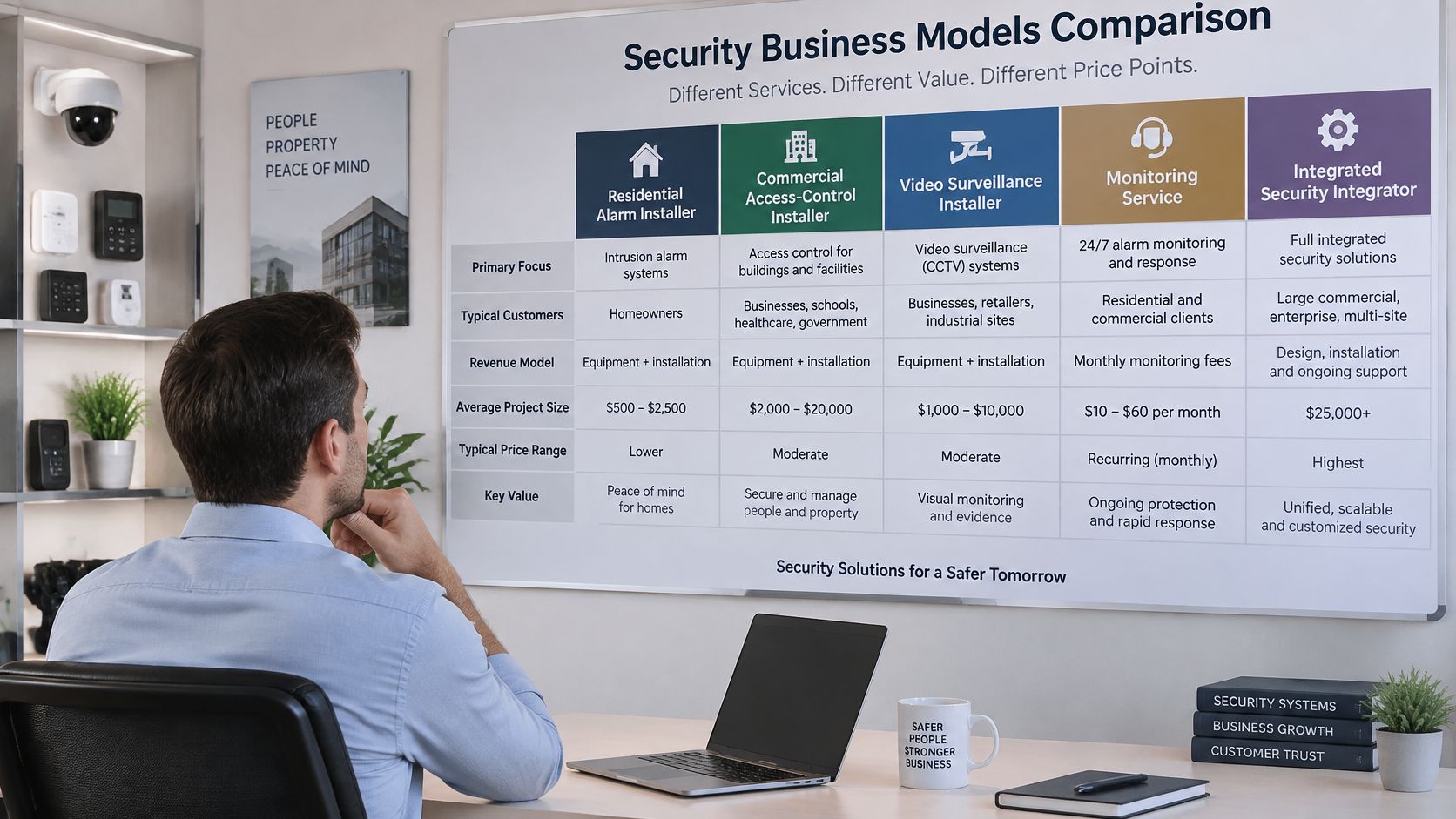
| Business model | Core value driver | Likely buyer pool | Diligence focus |
|---|---|---|---|
| Residential alarm installer | Installation volume plus monitoring accounts | Regional installers and monitoring platforms | Monitoring contract transferability and licenses |
| Commercial access-control integrator | Project backlog and service agreements | Strategic integrators and private-equity platforms | Service agreement terms, certifications, and backlog quality |
| Contract guard services | Contracted sites and labor efficiency | Consolidators and guard companies | Workers’ compensation, overtime, licensing, and client concentration |
| Monitoring company | Recurring monthly revenue and attrition | Monitoring platforms and private-equity add-ons | Attrition rates, contract terms, and operator capacity |
| Cybersecurity or managed security | Software or recurring service revenue | Strategic and financial buyers | Recurring revenue mix, security controls, and retention |
A mixed business needs separate schedules, not a convenient label. An access-control installer might have profitable service agreements, occasional equipment projects, and monitoring accounts, each with different delivery costs and renewal risks.
Distinguish signed backlog from proposals you expect to win. Separate contracted maintenance from repeat customers who haven’t committed to another purchase. Identify whether software belongs to your company or is a third-party product you resell.
Axia Growth’s security-services guidance emphasizes separating business models and evaluating transferable cash flow rather than revenue scale alone. That distinction matters when an owner assumes a technology-related service deserves software-company pricing.
The video below offers another format for considering the sale process.
The diagnostic isn’t whether your company sounds attractive. It’s whether you can describe its economics without blending unlike activities together.
Write down your answers:
Those answers help you identify an appropriate buyer pool before anyone starts discussing a multiple.
Say two security businesses generate the same revenue. One depends on equipment installations that must be resold continually; the other has documented monitoring agreements and a team that handles renewals. Equal sales don’t mean equal earnings, risk, or value.
Start with earnings a buyer can verify. A multiple applied to unreliable accounts only produces a precise-looking guess.
An adjustment isn’t valid because you’d prefer the expense to disappear. If you handle estimating without taking a market salary, a buyer may need to reduce adjusted earnings to account for your replacement.
The reported benchmarks below describe different company profiles. They don’t establish an asking price, and the medium-sized and larger ranges belong to the contract-guarding comparison rather than every security business.
| Company profile | Reported multiple | How to use it |
|---|---|---|
| Smaller contract-guarding business | 4x to 5x EBITDA | Context for smaller guarding operations |
| Medium-sized contract-guarding company | 6x to 7x EBITDA | Compare operational scale and earnings quality |
| Larger contract-guarding company | 9x to 12x EBITDA | Don’t assume a smaller operator receives a scale premium |
| Security-solutions deals, 2023 average | 13x EV/EBITDA | Included larger, more scalable assets, not a direct small-company price |
| Security-solutions deals, five-year average | 11.8x EBITDA | Broad transaction context, not a model-specific quote |
The guarding ranges and 2023 average are reported in Axia Growth’s security-services guidance; Capstone Partners’ security M&A update reports the 11.8x EBITDA five-year security-solutions average through 2025. Use the table to challenge unsuitable comparisons, not to select the most flattering number.
To understand why methods produce different answers, Stewart Accounting Services explains how to compare business valuation methods. Our guide to valuing a service business provides additional context for owner-operated companies.
Our listed specialists work with owners on valuation, taxes, legal matters, deal structure, or family transfers. Before a broker conversation, prepare an initial adjusted-earnings schedule and flag every adjustment your accountant hasn’t verified.
A confident pitch isn’t evidence that a broker knows how to sell your company. Relevant transaction experience matters more than familiarity with general business-sale vocabulary.
Compare candidates on what they’ve sold, how they handled difficult negotiations, and who will manage your transaction. A broker who understands monitoring attrition may still need help evaluating a labor-heavy guarding operation.
Use this checklist to keep the interview grounded.
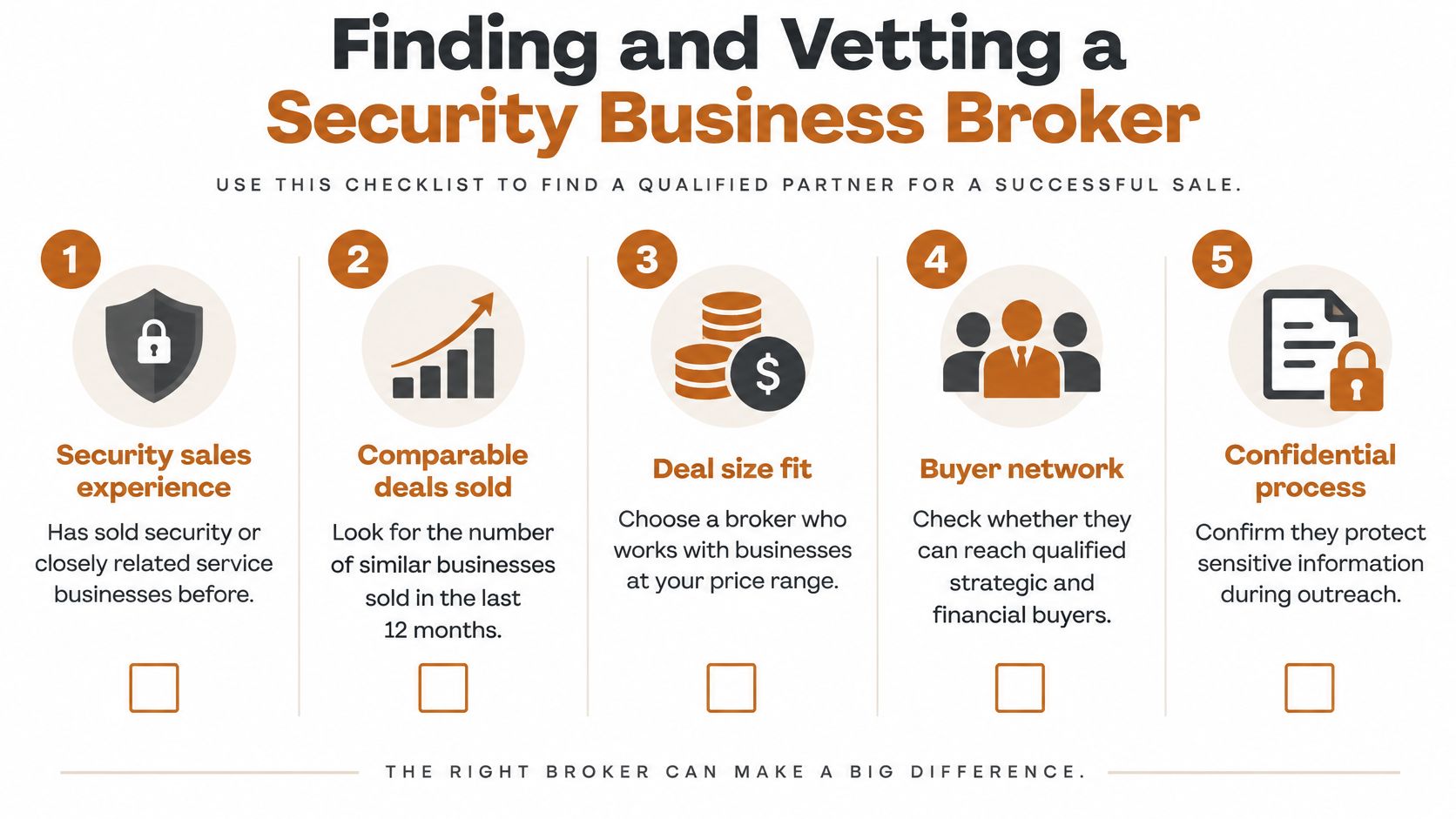
Speak with past clients about what happened after closing. Ask whether the broker explained contingent payments clearly, stayed involved when problems arose, and left the owner with realistic expectations. Our questions to ask a business broker can help you structure those conversations.
A direct search gives you control over the candidate pool, but you’ll need to verify experience and references yourself. A curated introduction can reduce that initial sorting work without replacing your own judgment.
The Owner’s Shortlist isn’t a broker and doesn’t sell businesses. We’re a curated network, and a person reviews your situation before introducing you to a specialist whose past work fits. Brokers are listed because they have a track record with businesses like yours.
Specialists pay to be listed, but only after a review of past deals and conversations with past clients. Owners pay nothing for an introduction and have no obligation afterward; our specialist network is Florida-based today, and we’ll say when there isn’t a fit.
Check credentials independently and have your attorney and tax adviser review any engagement. Before the first call, write a page describing your services, revenue mix, management team, daily responsibilities, location, and preferred outcome.
You don’t need employees, customers, or competitors learning about a possible sale before you’ve decided whether to proceed. Controlled disclosure is safer than sending financial statements to everyone who expresses interest.
Start with a confidential information memorandum that explains the operation, earnings, customers, and opportunity without distributing unnecessary sensitive detail. Prepare the underlying records separately so disclosure can become more detailed as buyers qualify.
Security Sales & Integration’s security M&A analysis provides context for strategic and financial buyer activity. For your transaction, the practical priority is identifying who can finance, legally operate, and integrate the business.
This visual summarizes the disclosure and offer-review sequence.
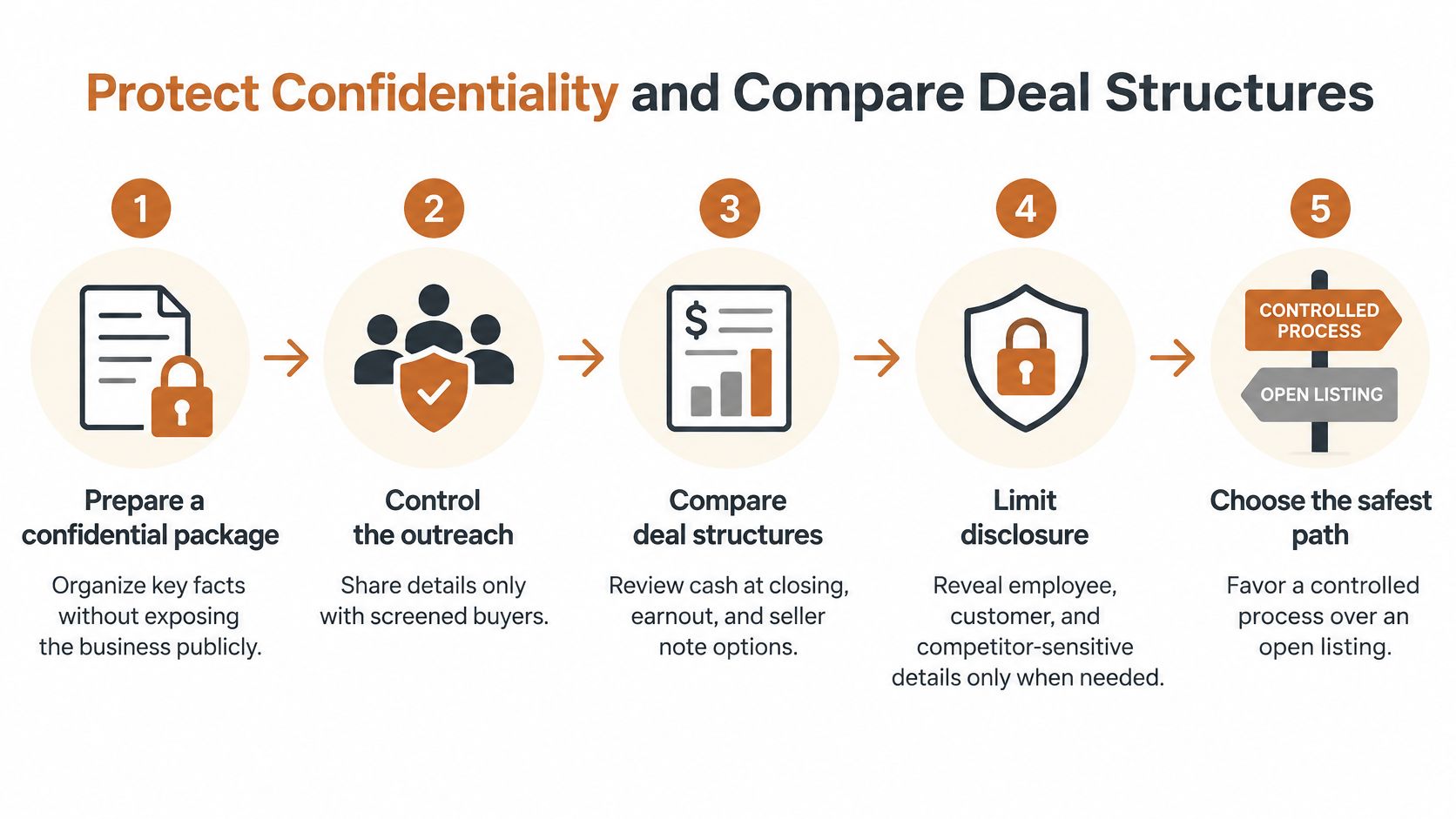
| Structure | What you receive | Main risk to check | Terms to model |
|---|---|---|---|
| All cash at close | Agreed consideration at closing, subject to adjustments | Financing failure or deductions from the headline price | Working-capital target and cash-free, debt-free definition |
| Seller financing | Part of the price paid over time | Buyer default and payment timing | Interest rate, term, security, and lender subordination |
| Earnout | Payment tied to post-close results | Buyer decisions affecting achievement | Metrics, measurement period, accounting rules, and remedies |
| Rollover equity | Ownership in the buyer’s platform | Illiquidity and uncertain future value | Equity percentage, governance, dilution, and exit rights |
| Escrow or indemnity holdback | Proceeds retained pending release conditions | Claims reducing the eventual payment | Release conditions, duration, indemnity cap, and insurance |
Have your advisers model a cash offer, a seller-financed offer, and an earnout or rollover proposal side by side. Show net cash at closing, scheduled later receipts, contingent amounts, and the outcome if performance disappoints.
For an earnout, define customer-retention measurement and accounting rules precisely. If the buyer changes pricing, moves accounts, cuts staff, or allocates new overhead, the agreement should explain how those decisions affect your payment.
For each offer, resolve working-capital targets, indemnity caps, escrow duration, and whether representations-and-warranties insurance is appropriate and available. Review post-close employment duties separately from the purchase price.
A higher offer isn’t necessarily a better offer if the buyer controls whether you receive the difference.
We publish plain-language guides explaining earnouts and seller financing. Use those resources to understand the vocabulary, then have your advisers stress-test the actual financing, payment protections, and license-transfer conditions.
The same headline price can leave you with different proceeds depending on how the transaction is built. Bring your tax adviser and transaction attorney into the discussion before signing a letter of intent, when the main structure is still negotiable.
Ask them to work from proposed terms rather than a verbal estimate of the price. Your entity type, tax basis, jurisdiction, contracts, and payment schedule all need attention.
Bring entity documents, ownership records, tax returns, major contracts, license details, debt agreements, and the proposed offer. HeyAtty’s guide to what to bring to business counsel can help you organize the consultation.
Ask your attorney to review the purchase agreement, disclosure schedules, restrictive covenants, indemnities, and employment terms together. A favorable purchase-price clause won’t necessarily offset a broad repayment obligation elsewhere.
Tax and legal outcomes are situation-specific. Treat these questions as a consultation agenda, not conclusions you can rely on without professional review.
Much of your negotiating position is established before the first buyer call. You’ll make better decisions if you know what you’re selling, what you can prove, and what you need from the transaction.
A clear plan also protects you from an offer that sounds generous but leaves too much of your retirement dependent on future payments.
Keep this plan short enough to use during an offer discussion. Your adviser should be able to distinguish a firm requirement from a preference without guessing.
For owners who want a single introduction, we review the situation by phone or short form and connect them with an appropriate specialist in one conversation, at no cost and with no obligation. The introduction is a starting point, not a substitute for independently evaluating the specialist.
Nothing in this guide or on our site is legal, tax, or financial advice. Speak with a specialist and your own advisers before making a decision.
This week, put the first three checklist items on paper. If an answer is missing, write down the document or person needed to resolve it.
Takeaway: Prepare a business someone else can operate, then negotiate what you’ll receive for handing it over.
If you’re considering selling your security company, The Owner’s Shortlist offers a no-cost introduction to a specialist whose experience fits your situation. Tell us what services you provide, where you operate, and how involved you are day to day, and we’ll assess whether our Florida-based network has an appropriate fit, with no obligation to proceed.
Who wrote this: The Owner's Shortlist is not a broker and doesn't sell businesses. We get paid the same no matter which specialist we introduce you to. More about how we work.
Tell us your situation. We'll connect you with a specialist who works with owners like you. One conversation, no sales pressure.
Found this useful?
Add The Owner's Shortlist as a preferred source and get our articles highlighted in Google Search results.
Add to Preferred SourcesSelling a business valuation explained for owners: the methods buyers use, the earnings they price, and how to get a number you can defend.
November 4, 2026
Your Florida pest control license and operator certificate don't transfer to a buyer. Here's how sales handle it, what buyers check, and what to do first.
October 30, 2026
Don't say yes, don't say no, and don't sign anything. Find out what the offer really pays, get a second opinion, then respond. Here's the order to do it in.
October 29, 2026
Most small trucking companies sell for about 3 times owner earnings. Here's how buyers price your trucks, your authority, and your customers, and how to start.
October 29, 2026