What Are the Best Alternatives to East Coast Advisory Team?
East Coast Advisory Team is a broker practice led by Mike Morris. Here are four alternatives, and the questions to ask before you pick any broker.
November 15, 2026
By Remi Taffin · November 17, 2026 · Updated November 20, 2026
Main street business brokers typically charge a success fee of 8% to 15% of the sale price, according to Iconic’s broker comparison, usually subject to a negotiated minimum and often with retainers or upfront charges added on top. The percentage is only the starting point. What you pay in the end can run tens of thousands of dollars higher once monthly fees, valuation charges and expense reimbursements appear in the same agreement.
Start with the arithmetic that surprises owners most. A 6% fee on a $2 million sale equals $120,000 before any separate charges. Owners tend to anchor near that 6% mark, according to the IBBA business owner research, which sits well below the range brokers typically quote on smaller deals. That gap between expectation and quote is where most of the confusion in this market lives.
So read any broker proposal as a bill. You want three things in writing: the total in dollars, the trigger that makes each charge payable, and the definition of the price the percentage applies to. Get those, and two proposals become comparable. Skip them, and you are comparing a headline to a mystery.
Start with what owners expect, because the gap between that number and a typical quote is where the confusion begins. In a 2023 national study of 500 U.S. main-street small-business owners, 53% expected broker costs to fall between 3% and 10% of the eventual sale price, 13% expected a flat fee, and 16% had no prior expectation at all, according to the IBBA business owner research. Across the full sample, the fee owners said they would accept averaged just 6%.
Actual proposals tend to land above that average. The dominant model is the success fee: a contingent percentage of the final sale price, paid when the deal closes. Around it sit four other charges that appear in some agreements and not in others, and those extras are what turn a rate into a bill.
The building blocks of a broker bill
| Fee type | How it is charged | Typical range | When it is paid |
|---|---|---|---|
| Success fee | Percentage of the final sale price | 8% to 15% on smaller main street deals | At closing |
| Tiered success fee | Declining percentage by price band | Lehman-style: 5% on the first $1M down to 1% above $4M | At closing |
| Upfront or valuation fee | Fixed engagement or valuation payment | Fixed amount set by the advisor, often credited against the closing fee | At engagement or valuation |
| Monthly retainer | Fixed charge each month | Added by some advisors, most often on smaller deals | Monthly, until the agreement ends |
| Minimum fee | Floor on the closing commission | A dollar floor negotiated per engagement | At closing, even if the price is lower |
Read that table the way you would read a menu. Most proposals pick two or three of these rows, and the combination matters far more than the headline rate. Say one broker quotes 8% plus a $2,000 monthly retainer, and a second quotes a flat 10% with nothing upfront. On a $500,000 sale, the first agreement costs $56,000 and the second costs $50,000, so the lower percentage produces the bigger check. The math only flips once the price clears roughly $800,000; above that line, the retainer deal starts to win.
Before you compare a single quote, write down which of those five fee types your advisor is proposing. Naming them is half the work of negotiating them, because a charge you can point to is a charge you can ask to have capped, credited or removed.
A success fee sounds simple: the broker gets paid when your business sells. Two decisions inside that sentence determine your real bill. The first is the percentage. The second is the number it gets applied to, and that second one is where proposals diverge.
The fee has to compensate for everything that happens before a close: buyer sourcing, confidentiality control, marketing, financial cleanup, negotiation, diligence coordination and closing management. On smaller deals, that workload is roughly the same as on larger ones, spread over a smaller sale price. Published guidance for Main Street sales quotes approximately 8% to 15% of the final sale price, commonly subject to a negotiated minimum, with the fee generally payable at closing, as Iconic’s broker comparison sets out.
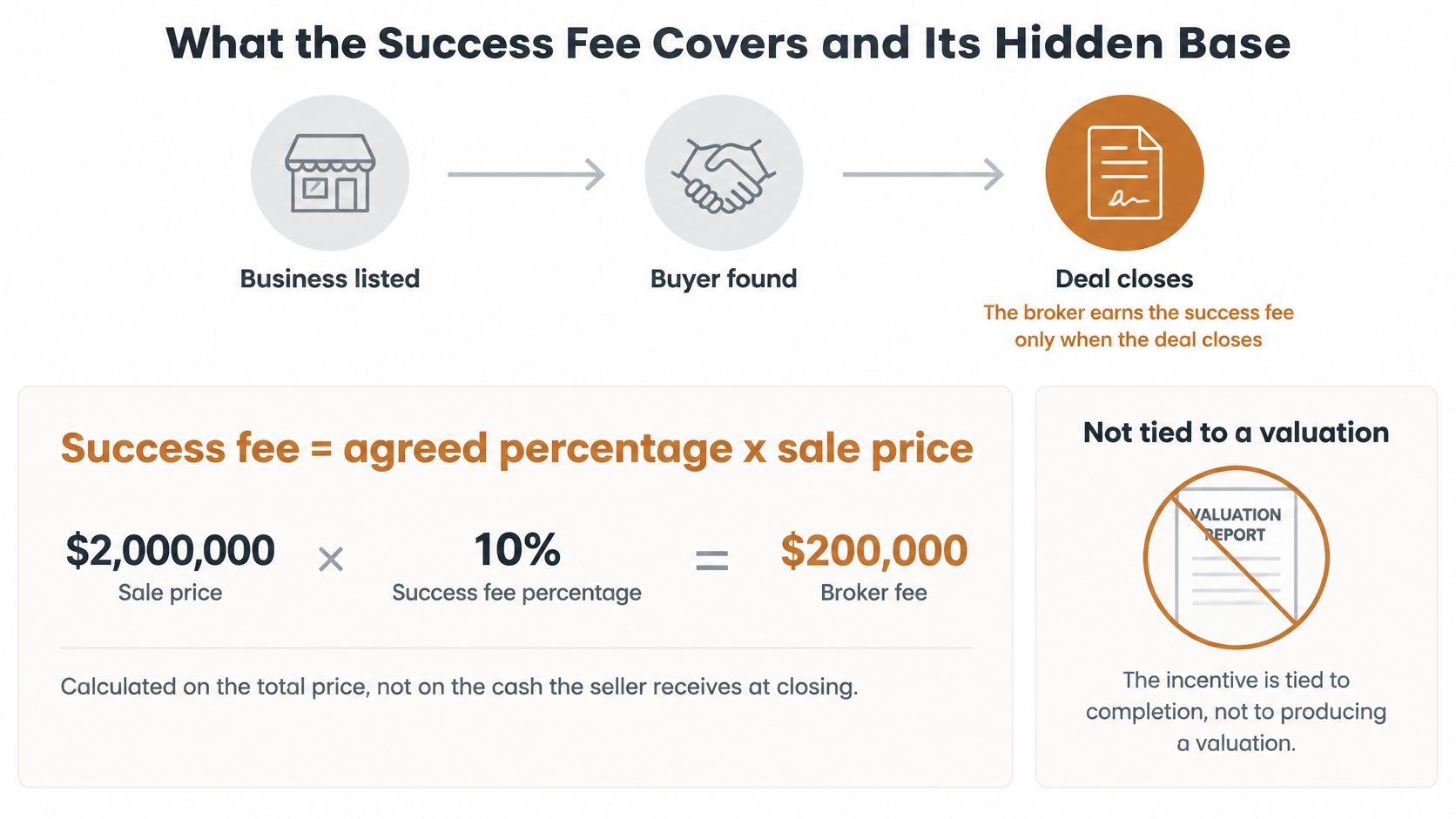
Run the numbers on a $2 million sale
All of those are before any separate upfront charges. That spread, $120,000 to $300,000 on the identical business, is why the percentage deserves a real negotiation rather than a nod.
A flat rate creates an obvious distortion. A $1 million sale at 10% implies $100,000; a $10 million sale at the same 10% implies $1 million. The work behind the second deal is bigger, yet nowhere near ten times bigger, which is why industry data points toward sliding fee schedules as deal size climbs, per AxioBench’s brokerage industry statistics.
Now the second decision. The percentage applies to a number, and that number is negotiable. Ask the advisor to circle the definition of “sale price” in the engagement letter and read it aloud. Depending on the wording, the base may include assumed liabilities, seller financing, earnouts, real estate, inventory or other non-cash consideration.
Consider what that does to a $2 million deal. If the price includes $300,000 of real estate you are separately transferring, or a $400,000 earnout you may never collect, you are paying commission on money that isn’t the operating business. At 10%, a base padded by $700,000 adds $70,000 to the bill. Same percentage, same headline price, very different check.
The test to run on any proposal: multiply the quoted percentage by the amount you will actually receive, not the headline price. Then compare that dollar figure to the dollar figure in the proposal. If the two don’t match, you’ve found the gap.
Treat these published ranges as a starting position for a conversation, not a fixed price. And keep the contrarian point in view: a low percentage paired with a broad fee base, a retainer or weak buyer screening can cost more than a higher rate on a clean base.
Many advisors use a declining schedule instead of one rate on the whole price. The traditional Lehman structure charges 5% on the first $1 million, 4% on the second, 3% on the third, 2% on the fourth, and 1% above $4 million. A modified or doubled version may be negotiated for smaller lower-middle-market transactions, according to the Firmex and Axial M&A fee guide.
Here’s how a $5 million sale builds, tier by tier:
$50,000 + $40,000 + $30,000 + $20,000 + $10,000 = $150,000, which works out to 3% of total value. Same deal, flat 10%: $500,000. That’s a $350,000 difference on one transaction.
| Sale price | Tiered fee (Lehman) | Effective rate | Flat 10% fee |
|---|---|---|---|
| $1,000,000 | $50,000 | 5.0% | $100,000 |
| $2,000,000 | $90,000 | 4.5% | $200,000 |
| $5,000,000 | $150,000 | 3.0% | $500,000 |
| $10,000,000 | $200,000 | 2.0% | $1,000,000 |
Check the $2 million row yourself: 5% of the first million ($50,000) plus 4% of the second ($40,000) equals $90,000, or 4.5% of the total. Every figure in that column comes from the same five tiers, so you can rebuild it at any price.
Published variants differ, and the difference is large. One cited schedule uses a sliding Double Lehman scale of 10% on the first $1 million, 8% on the second, 6% on the third, 4% on the fourth and 2% above that, as AxioBench describes it. On a $5 million deal, that’s $300,000 against the traditional schedule’s $150,000.
So when an advisor says “we use a Lehman structure,” you haven’t learned the fee yet. Ask which one.
The scale effect shows up in real fee data too. Independent middle-market fee research reports the average effective fee falls from about 6.3% on a $5 million transaction to roughly 1.8% on a $150 million transaction, per the Firmex and Axial fee guide. Bigger transactions pay a smaller share, even though the dollar amount is larger.
Model each tier yourself before you sign. Ask for the full schedule in writing, including any minimum, and confirm how contingent consideration is treated. A verbal “it’s about 8%” tells you nothing about where the tier boundaries fall.
The commission is rarely the whole bill. An IBBA Market Pulse survey reported that for transactions valued at $500,000 or less, 33% of advisors charged a retainer and/or monthly fee on top of a commission. As deal values increased, advisors became more likely to add those recurring charges, reaching roughly 60% in the lower-middle-market segment.
That matters for an established service business, because the headline percentage can understate the cost of representation by a wide margin. Watch the arithmetic:
The $500,000 sale, itemized
The monthly fee alone adds 24% to the commission. If the deal takes nine months instead of six, that charge grows to $18,000. The retainer runs on the calendar, not on your timeline, so every extra month of marketing is a month you pay for.
A retainer is paid at engagement, before any work is visible, and may or may not be refundable. A monthly marketing or advisory fee recurs until the agreement ends, and the end date is often written loosely. A valuation or engagement payment may be credited against the closing fee or may sit alongside it as a separate cost.
Treat each charge as a line item to verify. Ask which of them, if any, gets credited against the success fee at closing, and get the credit language in writing before you sign.
A broker might work on a success fee alone, or combine that fee with an upfront engagement payment plus monthly charges, per the IBBA survey. Both structures are common. The risk is signing a letter without knowing which structure you’re in.
Before you sign an engagement letter, confirm four things in writing: whether retainers are refundable or credited against the closing fee, when monthly charges stop, what happens if you find a buyer independently, and whether the broker remains entitled to payment after the agreement expires.
That last one catches people. If your cousin’s neighbor makes an offer eleven months after the exclusive term lapsed, the answer depends entirely on the tail clause someone drafted.
Practical rule: compare proposals by total expected dollars, not by commission rate. A 7% deal with a $20,000 retainer and six months of fees is not cheaper than a 9% deal with nothing upfront.
One charge worth pinning down early is the valuation fee, and a plain explanation of what a business valuation costs helps you tell a credited valuation fee from a standalone charge. Record each retainer’s amount and end date as you read, so the figures can carry straight into your final comparison.
Headline price misleads, because the fee is usually calculated on the total price while the cash arrives over time. In most small and mid-size deals, the bulk of the price lands as cash at closing, with the rest carried as seller financing or earnouts. Seller financing’s share of a deal varies with size, and in smaller transactions it shows up more often than earnouts.

The same business draws three offers, each with an 8% success fee calculated on total consideration:
Offer A, all cash at $1.9 million. Fee: $152,000, due at closing from money you’re holding.
Offer B, $2.2 million with a $300,000 seller note. Fee: $176,000 if calculated on total consideration. You may owe the full amount at closing while $300,000 of the price arrives over three years.
Offer C, earnout-heavy at $2.4 million. Fee: $192,000 on paper, and part of that commission may be due on money you never collect if the earnout targets aren’t hit.
Offer A nets $1,748,000 in hand today. Offer B nets $1,724,000 at closing but leaves you holding a note. Offer C carries the highest theoretical number and the most risk.
That spread is $24,000 in cash on day one, and a dollar in your account is not the same as a dollar promised in a note. A broker’s percentage works like a tax on the sticker price rather than on the cash that reaches you, so the structure of the offer changes your real bill even when the rate stays fixed.
Does the fee become payable when the note or earnout is signed, when the buyer pays, or only when you receive the money? Those three answers produce very different outcomes on the same deal. A fee triggered at signing puts the default risk on you: if the buyer stops paying the note in year two, the commission on that money has already left your account. A fee triggered on receipt keeps the broker aligned with your outcome, because they only earn on dollars you collect.
Two screening questions follow from that. Ask who absorbs the loss if a financed buyer defaults, and ask whether the broker evaluates the buyer’s creditworthiness before recommending the offer. A broker who doesn’t check whether your buyer can fund the note has left you holding an unsecured promise from a stranger.
A higher price containing a seller note or an earnout can leave you with less cash and more risk than a lower all-cash offer. Before you weigh structures against each other, it helps to understand how deal structuring works and where the fee attaches at each stage.
Take this list into any proposal and use it as a working document. Ask for written answers before signing, not after the first offer arrives.
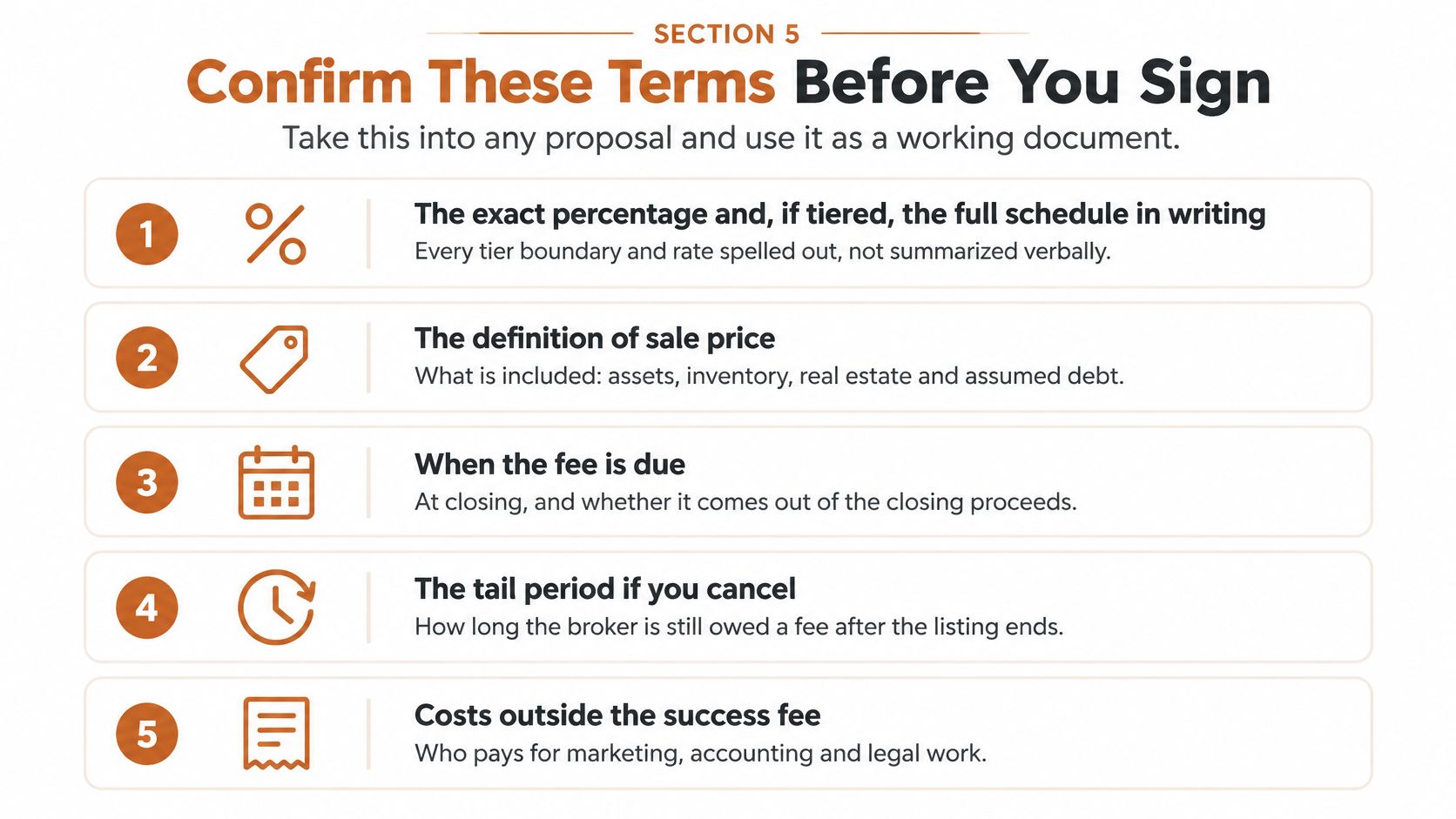
Most of the terms that change your bill sit in the engagement letter, not the listing agreement, and they’re written by the broker’s side. Bring your lawyer in before you sign, and use a secure contract signing checklist so you’re tracking what was signed, when, and in what version. Two versions of an engagement letter floating around is how disputes start.
If you want a wider set of questions to put to a broker before you commit, this list of questions to ask a business broker covers track record, buyer reach and process alongside fees.
Do this week: build a one-page fee worksheet. List every charge in the proposal, its trigger, and your estimated dollar amount at your expected sale price. Send it to the broker and ask for written answers to every line. A broker confident in the terms will answer in a day.
If you’re weighing a sale and want a plain read on what a broker would cost you, The Owner’s Shortlist connects you with one specialist whose past deals match your business, and owners pay nothing for that introduction. Tell us your situation and we’ll make the connection in one conversation, with no sales pressure and no obligation afterward. Visit The Owner’s Shortlist to get started.
Who wrote this: The Owner's Shortlist is not a broker and doesn't sell businesses. We get paid the same no matter which specialist we introduce you to. More about how we work.
Tell us your situation. We'll connect you with a specialist who works with owners like you. One conversation, no sales pressure.
Found this useful?
Add The Owner's Shortlist as a preferred source and get our articles highlighted in Google Search results.
Add to Preferred SourcesEast Coast Advisory Team is a broker practice led by Mike Morris. Here are four alternatives, and the questions to ask before you pick any broker.
November 15, 2026
The best Transworld alternatives are a free broker match, a local independent broker, an IBBA or M&A Source member, or Sunbelt. Here's how to choose.
November 15, 2026
Most Florida business brokers charge a success fee near 10% on smaller sales, less on bigger ones. Here's how fees work and what to negotiate first.
October 30, 2026
Succession planning experts come in six types: exit planners, attorneys, CPAs, appraisers, family consultants, and brokers. Here's who to call first.
October 24, 2026