Top 5 BizBuySell Alternatives for Finding a Business Broker
BizBuySell lists ads; it doesn't find you a broker. Compare The Owner's Shortlist, the IBBA and M&A Source directories, and 2 broker networks for 2026.
October 6, 2026
By Remi Taffin · October 10, 2026

For a Naples-area service business in the typical $1 million to $50 million range, your broker should use two valuation tracks, SDE for smaller owner-operated firms and EBITDA for larger companies. Most deals deliver 81% to 88% cash at closing, with seller financing commonly around 9% to 14%.
You may be in the familiar Naples position right now. The company is profitable, customers keep calling, and your trucks, equipment, employees, and reputation have taken years to build. You search for a business broker in Naples, see polished websites and confident valuation promises, and wonder whether speaking to one will expose your plans before you’re ready.
That concern is justified. A careless broker can leak your identity, overprice the company, or attract buyers who can’t finance the offer. A disciplined broker does the opposite. They normalize your earnings, test the price against lender requirements, qualify buyers before releasing sensitive records, and keep the sale private until disclosure serves your interests.
Naples also isn’t a single-industry market. Collier County recorded 18,444 establishments and average annual employment of 171,835 people in 2024, with professional and business services, construction, financial activities, and trade, transportation, and utilities forming substantial portions of the local base. The Collier County economic profile supports a practical conclusion: local experience matters, but industry-specific transaction experience matters more.
Most owners wait until they want to leave before they start preparing to leave. That timing is expensive. By then, the books may be messy, the owner may still control every customer relationship, and the business may depend on a handful of employees who have no idea a sale is being considered.
Start the conversation while you still have choices. If you want cash in hand after a sale, begin planning well before you sign a listing agreement. A broker needs time to understand your operation, identify weaknesses, prepare a confidential profile, and determine whether the business can support the price you have in mind.
Pull at least three years of tax returns and profit-and-loss statements. Then classify the items a buyer and lender will examine:
The reason is simple. A buyer doesn’t finance your memories, gross revenue, or reputation. They finance verifiable future cash flow. If the records don’t show that cash flow clearly, the buyer will either reduce the offer or demand more seller financing.
Naples has a commercially active consumer base. Census data reports $3,305,859,000 in total retail sales in 2022, along with $1,975,624,000 in health care and social assistance receipts and $780,090,000 in accommodation and food-services sales in the U.S. Census Bureau’s Naples profile. Those figures create opportunity, but they don’t remove the need to explain seasonality, visitor demand, second-home customers, staffing patterns, and the difference between Naples city and the broader Collier County market.
Practical rule: Start preparing when you can still reject a weak offer. If you wait until a buyer is already at the table, the buyer controls the clock.
Your first broker conversation shouldn’t be a commitment. It should be a test. Ask what information the broker needs, what problems they see immediately, and what would make the company difficult to finance.
Don’t hide weaknesses during this stage. A broker who hears about customer concentration, owner dependence, undocumented cash work, or a key employee’s planned departure early can help you fix the problem. A broker who learns about it after marketing begins has fewer options and less credibility with buyers.
Prepare for the process as an operating project, not a listing event. Keep serving customers, retain key employees, renew important contracts, and avoid unusual withdrawals that make the financial statements harder to defend. The best sale starts before anyone knows there is a sale.
A broker isn’t a newspaper ad with a commission agreement attached. The advertising is the visible part of the job, and often the least difficult part. The value sits in normalization, buyer qualification, controlled disclosure, negotiation, and diligence management.

A broker can know Naples well and still be the wrong person to sell an HVAC, plumbing, electrical, roofing, pest-control, landscaping, or commercial-cleaning company. Local familiarity helps with context. It doesn’t prove that the broker understands service agreements, fleet replacement, technician retention, dispatch systems, job costing, licensing, or owner dependence.
Ask for recent examples in your trade. You don’t need confidential names at the first meeting, but you do need specifics:
If the answers stay at “I sell all kinds of businesses,” keep looking. A broker should explain how the business was valued and why buyers accepted the earnings calculation.
For a broader comparison of coverage models, review local, regional, and national business broker approaches. The point isn’t to choose a particular geography automatically. It’s to match the broker’s reach and experience to the likely buyer pool.
A competent broker creates an anonymous profile before revealing the company name. That profile should describe the industry, general location, size, service mix, and broad financial characteristics without exposing the identity of the business.
Then comes qualification. The broker should ask whether a buyer has relevant operating experience, financing capacity, confidentiality discipline, and a credible plan to run the company without you. Someone who wants customer lists before signing an NDA isn’t “just doing research.” They’re asking you to carry their risk.
The broker should also connect valuation to deal structure. A high headline price may include a seller note, earnout, rollover interest, or a long transition requirement. Your broker must explain what you receive at closing, what remains at risk, and what you must do after the sale.
Charm is useful during negotiations, but it can’t replace a repeatable process. Ask to see a sample diligence index, a redacted confidential information memorandum, and the broker’s buyer-screening sequence. You want evidence that the broker can keep a transaction moving without disclosing too much too early.
A real professional won’t promise a price before reviewing the books. They won’t claim every add-back will survive lender scrutiny. They won’t treat your company name as a marketing asset.
Your asking price is an opinion. A financeable purchase price is a test.
For a Naples-area service company valued between roughly $1 million and $50 million, the broker should first normalize at least three years of financial statements. That means separating owner compensation, personal expenses, one-time costs, nonrecurring repairs, and unusual revenue before calculating sustainable earnings. The Q3 2025 IBBA and M&A Source benchmark distinguishes SDE analysis for $1 million to $2 million deals from EBITDA analysis for $2 million to $50 million transactions.
| Business situation | Primary analysis | What buyers need to understand |
|---|---|---|
| Smaller owner-operated company | Seller’s Discretionary Earnings | How much one owner can receive after legitimate adjustments |
| Larger company with management depth | EBITDA | Whether operating profit transfers without the selling owner |
| Mixed recurring and project work | Earnings analysis plus revenue-quality review | Which revenue is durable and which depends on one-off jobs |
| Owner remains the main salesperson or operator | Adjusted earnings with replacement-cost testing | What it will cost to replace the owner’s role |
SDE can make sense when the owner is central to the business and a buyer expects to step into that role. EBITDA becomes more relevant as management, systems, and transferable operations matter more. Using EBITDA to flatter a small owner-dependent company, or using SDE to disguise weak management depth in a larger company, produces a number that may look attractive but won’t survive diligence.
Ask the broker for a written bridge from reported net income to SDE or EBITDA. Every add-back should answer three questions:
Buyers and lenders may reverse aggressive adjustments. When they do, earnings fall. The buyer may then reduce the multiple, increase seller financing, or walk away.
The broker should also separate the characteristics that affect the multiple. Recurring maintenance revenue generally deserves different treatment from project revenue. Customer concentration, owner dependence, fleet condition, labor availability, and documented management depth all require specific analysis. A gross-revenue rule can’t capture those differences.
The Q3 2025 benchmark reports median cash at closing ranging from 81% to 88% across principal deal-size bands, with seller financing generally around 9% to 14%. Those figures are transaction benchmarks, not a promise for your company. They show why a seller needs a proceeds model rather than a single valuation number.
Run three versions:
For deeper diligence planning, research methods for investors and brokers can help frame the questions behind market comparisons. Your broker should still apply those questions to your actual customer base, records, contracts, and operating model.
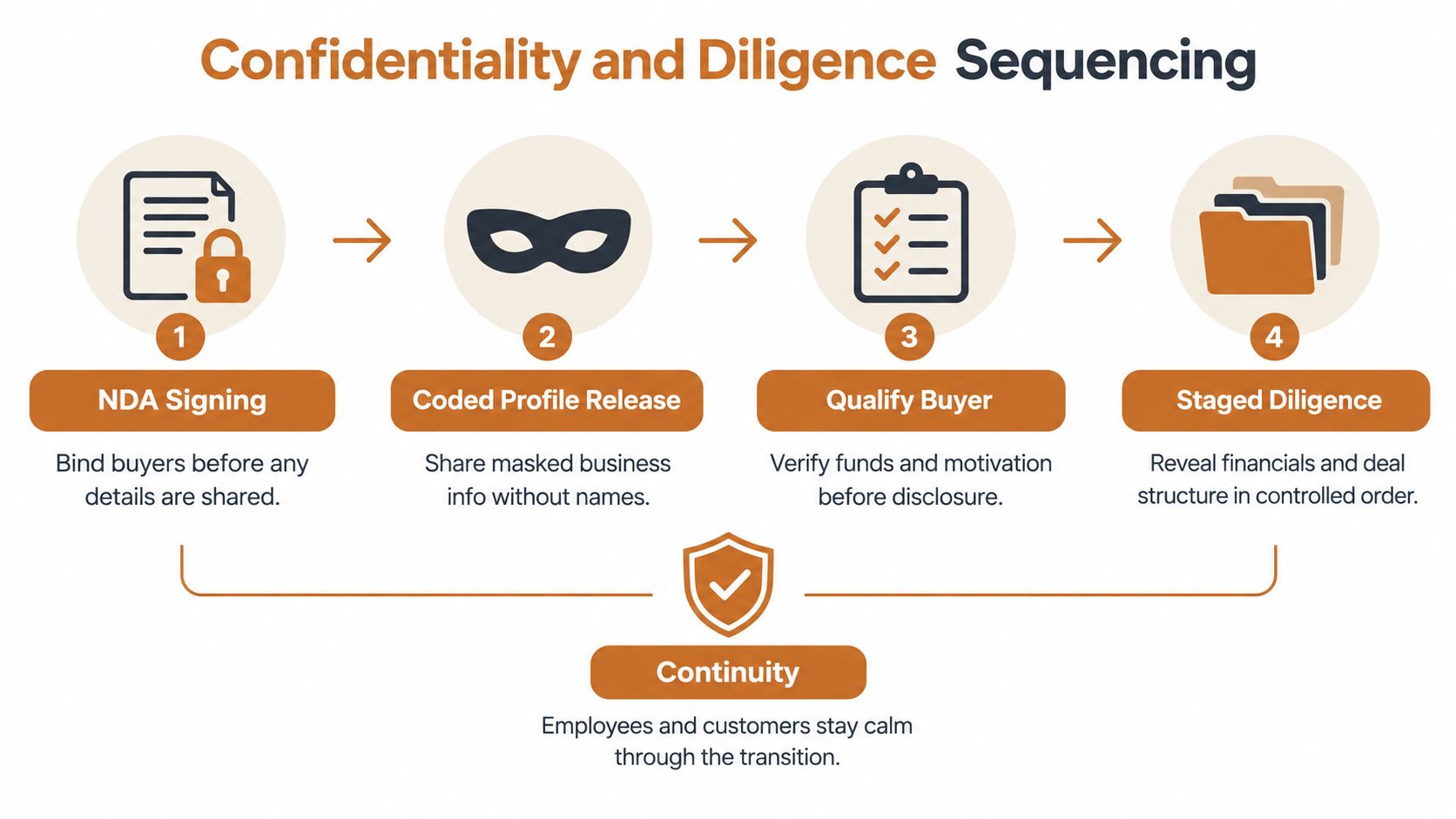
Confidentiality isn’t a sentence in a listing agreement. It’s a sequence of decisions that determines who learns what, and when.
The first disclosure should be an anonymous business profile. It can describe the trade, broad geography, operating model, and general financial scale without naming the company. A buyer who can’t explain why they are interested at that stage shouldn’t receive your customer list, employee roster, or lease.
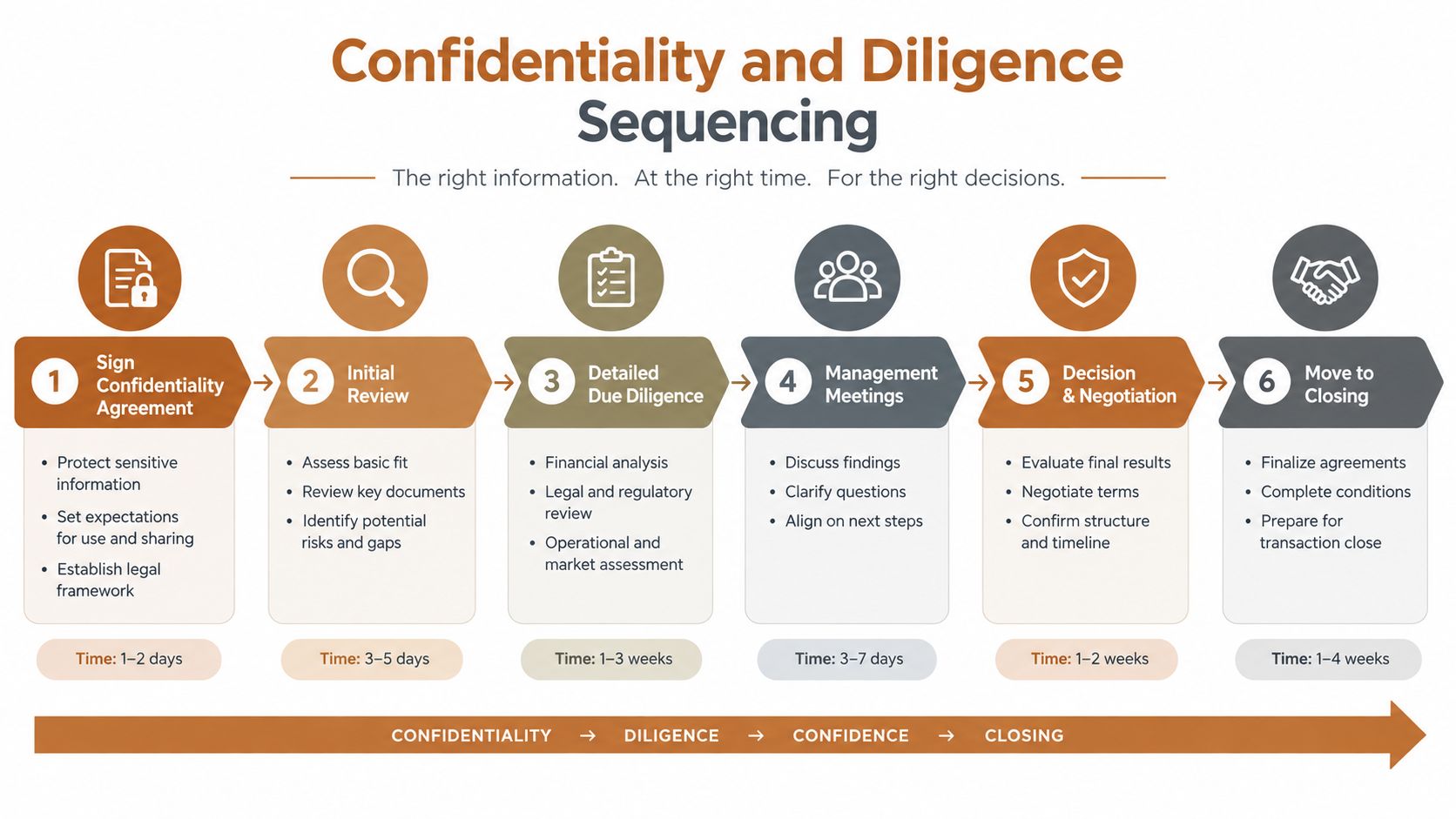
Use a staged process:
A broker should maintain an access record. They should know which buyer received which files and should be able to stop disclosure when a buyer misses a deadline, changes terms without explanation, or asks for information outside the agreed stage.
When documents contain customer names, employee identifiers, bank details, or other sensitive data, redaction matters. A practical guide to how to redact a PDF can help your team understand the difference between hiding text visually and removing sensitive content properly. Your attorney should review the process for transaction-critical documents.
Build a diligence file while the business is still private. Include financial statements, tax returns, material contracts, licenses, permits, leases, insurance, equipment records, employee roles, benefit obligations, litigation information, and key supplier arrangements.
The buyer and lender will test whether the earnings are real, whether contracts transfer, whether licenses remain valid, and whether important employees will stay. If you wait until after an offer, normal document gaps will look like concealment.
Deal structure deserves the same discipline. Model after-tax proceeds, debt-service exposure, collateral, default remedies, reporting obligations, and your post-closing workload. An earnout needs definitions for revenue recognition, customer retention, control rights, reporting access, acceleration, and disputes. A seller note needs security, payment terms, remedies, and a clear answer to what happens if the buyer fails to pay.
A buyer doesn’t need to know everything on day one. A serious buyer does need to see that you know what must be disclosed, protected, and verified.
Directories make comparison easy and verification difficult. A long profile, attractive office, or list of industries doesn’t prove that a broker has closed a trade-service transaction like yours.
Ask each candidate to describe three recent trade-service sales. Focus on the last deals they can substantiate, not the first deals they completed decades ago. Ask what they can verify, which issues affected the transaction, and whether they can provide anonymized seller references after an NDA.
Ask directly:
A broker who immediately praises gross revenue or promises a simple multiple is selling confidence, not analysis. A broker who can’t explain customer concentration, owner replacement cost, or lender coverage is likely to create a valuation gap later.
The questions to ask a business broker should lead to specific answers about process, not general assurances.
The test comes after a buyer raises concerns. Does the broker bring evidence, revise the model, and protect your negotiating position? Or do they pressure you to accept a lower price to preserve momentum?
A capable broker manages exclusivity periods, lender communication, diligence deadlines, and buyer expectations. They know that a buyer who can’t produce financing evidence is not a buyer, and that a seller note without adequate protection may be worse than a lower cash offer.
A person-to-person introduction can be more useful than opening another directory tab. The broker match should reflect your trade, business scale, geography, and desired exit, not just whoever paid for visibility.
You don’t need to interview six strangers to discover that only one understands your business. A curated introduction can narrow the field before you share detailed records or announce that you’re considering a sale.
The Owner’s Shortlist offers a free service in which a real person reviews an established residential or commercial service business and introduces the owner to one specialist whose past work fits the industry and transaction. The service focuses on businesses such as plumbing, HVAC, electrical, roofing, landscaping, accounting, engineering, commercial cleaning, and general contracting.

A private match should preserve your negotiating advantage:
Many owners need help deciding between a full exit, partial sale, family succession, or a gradual transition. That decision affects valuation, management requirements, taxes, financing, and the information a buyer needs. You can get matched with a specialist after you have organized the basic facts, or begin with a plain-language phone conversation while the records are still being prepared.
The strongest position is informed, private, and unhurried. Prepare the financials, identify the owner-dependent functions, test the broker’s deal history, and refuse to confuse an asking price with a financeable offer.
The Owner’s Shortlist connects Florida service-business owners with a vetted specialist based on industry, scale, and transaction needs, without listing the business publicly. If you’re considering a Naples sale, visit The Owner’s Shortlist to request a confidential person-to-person introduction before you hand your information to a broker.
Tell us your situation. We'll connect you with a specialist who works with owners like you. One conversation, no sales pressure.
Found this useful?
Add The Owner's Shortlist as a preferred source and get our articles highlighted in Google Search results.
Add to Preferred SourcesBizBuySell lists ads; it doesn't find you a broker. Compare The Owner's Shortlist, the IBBA and M&A Source directories, and 2 broker networks for 2026.
October 6, 2026
Learn how to sell my business without a broker. This guide covers valuation, buyer screening, deal structure, and when to hire specialists to protect your exit.
September 26, 2026
CBI, M&AMI, and CEPA sound similar but prove different things. Here's what each credential actually certifies, and how to verify one before you rely on it.
September 25, 2026
Local brokers know your market. Regional brokers have reach. National niche brokers own one vertical. Here's how to pick the right type for your sale.
September 12, 2026